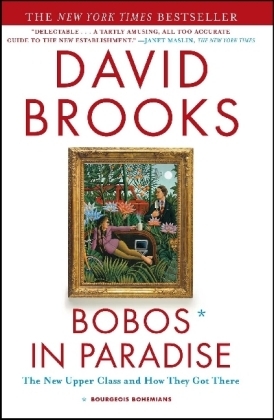
Bobos in Paradise (eBook)
288 Seiten
Simon & Schuster (Verlag)
978-1-4165-6173-6 (ISBN)
Do you believe that spending $15,000 on a media center is vulgar, but that spending $15,000 on a slate shower stall is a sign that you are at one with the Zenlike rhythms of nature? Do you work for one of those visionary software companies where people come to work wearing hiking boots and glacier glasses, as if a wall of ice were about to come sliding through the parking lot? If so, you might be a Bobo.
In his bestselling work of 'comic sociology,' David Brooks coins a new word, Bobo, to describe today's upper class -- those who have wed the bourgeois world of capitalist enterprise to the hippie values of the bohemian counterculture. Their hybrid lifestyle is the atmosphere we breathe, and in this witty and serious look at the cultural consequences of the information age, Brooks has defined a new generation.
In this witty and bestselling look at the cultural consequences of the information age, David Brooks coins a new word, Bobo, to describe today's upper classthose who have wed the bourgeois world of capitalist enterprise to the hippie values of the bohemian counterculture. Do you believe that spending $15,000 on a media center is vulgar, but that spending $15,000 on a slate shower stall is a sign that you are at one with the Zenlike rhythms of nature? Do you work for one of those visionary software companies where people come to work wearing hiking boots and glacier glasses, as if a wall of ice were about to come sliding through the parking lot? If so, you might be a Bobo.
Introduction
This book started with a series of observations. After four and a half years abroad, I returned to the United States with fresh eyes and was confronted by a series of peculiar juxtapositions. WASPy upscale suburbs were suddenly dotted with arty coffeehouses where people drank little European coffees and listened to alternative music. Meanwhile, the bohemian downtown neighborhoods were packed with multimillion-dollar lofts and those upscale gardening stores where you can buy a faux-authentic trowel for $35.99. Suddenly massive corporations like Microsoft and the Gap were on the scene, citing Gandhi and Jack Kerouac in their advertisements. And the status rules seemed to be turned upside down. Hip lawyers were wearing those teeny tiny steel-framed glasses because now it was apparently more prestigious to look like Franz Kafka than Paul Newman.
The thing that struck me as oddest was the way the old categories no longer made sense. Throughout the twentieth century it's been pretty easy to distinguish between the bourgeois world of capitalism and the bohemian counterculture. The bourgeoisie were the square, practical ones. They defended tradition and middle-class morality. They worked for corporations, lived in suburbs, and went to church. Meanwhile, the bohemians were the free spirits who flouted convention. They were the artists and the intellectuals -- the hippies and the Beats. In the old schema the bohemians championed the values of the radical 1960s and the bourgeois were the enterprising yuppies of the 1980s.
But I returned to an America in which the bohemian and the bourgeois were all mixed up. It was now impossible to tell an espresso-sipping artist from a cappuccino-gulping banker. And this wasn't just a matter of fashion accessories. I found that if you investigated people's attitudes toward sex, morality, leisure time, and work, it was getting harder and harder to separate the antiestablishment renegade from the pro-establishment company man. Most people, at least among the college-educated set, seemed to have rebel attitudes and social-climbing attitudes all scrambled together. Defying expectations and maybe logic, people seemed to have combined the countercultural sixties and the achieving eighties into one social ethos.
After a lot of further reporting and reading, it became clear that what I was observing is a cultural consequence of the information age. In this era ideas and knowledge are at least as vital to economic success as natural resources and finance capital. The intangible world of information merges with the material world of money, and new phrases that combine the two, such as 'intellectual capital' and 'the culture industry,' come into vogue. So the people who thrive in this period are the ones who can turn ideas and emotions into products. These are highly educated folk who have one foot in the bohemian world of creativity and another foot in the bourgeois realm of ambition and worldly success. The members of the new information age elite are bourgeois bohemians. Or, to take the first two letters of each word, they are Bobos.
These Bobos define our age. They are the new establishment. Their hybrid culture is the atmosphere we all breathe. Their status codes now govern social life. Their moral codes give structure to our personal lives. When I use the word establishment, it sounds sinister and elitist. Let me say first, I'm a member of this class, as, I suspect, are most readers of this book. We're not so bad. All societies have elites, and our educated elite is a lot more enlightened than some of the older elites, which were based on blood or wealth or military valor. Wherever we...
| Erscheint lt. Verlag | 11.5.2010 |
|---|---|
| Sprache | englisch |
| Themenwelt | Sozialwissenschaften ► Politik / Verwaltung |
| Sozialwissenschaften ► Soziologie ► Makrosoziologie | |
| ISBN-10 | 1-4165-6173-0 / 1416561730 |
| ISBN-13 | 978-1-4165-6173-6 / 9781416561736 |
| Informationen gemäß Produktsicherheitsverordnung (GPSR) | |
| Haben Sie eine Frage zum Produkt? |
 EPUB (Adobe DRM)
Kopierschutz: Adobe-DRM
Adobe-DRM ist ein Kopierschutz, der das eBook vor Mißbrauch schützen soll. Dabei wird das eBook bereits beim Download auf Ihre persönliche Adobe-ID autorisiert. Lesen können Sie das eBook dann nur auf den Geräten, welche ebenfalls auf Ihre Adobe-ID registriert sind.
Details zum Adobe-DRM
Dateiformat: EPUB (Electronic Publication)
EPUB ist ein offener Standard für eBooks und eignet sich besonders zur Darstellung von Belletristik und Sachbüchern. Der Fließtext wird dynamisch an die Display- und Schriftgröße angepasst. Auch für mobile Lesegeräte ist EPUB daher gut geeignet.
Systemvoraussetzungen:
PC/Mac: Mit einem PC oder Mac können Sie dieses eBook lesen. Sie benötigen eine
eReader: Dieses eBook kann mit (fast) allen eBook-Readern gelesen werden. Mit dem amazon-Kindle ist es aber nicht kompatibel.
Smartphone/Tablet: Egal ob Apple oder Android, dieses eBook können Sie lesen. Sie benötigen eine
Geräteliste und zusätzliche Hinweise
Buying eBooks from abroad
For tax law reasons we can sell eBooks just within Germany and Switzerland. Regrettably we cannot fulfill eBook-orders from other countries.
aus dem Bereich