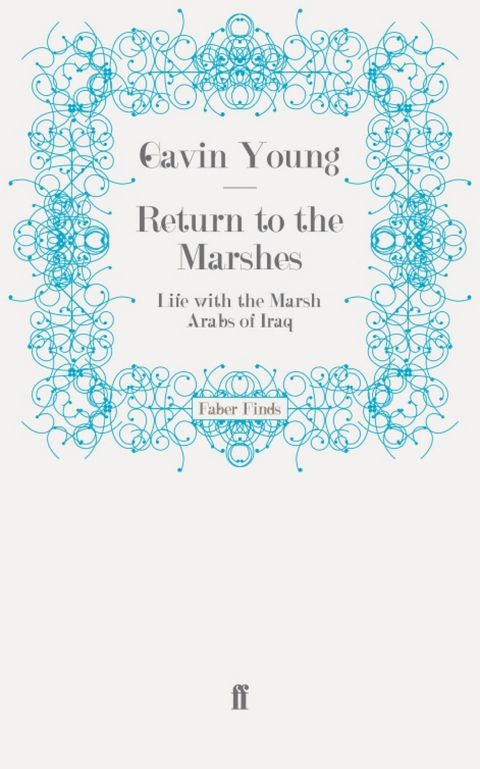
Return to the Marshes (eBook)
200 Seiten
Faber & Faber (Verlag)
978-0-571-28097-1 (ISBN)
Gavin Young (1929-2001) was a journalist, writer, and briefly a member of MI6. As a journalist, he was most associated with the Observer, being in the words of Mark Frankland's obituary 'a star foreign correspondent'. When disenchantment with journalism set in he turned to the writing of books. The two most famous ones are Slow Boats to China and its sequel Slow Boats Home. He himself had a particular affection for two later books In Search of Conrad (winner of the Thomas Cook Book Award) and A Wavering Grace. These and Beyond Lion Rock, From Sea to Shining Sea, Return to the MarshesandWorlds Apartare all being reissued in Faber Finds.
It was the legendary traveller Wilfred Thesiger who first introduced Gavin Young to the Marshes of Iraq. Since then Young has been entranced by both the beauty of the Marshes and by the Marsh Arabs who inhabit them, a people whose lifestyle is almost unchanged from that of their predecessors, the Ancient Sumerians. On his return to the Marshes some years later Gavin Young found that the twentieth-century had rudely intruded on this lifestyle and that war was threatening to make the Marsh Arabs existence extinct. Return to the Marshes, first published in 1977, is at once a moving tribute to a unique way of life as well as a love story to a place and its people. 'A superbly written essay which combines warmth of personal tone, a good deal of easy historical scholarship and a talent for vivid description rarely found outside good fiction.' Jonathan Raban, Sunday Times
Now it seems to me that I have known the Marsh Arabs of southern Iraq all my life, yet six weeks before meeting them I was hardly aware of their existence. That first meeting took place in the Marshes on a sunny day in 1952, but I had not meant to go there at all. My aching ambition at the time – it was intense and, I thought, irreversible – was to ride a camel across Arabia from the Gulf to the Red Sea.
I was learning Arabic. I had plunged into the writings of famous desert adventurers, and had already snapped up all of T. E. Lawrence, Bertram Thomas and Gertrude Bell, some of H. St John Philby and much of Charles Doughty. I was determined to follow their example at any risk. So when Wilfred Thesiger, who is certainly the last of the great Arabian travellers, came to Basra where I lived and worked in a shipping company, I made sure I met him. I wangled a lunch date from the British Consul and over the meal confidently told Thesiger of my Arabian dream; I was quite sure that such a man would be completely sympathetic to my ambition and offer nothing but encouragement. I was rudely rebuffed. To my intense surprise and utter dismay, Thesiger suggested forgetting the camel.
‘You’ll never get a visa to enter Saudi Arabia,’ he said, flatly: ‘So that’s that.’
I had completely forgotten – if I had even noticed – that some political dispute involving Britain and Saudi Arabia had set, for the time being at least, an unbridgeable diplomatic chasm between myself and my Arabian camel. The dishes on the consul’s table became a blur; the chilling vision I had been fighting off for months, that of myself writing out bills of lading in a shipping office for the next thirty years, settled on me like a shroud; I felt the weight of my dead dream plummeting to the pit of my stomach to join the consul’s undercooked suet-pudding. This, surely, was the end of my ambition. But suddenly Thesiger, who had been about to leave the room, paused in the doorway. ‘As an alternative,’ he said, in his solemn voice, ‘you might consider having a look at the Marshes. I am going up there tomorrow morning, but I shall be back here in six weeks’ time for a bath. I could take you up then if you can get some time off from your office.’
At this point I think it is time to say a few words more about this remarkable and incomparable man. Wilfred Thesiger was then in his early forties, but then, as now, there was a timeless quality about him. He was born in Addis Ababa, where his father was the British Minister, and had had an Ethiopian foster-mother. Since then he had explored the remoter parts of the Near and Middle East from the wild Danakil country of Abyssinia to the Hindu Kush, the Karakorams and Nuristan. He had accompanied the Kashgai on their annual migration across the plains of Iran; he had travelled with mules across northern, mountainous Persia and found, among other things, that he liked and respected the Arab tribes, with their warmth of character and hospitality, a good deal more than the stingey and even churlish Persian hillsmen. I suppose no man alive knows more about tribal Arabs than Wilfred Thesiger. He had already, when I first met him, spent years travelling in the Arabian ‘outback’, through the humid Tihama coastal plain on the Red Sea, through the high, cool, well-watered valleys of the Asir province in the lower Hejaz range. His towering achievement had been his double passage (across it and back), on foot and camel, of the vast waterless deserts and dunes of the Empty Quarter of Southern Arabia – only traversed by two other non-Arabs, Bertram Thomas and H. St John Philby, both of whom started their life with Arabs in the post-Great War British administration in Iraq.
The man I saw at the consul’s table in Basra all those years ago was tall and gaunt with a long, creased, sunburnt face, deep-set, probing eyes and large, sinewy, sunburnt wrists and hands. I found later that he was amazingly strong. He had been a successful light-heavyweight boxer at Oxford – but he had a strength quite different from that of a run-of-the-mill undergraduate bruiser. The Marsh Arabs, who naturally admire physical prowess of any kind, were awed by Thesiger’s ability to pursue the wild boars of the region on the saddle-less back of a temperamental Arab mare, with the reins in one hand and unerringly shoot the pigs dead, holding his Rigby ·275 rifle in the other hand like a pistol. Anyone who has tried to aim such a relatively heavy rifle one-handed, let alone fire it accurately, will know what special strength of forearm and shoulder this feat requires.
Thesiger, by this time, had established himself through his unmatchable journeys as the greatest traveller of his time, and possibly any other. Of course, he was aware of this. And although he was by no means an offensive prima donna, he had a tart tongue in private for some well-known British Arabists who based pretentious claims to great courage and adventurousness on relatively easy and riskless journeys. Of one such ‘intrepid’ traveller, he said scornfully, ‘Oh, So-and-So! She’s never been anywhere one couldn’t go by taxi.’ And of another inflated reputation he wrote in a book review, ‘What’s-’is-name is not so much the last of the Arabian travellers as the first of the Arabian tourists.’
These were harsh criticisms, but reasonable, coming from such an uncompromising and genuine man as Thesiger. He hated the intrusion of cars and taxis into beautiful and unspoiled areas of the world and steered as far clear of them as possible (you could take a taxi to the edge of the Marshes but from there on firm land ceases to exist). He had – and has – strict standards of conduct for travellers. He believes passionately (and taught me to believe) that between outsiders and tribesmen stand natural barriers of colour, language, religion, race, upbringing and so forth that are already formidable enough; that no real understanding of people like Marsh Arabs is possible if you add artificial barriers – canned food, mosquito-netting, campbeds, boiled water. And, of course, it is a crime to press alcohol on tribesmen brought up to scorn it. One might say that he is old-fashioned and he would not deny it. The men whose tradition he followed were Richard Burton, Speke, Mungo Park, Doughty, and Lawrence, to pick random names from a noble list. He travelled – and, I am glad to say, still travels – for love; for the love of remote and beautiful peoples in wild and beautiful corners of the world, and for the serene grandeur of desert, river and mountain regions and the wild animals and birds that inhabit them.
Since 1950 Thesiger had been studying the Marsh Arabs in their mysterious and virtually unknown marsh world sixty miles or so north of Basra, living as nearly as possible as one of them, without any artificial aids to comfort, despite heat, insects and stagnant drinking water. As for me, I had no idea what the Marsh Arabs would be like, although I knew vaguely that they lived in the ancient flatlands of Sumer, where civilization was born between the rivers Tigris and Euphrates. But I was still determined to be an explorer despite my disappointment over the camel; and when Thesiger invited me I did not hesitate. I begged a week’s leave from my shipping company and presently I was speeding north, braced in the corner of a ramshackle taxi that careered erratically along the uneven asphalt from Basra to the tiny riverside town near Amara that Thesiger had named as our rendezvous.
After three hours of this ‘main road’ the taxi swung off it, jolted over a rutted mud track until that frayed out into nothing near a wide water-course, and there rocked to a halt. ‘Well, here we are,’ said the driver genially, and spat through the window. I saw a slender black canoe a few feet away in the water; it rode there majestically, a king of boats, amazingly long and sleek – thirty-six feet long I discovered later – and very beautiful. Thesiger stood beside it and raised a welcoming hand. Four young Arabs with him, wearing black and white check headcloths bound round with thick head ropes, stepped forward grinning and shook my hand, and two of them took my small bag and shotgun – all I could bring, Thesiger had insisted – and loaded them into the canoe. ‘I hope that bag isn’t too heavy,’ Thesiger said, anxiously. He indicated the Arabs – ‘These boys are Marsh Arabs. They’ll look after you. Step into the dead centre of the canoe or you’ll have it over.’ I sat crosslegged and too terrified to move in the flat bottom of this work of art, this wonderful boat, so delicately balanced and so low in the water that it seemed bound to capsize. I tried to take comfort from what I read – that these craft had proved superbly efficient for 5000 years – but the effort failed. By now, two Marsh Arabs had hitched their long shirts round their hips and taken up paddles in the high-curved bow, while the other two crouched with their paddles raised in the stern. ‘Let’s go,’ said Thesiger. The four Arabs dipped their paddles together into the pale brown stream, gave them a quick muscular flick of shoulders and arms, and with a lurch that lapped the water to the lip of the gunwales, we shot away.
This branch of the Tigris – the main river has already flowed down from Armenia – whirls deep and strong between its sharp-edged mud banks, slopping water into irrigation channels at intervals and spilling what is left into the Marshes a few miles further on. It often seems to give little to the surrounding land, which is flat and dry and cracked for much...
| Erscheint lt. Verlag | 20.10.2011 |
|---|---|
| Verlagsort | London |
| Sprache | englisch |
| Themenwelt | Sachbuch/Ratgeber |
| Reisen ► Reiseberichte | |
| Sozialwissenschaften ► Ethnologie | |
| Sozialwissenschaften ► Soziologie | |
| Schlagworte | civilisations • Faber Finds • Travelogue |
| ISBN-10 | 0-571-28097-8 / 0571280978 |
| ISBN-13 | 978-0-571-28097-1 / 9780571280971 |
| Informationen gemäß Produktsicherheitsverordnung (GPSR) | |
| Haben Sie eine Frage zum Produkt? |
 EPUB (Adobe DRM)
Kopierschutz: Adobe-DRM
Adobe-DRM ist ein Kopierschutz, der das eBook vor Mißbrauch schützen soll. Dabei wird das eBook bereits beim Download auf Ihre persönliche Adobe-ID autorisiert. Lesen können Sie das eBook dann nur auf den Geräten, welche ebenfalls auf Ihre Adobe-ID registriert sind.
Details zum Adobe-DRM
Dateiformat: EPUB (Electronic Publication)
EPUB ist ein offener Standard für eBooks und eignet sich besonders zur Darstellung von Belletristik und Sachbüchern. Der Fließtext wird dynamisch an die Display- und Schriftgröße angepasst. Auch für mobile Lesegeräte ist EPUB daher gut geeignet.
Systemvoraussetzungen:
PC/Mac: Mit einem PC oder Mac können Sie dieses eBook lesen. Sie benötigen eine
eReader: Dieses eBook kann mit (fast) allen eBook-Readern gelesen werden. Mit dem amazon-Kindle ist es aber nicht kompatibel.
Smartphone/Tablet: Egal ob Apple oder Android, dieses eBook können Sie lesen. Sie benötigen eine
Geräteliste und zusätzliche Hinweise
Buying eBooks from abroad
For tax law reasons we can sell eBooks just within Germany and Switzerland. Regrettably we cannot fulfill eBook-orders from other countries.
aus dem Bereich