


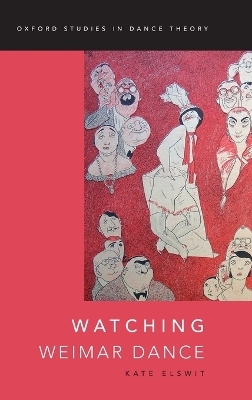
Watching Weimar Dance
Seiten
2014
Oxford University Press Inc (Verlag)
978-0-19-984481-4 (ISBN)
Oxford University Press Inc (Verlag)
978-0-19-984481-4 (ISBN)
Watching Weimar Dance historicizes and theorizes the spectatorship of dances in and from interwar Germany - at home, on tour, and later returning from exile - developing a culturally-situated model of watching that not only offers a revisionist historical narrative, but also demonstrates new methods for dance scholarship to shape cultural history.
Watching Weimar Dance asks what audiences saw in the peculiarly turbulent and febrile moment of the Weimar Republic. It closely analyses the reception of various performances, from cabaret to concert dance and experimental theatre, in their own time and place - at home in interwar Germany, on tour, and later returning from exile after World War II. Spectator reports that performers died or became half-machine archived not only the physicality of past performance, but also the ways audiences used the temporary world of the stage to negotiate pressing social issues, from female visibility within commodity culture to the functioning of human-machine hybrids in an era of increasing technologization. These accounts offer offer limit cases for the body on stage and, in so doing, speak to the preoccupations of the day. Approaching a range of performance artists, including Oskar Schlemmer, Valeska Gert, Kurt Jooss, Mary Wigman, Bertolt Brecht, Anita Berber, and the Tiller Girl troupes, through archives of watching, the reception of these performances also revises and complicates understandings of Ausdruckstanz as the representative dance of this moment in Germany. They further reveal how such practices came to be reconfigured and imbued with new significance in the post-war era. By bringing insights from theatre, dance, and performance studies to German cultural studies, and vice versa, Watching Weimar Dance develops a culturally-situated model of watching that not only offers a revisionist narrative, but also demonstrates new methods for dance scholarship to shape cultural history.
Watching Weimar Dance asks what audiences saw in the peculiarly turbulent and febrile moment of the Weimar Republic. It closely analyses the reception of various performances, from cabaret to concert dance and experimental theatre, in their own time and place - at home in interwar Germany, on tour, and later returning from exile after World War II. Spectator reports that performers died or became half-machine archived not only the physicality of past performance, but also the ways audiences used the temporary world of the stage to negotiate pressing social issues, from female visibility within commodity culture to the functioning of human-machine hybrids in an era of increasing technologization. These accounts offer offer limit cases for the body on stage and, in so doing, speak to the preoccupations of the day. Approaching a range of performance artists, including Oskar Schlemmer, Valeska Gert, Kurt Jooss, Mary Wigman, Bertolt Brecht, Anita Berber, and the Tiller Girl troupes, through archives of watching, the reception of these performances also revises and complicates understandings of Ausdruckstanz as the representative dance of this moment in Germany. They further reveal how such practices came to be reconfigured and imbued with new significance in the post-war era. By bringing insights from theatre, dance, and performance studies to German cultural studies, and vice versa, Watching Weimar Dance develops a culturally-situated model of watching that not only offers a revisionist narrative, but also demonstrates new methods for dance scholarship to shape cultural history.
Kate Elswit is Lecturer in Theatre and Performance Studies at the University of Bristol. She was awarded the Gertrude Lippincott Award from the Society of Dance History Scholars and the Sally Banes Publication Prize from the American Society for Theatre Research, and her essays have been published in TDR: The Drama Review, Theatre Journal, Modern Drama, Art Journal, Performance Research and in the edited collection New German Dance Studies. She also works as a choreographer, curator, and dramaturg.
ACKNOWLEDGEMENTS; INTRODUCTION; CODA; INDEX
| Erscheint lt. Verlag | 11.9.2014 |
|---|---|
| Reihe/Serie | Oxford Studies in Dance Theory |
| Zusatzinfo | 29 photographs |
| Verlagsort | New York |
| Sprache | englisch |
| Maße | 239 x 160 mm |
| Gewicht | 632 g |
| Themenwelt | Kunst / Musik / Theater ► Theater / Ballett |
| Sachbuch/Ratgeber ► Sport ► Tanzen / Tanzsport | |
| Geschichte ► Allgemeine Geschichte ► 1918 bis 1945 | |
| Geisteswissenschaften ► Geschichte ► Regional- / Ländergeschichte | |
| Geschichte ► Teilgebiete der Geschichte ► Kulturgeschichte | |
| Sozialwissenschaften | |
| ISBN-10 | 0-19-984481-X / 019984481X |
| ISBN-13 | 978-0-19-984481-4 / 9780199844814 |
| Zustand | Neuware |
| Informationen gemäß Produktsicherheitsverordnung (GPSR) | |
| Haben Sie eine Frage zum Produkt? |
Mehr entdecken
aus dem Bereich



aus dem Bereich
Deutschland 1933 bis 1945
Buch | Hardcover (2025)
S. Fischer (Verlag)
CHF 47,60
ein Psychologe erlebt das Konzentrationslager
Buch | Hardcover (2024)
Kösel (Verlag)
CHF 30,80
Helfer und Vollstrecker: Das Dritte Reich in 24 Porträts
Buch | Hardcover (2025)
DVA (Verlag)
CHF 55,95


