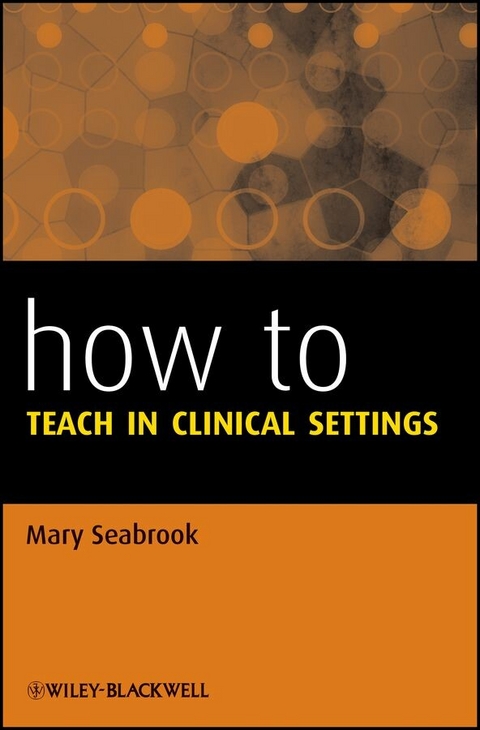
How to Teach in Clinical Settings (eBook)
John Wiley & Sons (Verlag)
978-1-118-62090-8 (ISBN)
How to Teach in Clinical Settings is a practical guide to support all doctors wishing to develop their skills in clinical teaching and supervision.
It provides hands on strategies to address common problems such as giving critical feedback effectively and teaching mixed-level groups. It gives guidance on the particular challenges of teaching in clinical settings including the need to manage teaching with service provision, to engage patients, motivate students, and to judge the balance of support and independence appropriate for each trainee.
How to Teach in Clinical Settings is invaluable for all doctors involved in teaching and training at any stage of their career. It is also useful and accessible to medical students who increasingly need to consider and develop their own teaching skills as part of their career progression.
Mary Seabrook, Medical Education Consultant, London, UK
How to Teach in Clinical Settings is a practical guide to support all doctors wishing to develop their skills in clinical teaching and supervision.It provides hands on strategies to address common problems such as giving critical feedback effectively and teaching mixed-level groups. It gives guidance on the particular challenges of teaching in clinical settings including the need to manage teaching with service provision, to engage patients, motivate students, and to judge the balance of support and independence appropriate for each trainee.How to Teach in Clinical Settings is invaluable for all doctors involved in teaching and training at any stage of their career. It is also useful and accessible to medical students who increasingly need to consider and develop their own teaching skills as part of their career progression.
Mary Seabrook, Medical Education Consultant, London, UK
Acknowledgements ix
Introduction xi
Chapter 1 Creating an effective learning environment 1
Practical ways to create an environment conducive to learning
4
Design of clinical placements 6
Continuity between learners teachers and patients 8
Teaching and learning resources 9
The teaching climate 9
What makes a good clinical teacher? 10
Involving patients in teaching 11
Involving other disciplines in teaching 13
Some principles of effective clinical teaching 15
Useful strategies for clinical teaching 15
Five tips for clinical teaching which do not take time or money
17
References 17
Chapter 2 Teaching in clinical contexts 19
Teaching on ward rounds 19
General principles 19
Useful strategies 21
What you teach unwittingly 23
The psychiatric ward round 25
Handover meetings board rounds and bench rounds 26
Bedside teaching 29
Preparation 29
Structure for bedside teaching 30
Feedback at the bedside 34
Examination practice at the bedside 36
Teaching in clinics 38
General principles 38
Supervising trainees in parallel clinics 40
Effective questioning on presented cases 41
Seeing the patient together 42
Supervising students or trainees who are supernumerary 43
Teaching in the Accident and Emergency department 46
Teaching the interpretation of images/specimens 47
Teaching in theatre 49
General principles 50
Useful strategies 50
Teaching practical skills 56
On-call/remote teaching 60
Teaching patients 62
Teaching other disciplines 64
Further reading on clinical teaching 65
References 66
Chapter 3 Workplace-based assessment and feedback 67
The workplace-based assessments/supervised learning events
67
Using the tools effectively 69
Case-based discussion 71
The mini-clinical evaluation exercise (Mini-ACE in psychiatry)
73
Directly observed procedural skills 75
Multi-source feedback (MSF) 77
Teaching observation tools 79
Giving feedback 81
Giving negative feedback 81
General principles of feedback 82
Useful strategies for giving feedback 82
Feedback models and structures 85
Further reading on assessment and feedback 89
References 90
Chapter 4 Common problems in clinical teaching 91
Balancing teaching and service demands 91
Pitching teaching at the right level 94
Dealing with complaints and clinical incidents 96
Ad hoc teaching 100
Teaching people at different levels together 101
Teaching older or more experienced colleagues 103
Engaging the quiet or reluctant learner 104
The difficult consultation 106
Teaching multiple students 107
Teaching trainees with no interest in your speciality 108
References 109
Chapter 5 Next steps 110
Developing as a teacher 110
Evaluating your teaching 111
Useful resources 115
Appendix Glossary of assessment tools 118
Index 119
Chapter 1
Creating an effective learning environment
The clinical environment can be an exciting and, at the same time, daunting place in which to learn. Students entering clinical placements have to adjust to learning in a work environment, where, unlike at school or college, their learning is not the organisation's primary goal. They are usually enthused by the prospect of clinical work but feel that they lack a genuine role or place in the team. They may need help to learn how to gain access to patients and find learning opportunities.
So what determines how much people learn in workplace settings such as hospitals and general practices?
A study of learning at work found three main factors (Table 1.1).
Table 1.1 Main factors affecting learning at work [1]
| Factor | Examples |
| 1. Characteristics of the learner | Confidence, motivation, capability, prior knowledge (This is probably the most important factor, accounting for about 50% of variance in learning.) [2] |
| 2. The immediate work culture | Level of challenge and responsibility, quality of supervision/management, emotional support, learning climate, pressures and priorities |
| 3. The broader context | The career structure, appraisal systems, working hours, training policies |
Depending on your role, you may be able to impact on different areas. Most people find it quite easy to teach a motivated, competent and appropriately confident student or trainee. However, what if a trainee appears uninterested or lacking basic clinical skills? Someone in a pastoral role such as an educational supervisor or a personal tutor could address areas such as a learner's confidence and motivation. They might also help learners to set goals for developing their clinical skills, with teachers at all levels providing opportunities for practice and feedback.
Someone with a more strategic role such as a course organiser or training programme director may have some influence on the broader context, for example, ensuring that learners have adequate time for private study in their timetable.
Those supervising learners on a daily basis (often students or trainees at the next level up) will probably have most influence on their immediate conditions of work, such as the climate for learning and the type of work in which they are engaged. These aspects (which are addressed in the next two sections) are important, and sometimes underestimated, although not by Albert Einstein, who is reported to have said
I never teach my pupils; I only attempt to provide the conditions in which they can learn [3].
Factors identified by medical students as influencing the effectiveness of placements at a large teaching hospital are shown in Table 1.2. Trainees mention similar helpful characteristics: a study of resident medical officers in Australia identified eight elements of a placement contributing to professional development (Table 1.3).
Table 1.2 Medical students' experiences of clinical placements [6]
| What students found helpful | What students found difficult |
| Feeling valued within the team | Feeling in the way |
| Being made to feel useful | Being ignored |
| Having a forum to discuss their ideas where they will not be laughed at | Being talked over and not having things explained to them |
| Friendly, accessible and approachable staff | Not being able to contribute to patient care |
| Staff who want to teach | A pattern of teachers being late or cancelling planned teaching |
| Lots of practical experience and exposure | Hanging around waiting for opportunities |
| Doctors being interested in what they are doing | Lack of induction—learning by getting things wrong |
| Expectations being made explicit |
Table 1.3 Elements of the clinical environment perceived by trainees as contributing to learning
| Element | Description |
| Autonomy | Responsibility for patient care |
| Supervision | Guidance and direction from senior medical colleagues |
| Social support | Being accepted, recognised and valued within the team |
| Workload | Balance between service and professional development |
| Role clarity | Clarity of expectations about what should be done and achieved |
| Variety | Diversification of the work |
| Orientation to learning and teaching | Emphasis on learning and development and availability of learning activities |
| Orientation to general practice | Attention given to learning requirements relevant to general practice |
Adapted from [8] with permission from Taylor & Francis Ltd.
Both studies highlight the importance of clear expectations, opportunities for practical experience and the exercise of responsibility. They also agree on the need for a social climate in which learners feel accepted and valued. These findings are supported by a major review of educational research which found that expert teachers respect students, both as learners and as people, showing care and commitment for them [2]. The optimal educational climate is described as one ‘where error is welcomed, where student questioning is high, where engagement is the norm’ [2].
In a clinical context, error would not be welcomed, but it is safer for patients if the climate is sufficiently open that learners are not afraid to ask questions or admit mistakes or weaknesses [9, 10]. It is easy for senior doctors to forget how scary they can seem to those lower down the hierarchy! At the same time, a culture of high expectations is important, with teachers demonstrating high standards themselves and expecting the same of their learners [11].
Practical ways to create an environment conducive to learning
Aim for a combination of challenge (setting goals and tasks which are demanding but achievable) and support (providing advice, encouragement and feedback to enable goals to be met). Practical things you can do include the following.
Before students/trainees arrive
- Send a welcome letter/e-mail to let them know where and when to come and what to bring.
- You may want to suggest how they could prepare for their placement, for example, relevant reading.
On arrival
- remember and use their name;
- show a personal interest, for example, finding out more about their previous jobs, travel to work, spare time activities;
- find somewhere that they can meet, put things, access resources.
- introduce them to key colleagues;
- provide a proper induction, including written information;
- show them where to find and how to use relevant equipment or protocols;
- advise them how to learn—for example, what questions to ask themselves about patients, what to do when clinicians are late or do not arrive for teaching, how to focus their reading;
- direct them to relevant Intranet pages—ask current/past students to develop a list of useful resources which can be continuously modified by new trainees;
- tell them good times to contact you and how to do so (Box 1.2).
- explain what they can expect from the rotation, and perhaps what they cannot;
- explain the behaviour and standards you expect from them (e.g. dress code, punctuality, when/how to report back on patients);
- negotiate specific learning objectives;
- ask trainees/students from a previous rotation to advise them on working in the team—they will tend to tap into the things that newcomers want to know.
| Erscheint lt. Verlag | 14.11.2013 |
|---|---|
| Reihe/Serie | HOW - How To | How To |
| Sprache | englisch |
| Themenwelt | Medizin / Pharmazie ► Allgemeines / Lexika |
| Medizin / Pharmazie ► Medizinische Fachgebiete | |
| Medizin / Pharmazie ► Studium | |
| Sozialwissenschaften ► Pädagogik | |
| Schlagworte | Allgemeine u. Innere Medizin • appropriate • Balance • Clinical • Common • Critical • doctors • Feedback • General & Internal Medicine • Giving • Guide • hands • Independence • invaluable • Medical Professional Development • Medical Science • Medizin • mixedlevel • particular challenges • patients • Perspektiven in medizinischen Berufen • Practical • Problems • Settings • Skills • Strategies • Teach • Trainee |
| ISBN-10 | 1-118-62090-9 / 1118620909 |
| ISBN-13 | 978-1-118-62090-8 / 9781118620908 |
| Informationen gemäß Produktsicherheitsverordnung (GPSR) | |
| Haben Sie eine Frage zum Produkt? |
 EPUB (Adobe DRM)
Größe: 1,4 MB
Kopierschutz: Adobe-DRM
Adobe-DRM ist ein Kopierschutz, der das eBook vor Mißbrauch schützen soll. Dabei wird das eBook bereits beim Download auf Ihre persönliche Adobe-ID autorisiert. Lesen können Sie das eBook dann nur auf den Geräten, welche ebenfalls auf Ihre Adobe-ID registriert sind.
Details zum Adobe-DRM
Dateiformat: EPUB (Electronic Publication)
EPUB ist ein offener Standard für eBooks und eignet sich besonders zur Darstellung von Belletristik und Sachbüchern. Der Fließtext wird dynamisch an die Display- und Schriftgröße angepasst. Auch für mobile Lesegeräte ist EPUB daher gut geeignet.
Systemvoraussetzungen:
PC/Mac: Mit einem PC oder Mac können Sie dieses eBook lesen. Sie benötigen eine
eReader: Dieses eBook kann mit (fast) allen eBook-Readern gelesen werden. Mit dem amazon-Kindle ist es aber nicht kompatibel.
Smartphone/Tablet: Egal ob Apple oder Android, dieses eBook können Sie lesen. Sie benötigen eine
Geräteliste und zusätzliche Hinweise
Buying eBooks from abroad
For tax law reasons we can sell eBooks just within Germany and Switzerland. Regrettably we cannot fulfill eBook-orders from other countries.
 PDF (Adobe DRM)
Kopierschutz: Adobe-DRM
Adobe-DRM ist ein Kopierschutz, der das eBook vor Mißbrauch schützen soll. Dabei wird das eBook bereits beim Download auf Ihre persönliche Adobe-ID autorisiert. Lesen können Sie das eBook dann nur auf den Geräten, welche ebenfalls auf Ihre Adobe-ID registriert sind.
Details zum Adobe-DRM
Dateiformat: PDF (Portable Document Format)
Mit einem festen Seitenlayout eignet sich die PDF besonders für Fachbücher mit Spalten, Tabellen und Abbildungen. Eine PDF kann auf fast allen Geräten angezeigt werden, ist aber für kleine Displays (Smartphone, eReader) nur eingeschränkt geeignet.
Systemvoraussetzungen:
PC/Mac: Mit einem PC oder Mac können Sie dieses eBook lesen. Sie benötigen eine
eReader: Dieses eBook kann mit (fast) allen eBook-Readern gelesen werden. Mit dem amazon-Kindle ist es aber nicht kompatibel.
Smartphone/Tablet: Egal ob Apple oder Android, dieses eBook können Sie lesen. Sie benötigen eine
Geräteliste und zusätzliche Hinweise
Buying eBooks from abroad
For tax law reasons we can sell eBooks just within Germany and Switzerland. Regrettably we cannot fulfill eBook-orders from other countries.
aus dem Bereich