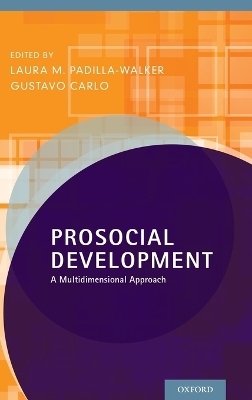
Prosocial Development
Oxford University Press Inc (Verlag)
9780199964772 (ISBN)
Prosocial Development examines a variety of biological, socialization, and contextual influences on prosocial development from infancy through early adulthood. While the definition of prosocial behavior may seem straightforward, recent research has highlighted its multifaceted nature. This volume specifically focuses on the multidimensionality of prosocial development, examining different contexts, motivations, types, and targets of prosocial behavior that are differentially predicted by socialization and dispositional characteristics. Skillfully edited by Drs. Padilla-Walker and Carlo, each chapter in this volume highlights some aspect of multidimensionality in regard to prosocial behavior and meaningful avenues for future research. This volume will be an important tool for scholars, researchers, and practitioners who are interested in prosocial, moral, and positive youth development. The organization and focus of this volume are also well-suited for use as a text for graduate courses in moral development, child and adolescent development, social psychology, sociology, anthropology, and family studies.
Laura Padilla-Walker is an Associate Professor in the School of Family Life at Brigham Young University. Her research focuses on the parent-child relationship as it relates to prosocial and moral development during adolescence and emerging adulthood. Dr. Padilla-Walker has published over 50 peer-reviewed articles and book chapters. Gustavo Carlo is the Millsap Professor of Diversity and Multicultural Studies in Human Development and Family Studies at the University of Missouri. His primary interests are the parenting, personality, and sociocultural correlates of prosocial and moral behaviors. Dr. Carlo has published well over 100 peer-reviewed articles and book chapters, and has co-edited several volumes.
About the Editors ; Contributors ; Section 1: Overview of Prosocial Behavior ; Chapter 1: The Study of Prosocial Behavior: Past, Present, and Future ; Laura M. Padilla-Walker and Gustavo Carlo ; Chapter 2: Multidimensionality of Prosocial Behavior: Re-thinking the Conceptualization and Development of Prosocial Behavior ; Nancy Eisenberg and Tracy L. Spinrad ; Section 2: Biological Perspectives ; Chapter 3: Evolution, Prosocial Behavior, and Altruism: A Roadmap for Understanding Where the Proximate Meets the Ultimate ; Patricia H. Hawley ; Chapter 4: Parental and Genetic Contributions to Prosocial Behavior during Childhood ; Keren Fortuna and Ariel Knafo ; Chapter 5: The Prosocial Brain: Perceiving Others in Need, and Acting on It ; Alek Chakroff and Liane Young ; Chapter 6: Autonomic regulation, Polyvagal Theory, and Children's Prosocial Development ; Paul D. Hastings and Jonas G. Miller ; Section 3: Socialization Perspectives ; Chapter 7: Parental Socialization of Prosocial Behavior: A Multidimensional Approach ; Laura M. Padilla-Walker ; Chapter 8: Sweetness on the Screen: A Multidimensional View of Prosocial Behavior in ; Media ; Sarah M. Coyne and Nathan J. Smith ; Chapter 9: Prosocial Behavior and Peer Relations in Adolescence ; Kathryn R. Wentzel ; Chapter 10: Linking Grandparent Involvement with the Development of Prosocial Behavior in Adolescents ; Jeremy B. Yorgason and Kathryn B. Gustafson ; Section 4: Cultural and Contextual Perspectives ; Chapter 11: The Cultural Contexts of Children's Prosocial Behaviors ; Maria Rosario T. de Guzman, Anh Do, and Car Mun Kok ; Chapter 12: Predicting Prosocial Tendencies Among Mexican American Youth: The Intersection of Cultural Values, Social Cognitions, and Social Emotions ; Gustavo Carlo, George P. Knight, Camille D. Basilio, and Alexandra Davis ; Chapter 13: Cross-Cultural Evidence of Multidimensional Prosocial Behaviors: An Examination of the Prosocial Tendencies Measure (PTM) ; Meredith McGinley, Deanna Opal, Maria Cristina Richaud, and Belen Mesurado ; Chapter 14: Educating Students to be Prosocial at School ; Christi Bergin ; Section 5: Specific Targets and Types of Prosocial Behavior ; Chapter 15: Parents as Recipients of Adolescent Prosocial Behavior ; Mary B. Eberly Lewis ; Chapter 16: Prosocial Behaviors Toward Siblings and Grandparents ; Asiye Kumru and Bilge Yagmurlu ; Chapter 17: Prosocial Behaviors in Early Childhood: Helping Others, Responding to the Distress of Others, and Working with Others ; Deborah Laible and Erin Karahuta ; Chapter 18: Adopting a Multidimensional Perspective on College Students' Prosocial Behaviors ; Brandy A. Randall and Jennifer R. Wenner ; Chapter 19: The Social Construction of Volunteering ; Daniel Hart and Michael Sulik ; Chapter 20: Early Generativity and Types of Civic Engagement in Adolescence and Emerging Adulthood ; Michael W. Pratt and Heather L. Lawford ; Chapter 21: Prosocial Exemplarity in Adolescence and Adulthood ; Lawrence J. Walker ; Index
| Erscheint lt. Verlag | 24.4.2014 |
|---|---|
| Verlagsort | New York |
| Sprache | englisch |
| Maße | 236 x 168 mm |
| Gewicht | 780 g |
| Themenwelt | Geisteswissenschaften ► Psychologie ► Entwicklungspsychologie |
| Geisteswissenschaften ► Psychologie ► Sozialpsychologie | |
| Sozialwissenschaften ► Soziologie | |
| ISBN-13 | 9780199964772 / 9780199964772 |
| Zustand | Neuware |
| Informationen gemäß Produktsicherheitsverordnung (GPSR) | |
| Haben Sie eine Frage zum Produkt? |
aus dem Bereich