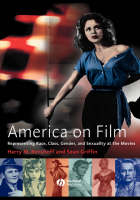
America on Film
Blackwell Publishing Ltd (Verlag)
978-0-631-22582-9 (ISBN)
- Titel erscheint in neuer Auflage
- Artikel merken

"America on Film: Representing Race, Class, Gender, and Sexuality in the Movies" is a lively introduction to issues of diversity as represented within the American cinema. This book: introduces issues of diversity as represented within the American cinema in a lively and accessible manner; provides a comprehensive overview of the industrial, socio-cultural, and aesthetic factors that contribute to cinematic representations of race, class, gender, and sexuality; is designed specifically for students and includes 101 illustrations, a glossary of key terms, questions for discussion, and lists for further reading and further viewing; includes case studies of a number of films, including "The Lion King", "The Jazz Singer", "Smoke Signals", "The Grapes of Wrath", and "The Celluloid Closet". Each chapter features a concise overview of the topic at hand, a discussion of representative films, figures, and movements, and an in-depth analysis of a single film.
Harry M. Benshoff is Assistant Professor of Radio, Television, and Film at the University of North Texas. He is author of Monsters in the Closet: Homosexuality and the Horror Film (1997). Sean Griffin is Assistant Professor of Cinema and Television at Southern Methodist University. He is author of Tinker Bells and Evil Queens: The Walt Disney Company from the Inside Out (2000).
Acknowledgements.How To Use This Book.Part I: American Film and Culture:.1. Introduction to the Study of Film Form and Representation:.Film Form.American Ideologies: Discrimination and Resistance.Culture and Cultural Studies.Case Study: The Lion King (1994).Questions for Discussion.For Further Reading.2. The Structure and History of Hollywood Filmmaking:.Hollywood vs. Independent Film.The Style of Hollywood Cinema.The Business of Hollywood.The History of Hollywood: The Movies Begin.The Classical Hollywood Cinema.World War II and Postwar Film."New" Hollywood and the Blockbuster Mentality.Questions for Discussion.For Further Reading/Screening.Part II: Race and Ethnicity and American Film:.Introduction to Part Two: What is Race?.3. American Film and the Concept of Whiteness:.Seeing White.Bleaching the Green: The Irish in American Cinema.Looking for Respect: The Italian in American Cinema.A Special Case: Jews and Hollywood.Case Study: The Jazz Singer (1927).Questions for Discussion.For Further Reading/Screening.4. African Americans and American Film:.African Americans in Early Film.Blacks in Classical Hollywood Cinema.World War II and the Postwar Social Problem Film.The Rise and Fall of Blaxploitation Filmmaking.Sidebar: Blacks on TV.1980s Hollywood and the Arrival of Spike Lee.Black Independent Film vs. "Neo-Blaxploitation" Today.Case Study: Bamboozled (2000).Questions for Discussion.For Further Reading/Screening.5. Native Americans and American Film:.The American "Indian" Before Film.Ethnographic Films and the Rise of the Hollywood Western.The Evolving Western.A Kinder, Gentler America?.Case Study: Smoke Signals (1998).Questions for Discussion.For Further Reading/Screening.6. Asian Americans and American Film:.Silent Film and Asian Images.Asians in Classical Hollywood Cinema.WWII and After: War Films, Miscegenation Melodramas, and Kung Fu.Asian American Actors and Filmmakers Today.Case Study: Eat a Bowl of Tea (1989).Questions for Discussion.For Further Reading/Screening.7. Latinos and American Film:.The Greaser and the Latin Lover: Alternating Stereotypes.WW2 and After: The Good Neighbor Policy.The 1950s to the 1970s: Back to Business as Usual?.Expanding Opportunities in Recent Decades.Case Study: My Family Familia (1995).Questions for Discussion.For Further Reading/Screening.Part III: Class and American Film:.Introduction to Part Three: What is Class?.8. Classical Hollywood Cinema and Class:.Setting the Stage: The Industrial Revolution.Early Cinema: The Rise of the Horatio Alger Myth.Hollywood and Unionization.Class in the Classical Hollywood Cinema.Case Study: The Grapes of Wrath (1940).Conclusion: Re-cloaking Class Consciousness.Questions for Discussion.For Further Reading/Screening.9. Cinematic Class Struggle After the Depression:.From World War II to the Red Scare.From Opulence to Counterculture.New Hollywood and the Resurrection of the Horatio Alger Myth.Case Study: Bulworth (1998).Conclusions: Corporate Hollywood and Labor Today.Sidebar: Class on Television.Questions for Discussion.For Further Reading/Screening.Part IV: Gender and American Film:.Introduction to Part Four: What is Gender?.10. Women in Classical Hollywood Filmmaking:.Images of Women in Early Cinema.Early Female Filmmakers.Images of Women in 1930s Classical Hollywood.World War II and After.Case Study: All That Heaven Allows (1955).Questions for Discussion.For Further Reading/Screening.11. Exploring the Visual Parameters of Women in Film:.Ways of Seeing."Visual Pleasure and Narrative Cinema".Case Study: Gilda (1946).Conclusion: Complicating Mulvey's Arguments.Questions for Discussion.For Further Reading/Screening.12. Masculinity in Classical Hollywood Filmmaking:.Masculinity and Early Cinema.Masculinity and the Male Movie Star.World War II and Film Noir.Case Study: Dead Reckoning (1947).Masculinity in 1950s American Film.Questions for Discussion.For Further Reading/Screening.13. Gender in American Film Since the 1960s:.Second Wave Feminism and Hollywood.Into the 1980s: A Backlash against Women?.A New Generation of Female Filmmakers.Case Study: The Ballad of Little Jo (1993).Conclusion: Gender at the Turn of the Millennium.Questions for Discussion.For Further Reading/Screening.Part V: Sexuality and American Film:.Introduction to Part Five: What is Sexuality?.14. Heterosexuality, Homosexuality, and Classical Hollywood.(Hetero)Sexuality on Screen.(Homo)Sexuality in Early Film.Censoring Sexuality during the Classical Hollywood Era.Postwar Sexualities and the Weakening of the Production Code.Camp and the Underground Cinema.Case Study: The Celluloid Closet (1995).Questions for Discussion.For Further Reading/Screening.15. Sexualities on Film Since the Sexual Revolution:.Hollywood and the Sexual Revolution.Film and Gay Culture from Stonewall to Aids.The Aids Crisis.Queer Theory and New Queer Cinema.Case Study: Go Fish (1995).Conclusions: Hollywood at the Turn of the Millennium.Questions for Discussion.For Further Reading/Screening.Glossary.Index.
| Erscheint lt. Verlag | 26.8.2003 |
|---|---|
| Zusatzinfo | 4 illustrations |
| Verlagsort | Oxford |
| Sprache | englisch |
| Maße | 180 x 254 mm |
| Gewicht | 874 g |
| Themenwelt | Kunst / Musik / Theater ► Film / TV |
| Sozialwissenschaften | |
| ISBN-10 | 0-631-22582-X / 063122582X |
| ISBN-13 | 978-0-631-22582-9 / 9780631225829 |
| Zustand | Neuware |
| Informationen gemäß Produktsicherheitsverordnung (GPSR) | |
| Haben Sie eine Frage zum Produkt? |
aus dem Bereich