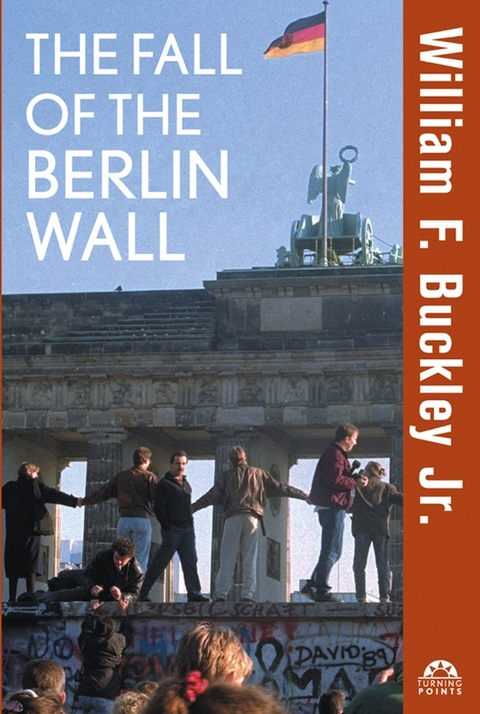
The Fall of the Berlin Wall (eBook)
224 Seiten
Turner Publishing Company (Verlag)
978-0-470-30773-1 (ISBN)
The late William F. Buckley Jr. was an award-winning author, editor, columnist, television host, lecturer, and adventurer. A father of modern conservative thought in America, he founded National Review in 1955, started writing his syndicated "On the Right" newspaper column in 1962, and began hosting the Emmy Award–winning Firing Line in 1966. His many bestselling books include God and Man at Yale, Atlantic High, Airborne, and ten Blackford Oakes spy novels. Buckley was awarded thirty-five honorary degrees and received the Presidential Medal of Freedom in 1991.
Foreword by Henry A. Kissinger.Acknowledgments.Introduction.1. Ulbricht’s Berlin Problem.2. The Continuing Crisis.3. In the Shadow of the Wall.4. The Wall Came Tumbling Down.5. The End of the Cold War.Notes.Index.
"Eloquent...immensely readable...the saga of the victory of capitalism over the brutal and irrational fraud that was state socialism." (Baltimore Sun, March 21, 2004)"[A] great narrative of democratic survival and democratic victory." (Washington Time, March 30, 2004)"This is a small masterpiece of the narrative tradition. The Fall of the Berlin Wall keep[s] readers turning the page." (National Review, March 22, 2004)"...decodes the Cold War endgame..." (Vanity Fair, March 2004)From the day the Berlin Wall went up, in August of 1961, separating East and West Berlin, to the day it came crumbling down in November 1989, it stood as a symbol of the denial of freedom and the horrors of communism. In his latest book, renowned conservative writer Buckley tells the story of the Wall from its historic inception to its fateful fall. This new entry in Wiley's Turning Points series is not an in-depth historical account of East German communism but a brief overview of cri tical events, accompanied by Buckley's insightful and occasionally witty commentary. Despite the author's political orientation, the book does not evince a strong political bias (traditionally, conservatives tout Reagan as a major player in the fall of communism, but Buckley devotes a scant couple of pages to Reagan's policies and his famous "te ar down this wall" speech); the story of the Berlin Wall is remarkable in itself, capable of being appreciated by all, regardless of their politics. It's a story about separated families, thousands of East Berliner s who risked their lives to taste freedom on the other side; those who did not make it-shot down by Communist police as they attempted to scale the wall. Buckley is at times funny, at times genuinely horrified by the Communist regime, and at times exultant over its fall. His lucid account celebrates the tenacity of the human spirit and the will to achieve freedom. Map. Agent, Lois Wallace. (Mar. 26) (Publishers Weekly, March 1, 2004)Early in his presidency, Ronald Reagan called communism a "sad, bizarre chapter in human history whose last pages even now are being written." Ten months after he left office, one of the grimmest symbols of communism's inhumanity -- the Berlin Wall -- was breached, and the Soviet empire itself soon lay on the ash heap of history.In "The Fall of the Berlin Wall" (Wiley, 212 pages, $19.95), William F. Buckley Jr. describes the Wall's final dramatic moments, as his title suggests, but he also tells the story of its construction and its role in the Cold War. The book is part of a publishing series called Turning Points, in which prominent writers take a fresh look at key moments in history. As stories go, few can match the intrigue and tragedy of the Berlin Wall. Imagine other great cities slashed through the middle: New York at 42nd Street, say, or Paris at the Champs-Elysees.Mr. Buckley himself tackled this subject in a 1984 novel in which his East German resistance hero came close to forcing the Soviets to back down from their plan to splice the city in two. This was not sheer fancy on Mr. Buckley's part. In 1961, Soviet leader Nikita Khrushchev informed the East Germans: "We Soviets are not willing to risk a major engagement with the West" and ordered them to withdraw if the Allies reacted to the Wall's construction with force. It turned out that John F. Kennedy and other Western leaders were relieved that Khrushchev's bluster only sealed off the city and didn't actually threaten West Berlin.Erich Honecker, the East German official in charge of building the Wall, kept direct knowledge of the project limited to 20 people. The troops who started stringing barbed wire at 2 a.m. on Aug. 12, 1961, were told of their mission only when they got to the border. Once he became East German leader, Mr. Honecker declared himself proud of his "anti-fascist protective barrier." Too proud, it turned out. By delaying reforms, he let resentment among his own citizens build until, by 1989, a full 5% of East German adults had taken the risk of being branded disloyal by requesting exit visas. That summer Hungary began allowing East German tourists to slip through to the West, and the genie was out of the bottle. Mr. Honecker was soon swept down into his own ash heap.In one sense, the Wall was a formidable barrier. It stood 13 feet high and was supplemented by watchtowers, alarms, mines, trenches, dogs and guards with machine guns. More than 100 people died trying to cross it. It became a tourist attraction. Mr. Buckley notes that "virtually every square inch of the Western side was covered with drawings and text and symbols." Even toward the end the experts thought it would remain in place. Many citizens, too. "Most Germans themselves are convinced," wrote journalist Peter Wyden weeks before the Wall fell, "that the prospect of a single Germany is a fantasy."But the Wall was surmounted by invisible forces. "The enemy of the people stands on the roof," raged Honecker's predecessor, Walter Ulbricht, complaining about the television antennas that were pointed west at night and allowed 85% of East Germans to watch Western TV and see what they were missing.Mr. Buckley writes about the many individual Germans who did their part to bring the Wall down. An American stalwart was Gen. Lucius Clay, the organizer of the 1948 Berlin Airlift, who learned after the Wall went up about the isolation of Steinstucken, an exclave of 200 West Berliners who were separated from the city by East German territory. He flew in by helicopter to reassure them and arranged to supply them by air until the East Germans allowed road access to the West, around the Wall.But for different reasons, history will record two paramount figures: Ronald Reagan and Mikhail Gorbachev. Mr. Reagan first saw the Wall in 1978, when he told his aide Peter Hannaford: "We've got to find a way to knock this thing down." After he became president, he returned in 1982 and enraged the Soviets by taking a couple of ceremonial steps across a painted border line. Then, in 1987, he overruled his own State Department by giving a momentous speech in which he implored the general secretary directly: "Mr. Gorbachev, tear down this wall!"The "tide of history" that Mr. Reagan liked to refer to in his speeches must have been on Mr. Gorbachev's mind two years later when he visited East Berlin and informed the comrades there that they needed to change. He told reporters who asked about the Wall: "Dangers await only those who do not react to life." The signal was sent that Moscow would no longer prop up a corrupt system.Mr. Buckley believes that the Wall's fall was both a vindication of the West's refusal to kowtow to the Soviets and a tribute to the "undeniable spirit of East German dissenters." Today pieces of the Wall exist as mere souvenirs on mantelpieces. Elsewhere in the world, sadly, the symbols of oppression are still intact. But as Mr. Buckley's poignant narrative reminds us: There is no reason to suppose that this will always be the case. (Wall Street Journal, March 18, 2004)
| Erscheint lt. Verlag | 21.4.2008 |
|---|---|
| Reihe/Serie | Turning Points in History | Turning Points in History |
| Vorwort | Henry A. Kissinger |
| Sprache | englisch |
| Themenwelt | Geschichte ► Allgemeine Geschichte ► Zeitgeschichte |
| Geisteswissenschaften ► Geschichte ► Regional- / Ländergeschichte | |
| Sozialwissenschaften ► Politik / Verwaltung ► Politische Systeme | |
| Sozialwissenschaften ► Politik / Verwaltung ► Politische Theorie | |
| Schlagworte | Berin • Berlin Wall • Cold War • Communism in Eastern Europe • East Germany • European politics • Fall of communism • fall of East Germany • German History • Germany • Iron curtain • Political Science • Soviet Union • The Fall of the Berlin Wall • Turning Points in History • Turning Points in History series • Warsaw Pact |
| ISBN-10 | 0-470-30773-0 / 0470307730 |
| ISBN-13 | 978-0-470-30773-1 / 9780470307731 |
| Informationen gemäß Produktsicherheitsverordnung (GPSR) | |
| Haben Sie eine Frage zum Produkt? |
 EPUB (Adobe DRM)
Kopierschutz: Adobe-DRM
Adobe-DRM ist ein Kopierschutz, der das eBook vor Mißbrauch schützen soll. Dabei wird das eBook bereits beim Download auf Ihre persönliche Adobe-ID autorisiert. Lesen können Sie das eBook dann nur auf den Geräten, welche ebenfalls auf Ihre Adobe-ID registriert sind.
Details zum Adobe-DRM
Dateiformat: EPUB (Electronic Publication)
EPUB ist ein offener Standard für eBooks und eignet sich besonders zur Darstellung von Belletristik und Sachbüchern. Der Fließtext wird dynamisch an die Display- und Schriftgröße angepasst. Auch für mobile Lesegeräte ist EPUB daher gut geeignet.
Systemvoraussetzungen:
PC/Mac: Mit einem PC oder Mac können Sie dieses eBook lesen. Sie benötigen eine
eReader: Dieses eBook kann mit (fast) allen eBook-Readern gelesen werden. Mit dem amazon-Kindle ist es aber nicht kompatibel.
Smartphone/Tablet: Egal ob Apple oder Android, dieses eBook können Sie lesen. Sie benötigen eine
Geräteliste und zusätzliche Hinweise
Buying eBooks from abroad
For tax law reasons we can sell eBooks just within Germany and Switzerland. Regrettably we cannot fulfill eBook-orders from other countries.
aus dem Bereich