


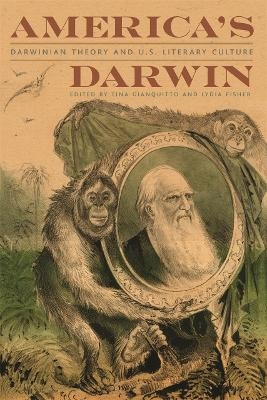
America's Darwin
Darwinian Theory and U.S. Literary Culture
Seiten
2014
University of Georgia Press (Verlag)
978-0-8203-4675-5 (ISBN)
University of Georgia Press (Verlag)
978-0-8203-4675-5 (ISBN)
- Lieferbar (Termin unbekannt)
- Versandkostenfrei
- Auch auf Rechnung
- Artikel merken
An engaging collection of interdisciplinary essays on the distinctive qualities of America's textual engagement with Darwinian evolutionary theory, especially in regard to On the Origin of Species, which highlights the influence of prevalent cultural anxieties on interpretation.
While much has been written about the impact of Darwin’s theories on U.S. culture, and countless scholarly collections have been devoted to the science of evolution, few have addressed the specific details of Darwin’s theories as a cultural force affecting U.S. writers. America’s Darwin fills this gap and features a range of critical approaches that examine U.S. textual responses to Darwin’s works.
The scholars in this collection represent a range of disciplines—literature, history of science, women’s studies, geology, biology, entomology, and anthropology. All pay close attention to the specific forms that Darwinian evolution took in the United States, engaging not only with Darwin’s most famous works, such as On the Origin of Species, but also with less familiar works, such as The Expression of the Emotions in Man and Animals.
Each contributor considers distinctive social, cultural, and intellectual conditions that affected the reception and dissemination of evolutionary thought, from before the publication of On the Origin of Species to the early years of the twenty-first century. These essays engage with the specific details and language of a wide selection of Darwin’s texts, treating his writings as primary sources essential to comprehending the impact of Darwinian language on American writers and thinkers. This careful engagement with the texts of evolution enables us to see the broad points of its acceptance and adoption in the American scene; this approach also highlights the ways in which writers, reformers, and others reconfigured Darwinian language to suit their individual purposes.
America’s Darwin demonstrates the many ways in which writers and others fit themselves to a narrative of evolution whose dominant motifs are contingency and uncertainty. Collectively, the authors make the compelling case that the interpretation of evolutionary theory in the U.S. has always shifted in relation to prevailing cultural anxieties.
While much has been written about the impact of Darwin’s theories on U.S. culture, and countless scholarly collections have been devoted to the science of evolution, few have addressed the specific details of Darwin’s theories as a cultural force affecting U.S. writers. America’s Darwin fills this gap and features a range of critical approaches that examine U.S. textual responses to Darwin’s works.
The scholars in this collection represent a range of disciplines—literature, history of science, women’s studies, geology, biology, entomology, and anthropology. All pay close attention to the specific forms that Darwinian evolution took in the United States, engaging not only with Darwin’s most famous works, such as On the Origin of Species, but also with less familiar works, such as The Expression of the Emotions in Man and Animals.
Each contributor considers distinctive social, cultural, and intellectual conditions that affected the reception and dissemination of evolutionary thought, from before the publication of On the Origin of Species to the early years of the twenty-first century. These essays engage with the specific details and language of a wide selection of Darwin’s texts, treating his writings as primary sources essential to comprehending the impact of Darwinian language on American writers and thinkers. This careful engagement with the texts of evolution enables us to see the broad points of its acceptance and adoption in the American scene; this approach also highlights the ways in which writers, reformers, and others reconfigured Darwinian language to suit their individual purposes.
America’s Darwin demonstrates the many ways in which writers and others fit themselves to a narrative of evolution whose dominant motifs are contingency and uncertainty. Collectively, the authors make the compelling case that the interpretation of evolutionary theory in the U.S. has always shifted in relation to prevailing cultural anxieties.
Tina Gianquitto (Editor) TINA GIANQUITTO is an associate professor of literature in the Division of Liberal Arts and International Studies at the Colorado School of Mines. Lydia Fisher (Editor) LYDIA FISHER is a visiting assistant professor in the Department of English at Portland State University.
| Co-Autor | Tina Gianquitto, Paul Ohler, Kimberly Hamlin |
|---|---|
| Zusatzinfo | 2 Maps; 2 Maps; 2 Maps; 2 Maps; 2 Maps; 2 Maps; 2 Maps |
| Verlagsort | Georgia |
| Sprache | englisch |
| Maße | 152 x 229 mm |
| Themenwelt | Geisteswissenschaften ► Sprach- / Literaturwissenschaft ► Anglistik / Amerikanistik |
| Geisteswissenschaften ► Sprach- / Literaturwissenschaft ► Literaturwissenschaft | |
| Naturwissenschaften ► Biologie ► Evolution | |
| Sozialwissenschaften ► Kommunikation / Medien ► Kommunikationswissenschaft | |
| ISBN-10 | 0-8203-4675-6 / 0820346756 |
| ISBN-13 | 978-0-8203-4675-5 / 9780820346755 |
| Zustand | Neuware |
| Informationen gemäß Produktsicherheitsverordnung (GPSR) | |
| Haben Sie eine Frage zum Produkt? |
Mehr entdecken
aus dem Bereich



aus dem Bereich
Poetik eines sozialen Urteils
Buch | Hardcover (2023)
De Gruyter (Verlag)
CHF 83,90


