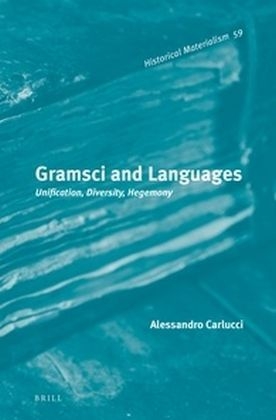
Gramsci and Languages
Brill (Verlag)
978-90-04-23111-5 (ISBN)
Winner of the prestigious 'Giuseppe Sormani International Prize' for the best monograph on Antonio Gramsci (4th edition, 2012-2017).
Antonio Gramsci (1891-1937) is one of the most translated Italian authors of all time. After the Second World War his thought became increasingly influential, and remained relevant throughout the second half of the century. Today, it is generally agreed that his Marxism has highly original and personal features, as confirmed by the fact that his international influence has continued to grow since the fall of the Berlin Wall and the collapse of the Soviet Union. Gramsci and Languages offers an explanation of this originality and traces the origins of certain specific features of Gramsci’s political thought by looking at his lifelong interest in language, especially in questions of linguistic diversity and unification.
Alessandro Carlucci, Ph.D. (London, 2010), is Lector in Italian at the University of Oxford. He has published widely on Gramsci, and is the editor of New Approaches to Gramsci: Language, Philosophy and Politics, special issue of the Journal of Romance Studies (2012).
Preface
Introduction
Linguistic reflections as an integral part of Gramsci’s legacy
Modern linguistics and the philosophy of praxis
Towards a better understanding of Gramsci’s views
1. The limited number of writings usually considered
2. The risks involved in neglecting Gramsci’s biography
3. Identifying sources and cultural links: a productive trend in recent research
4. Linguistic themes and the debates on Gramsci’s Leninism
Diversity and unification: a few considerations in conclusion
1. Experiencing Linguistic Diversity and Cultural Unification
1.1. Sardinian in Gramsci’s life
1.2. Gramsci’s correspondence
1.3. The Sardinian years
1.4. Turin
1.5. The Sassari Brigade in Turin, April-July 1919
1.5.1. The arrival of the Brigade
1.5.2. The editorial board of L’Ordine Nuovo
1.5.3. The successful campaign among Sardinian soldiers
1.6. From Turin to the prison years
1.7. Gramsci’s views on national linguistic unification
1.7.1. ‘Every individual ... is a philosopher’
1.7.2. The shortcomings of monolingualism
1.7.3. Final remarks
2. Influences and Differences: The Formation of Gramsci’s Views
2.1. Gramsci’s direct and indirect sources in language studies
2.2. Echoes of Saussure’s ideas
2.2.1. Grammar
2.2.2. Metaphors
2.2.3. Language planning
2.2.4. The penetration of Saussurean concepts into Italian intellectual culture
2.2.5. A possible channel of transmission: the Cours in Russia, 1917-1925
2.2.6. Final remarks
2.3. Language and social classes
2.3.1. Sociological linguistics and the Marxist critique of language
2.3.2. Bukharin
2.3.3. Sociolinguistic variation and the national question in the USSR
2.3.4. Grammar and language education for the popular masses
2.3.5. Final remarks
2.4. Glottopolitical aspects of Lenin’s influence
2.4.1. Early Marxist approaches to language policies: Marx and Engels
2.4.2. The Second International
2.4.3. Lenin
2.4.4. Did Gramsci know Lenin’s ideas on language?
2.4.5. Affinities
2.4.6. Jewish autonomy: a case of partial divergence
2.4.7. Final remarks
2.5. Rationalising and unifying linguistic communication
2.5.1. Soviet Esperantism
2.5.2. Proletarian culture
2.5.3. Sources and periodisation
2.5.4. Continuity and consistency of Gramsci’s glottopolitical views
2.5.5. Final remarks: Soviet inputs and the development of Gramsci’s views
3. Political Implications
3.1. Gramsci and the linguistics of his time
3.2. Language and politics in Gramsci’s writings
3.3. The role of linguistic themes in shaping Gramsci’s politics
3.3.1. Necessary conditions
3.3.2. Centres of irradiation
3.3.3. The Jacobins
3.3.4. Language and hegemony
3.4. Gramsci’s specificity
3.4.1. A man ‘in flesh and blood’
3.4.2. Gramsci’s Marxism
3.4.3. Final remarks
Conclusions: Gramscian Links between Language and Politics
Gramsci in linguistics...
...and linguistics in Gramsci
Appendix: Gramsci’s Legacy, 1937–2007
4.1. The reception of Gramsci’s writings: the letters
4.2. Lost, unpublished and recently published material
4.2.1. Matteo Bartoli’s glottology course of 1912–13
4.2.2. Gramsci’s translation of Finck’s work
4.2.3. Gramsci’s comments on Panzini’s Italian grammar
4.2.4. Early work on Manzoni
4.3. Pre-prison writings and prison notes
4.4. Gramsci’s writings on language
4.5. Gramsci and linguistic disciplines
4.5.1. Early research
4.5.2. Exploring Gramsci’s ideas on language
4.5.3. Using Gramsci’s ideas on language
4.5.4. Gramsci’s influence and its limits: some examples
4.5.5. Final remarks
References
Index
| Erscheint lt. Verlag | 13.9.2013 |
|---|---|
| Reihe/Serie | Historical Materialism Book Series ; 59 |
| Verlagsort | Leiden |
| Sprache | englisch |
| Maße | 155 x 235 mm |
| Gewicht | 547 g |
| Themenwelt | Geisteswissenschaften ► Philosophie ► Sprachphilosophie |
| Geisteswissenschaften ► Sprach- / Literaturwissenschaft ► Sprachwissenschaft | |
| Sozialwissenschaften ► Politik / Verwaltung ► Politische Systeme | |
| Sozialwissenschaften ► Politik / Verwaltung ► Politische Theorie | |
| Sozialwissenschaften ► Soziologie | |
| ISBN-10 | 90-04-23111-0 / 9004231110 |
| ISBN-13 | 978-90-04-23111-5 / 9789004231115 |
| Zustand | Neuware |
| Informationen gemäß Produktsicherheitsverordnung (GPSR) | |
| Haben Sie eine Frage zum Produkt? |
aus dem Bereich