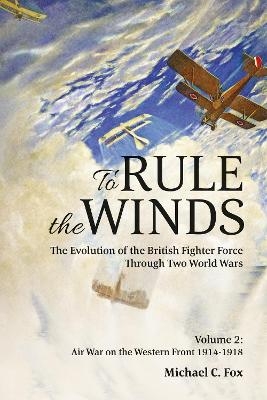
To Rule the Winds: The Evolution of the British Fighter Force Through Two World Wars
Helion & Company (Verlag)
978-1-909982-26-0 (ISBN)
- Titel nicht im Sortiment
- Artikel merken
While the resulting Air Force was not entirely successful in the grand objective of ruling the air, it did enough. But to do so, it had to change fundamentally. In August 1914 the British Air Service - or, at least, the Army's Wing of it - that went to France as part of the British Expeditionary Force comprised four squadrons populated with a small collection of slow and unarmed reconnaissance aeroplanes, typically the Royal Aircraft Factory's B.E.2 types, plus an even smaller scattering of somewhat faster but still unarmed single-seater scouting aeroplanes like the Bristol Scout and sundry Bleriot types. There was no specialisation worth the name: the aeroplanes of the Military Wing were just about all that were flyable; there was no plan for the future, precious little in the way of reserves and no duty other than to watch the enemy's forces on the ground. When the War ended in November 1918 there was a national, a Royal, Air Force of many squadrons: the Royal Naval Air Service had been (at least in principle and temporarily) rolled in; there were still the squadrons of reconnaissance machines, but faster, armed for defence and more robust. There were squadrons of bombing machines: like the reconnaissance machines, but more powerful and capable of carrying heavy bomb loads over distances that made strategic bombing a practical proposition. Finally, there were fighter squadrons, something of a real innovation, fast and manoeuvrable mostly single-seater gun platforms. Although an Independent bomber force was created during 1918 there was not, even by the war's end, a fighter force - just squadrons.
This Volume continues the underlying theme of the whole series: the development of the fighter force - a co-ordinated group of fighting squadrons adapted and later designed primarily to fight in the air against other aeroplanes.
Michael Fox was born at Farnborough Hospital in Kent during WWII. At the time, his parents were living at Biggin Hill, close to the famous aerodrome, a fact that seems to have impressed upon him an interest in military aviation ever since! He was brought up in South-East London and went into industry as a trainee metallurgist straight from school. He subsequently took an honours degree in metallurgy at Brunel University and returned to industry in the South-East of England as a research metallurgist, working firstly on the development of high temperature steels for the petrochemical and related industries and later on the marine corrosion of non-ferrous alloys. He gave up practical metallurgy upon joining the Standards Division of the British Standards Institution (BSI) in the mid-1970s, rising through a series of management positions to Resource Planning Manager and Departmental head. He left the BSI in 2001, taking the opportunity to begin writing Knights of the Skies, his first book. He is currently working on further volumes in the To Rule the Winds series, as well as a possible series of novels also based upon aspects of military aviation. Michael lives with his wife of over 40 years and a very aggressive (though slowing down) cat in a very un-model village in Kent; their two grown-up daughters and a beautiful grand-daughter live nearby.
| Erscheint lt. Verlag | 15.5.2026 |
|---|---|
| Zusatzinfo | 60 b/w photos and illustrations, 5 maps and 40 tables |
| Verlagsort | Solihull |
| Sprache | englisch |
| Maße | 152 x 229 mm |
| Themenwelt | Geschichte ► Allgemeine Geschichte ► Neuzeit (bis 1918) |
| Geschichte ► Allgemeine Geschichte ► 1918 bis 1945 | |
| Geisteswissenschaften ► Geschichte ► Regional- / Ländergeschichte | |
| Sozialwissenschaften ► Politik / Verwaltung | |
| ISBN-10 | 1-909982-26-1 / 1909982261 |
| ISBN-13 | 978-1-909982-26-0 / 9781909982260 |
| Zustand | Neuware |
| Informationen gemäß Produktsicherheitsverordnung (GPSR) | |
| Haben Sie eine Frage zum Produkt? |
aus dem Bereich