


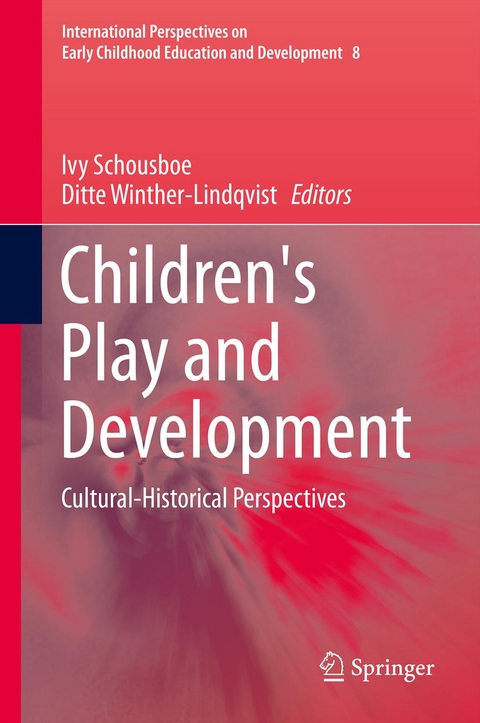
Children's Play and Development (eBook)
X, 265 Seiten
Springer Netherland (Verlag)
978-94-007-6579-5 (ISBN)
This book provides new theoretical insights to our understanding of play as a cultural activity. All chapters address play and playful activities from a cultural-historical theoretical approach by re-addressing central claims and concepts in the theory and providing new models and understandings of the phenomenon of play within the framework of cultural historical theory. Empirical studies cover a wide range of institutional settings: preschool, school, home, leisure time, and in various social relations (with peers, professionals and parents) in different parts of the world (Europe, Australia, South America and North America). Common to all chapters is a goal of throwing new light on the phenomenon of playing within a theoretical framework of cultural-historical theory. Play as a cultural, collective, social, personal, pedagogical and contextual activity is addressed with reference to central concepts in relation to development and learning. Concepts and phenomena related to ZPD, the imaginary situation, rules, language play, collective imagining, spheres of realities of play, virtual realities, social identity and pedagogical environments are presented and discussed in order to bring the cultural-historical theoretical approach into play with contemporary historical issues. Essential as a must read to any scholar and student engaged with understanding play in relation to human development, cultural historical theory and early childhood education.
This book provides new theoretical insights to our understanding of play as a cultural activity. All chapters address play and playful activities from a cultural-historical theoretical approach by re-addressing central claims and concepts in the theory and providing new models and understandings of the phenomenon of play within the framework of cultural historical theory. Empirical studies cover a wide range of institutional settings: preschool, school, home, leisure time, and in various social relations (with peers, professionals and parents) in different parts of the world (Europe, Australia, South America and North America). Common to all chapters is a goal of throwing new light on the phenomenon of playing within a theoretical framework of cultural-historical theory. Play as a cultural, collective, social, personal, pedagogical and contextual activity is addressed with reference to central concepts in relation to development and learning. Concepts and phenomena related to ZPD, the imaginary situation, rules, language play, collective imagining, spheres of realities of play, virtual realities, social identity and pedagogical environments are presented and discussed in order to bring the cultural-historical theoretical approach into play with contemporary historical issues. Essential as a must read to any scholar and student engaged with understanding play in relation to human development, cultural historical theory and early childhood education.
Preface.- 1. Introduction: Children’s Play and Development; Ivy Schousboe and Ditte Winther-Lindqvist.- 2. The Structure of Fantasy Play and its Implications for Good and Evil Games; Ivy Schousboe.- 3. Playing with Social Identities; Ditte Winther-Lindqvist.- 4. Pedagogical Perspectives on Play; Daniela Cecchin.- 5. Collective Imagining in Play; Marilyn Fleer.- 6. ‘Las Divinas’. Play and Emotions in a Mexican Telenovela Performance; Gloria Quiñones.- 7. A Cultural-Historical Study of Children’s Collective Imagination in Play: A Preschooler’s Bilingual Heritage Language Development; Liang Li.- 8. Language Play: The Development of Linguistic Consciousness and Creative Speech in Early Childhood Education; Niklas Pramling and Ingrid Pramling Samuelsson.- 9. Play to Learn, Learn to Play – Boundary Crossing Within Zones of Proximal Development; Lars Rossen.- 10. Online Adolescence. Real Life Development in the Virtual World of Warcraft; Halfdan Fryd Koot and Hernik Garde.- 11. Playing in Online Chat Communities; Morten Jack.- 12. The Persistence of Play and What-If Thinking; Ivy Schousboe.- 13. Cultural and Historical Influences on Conceptions and Uses of Play; Ivy Schousboe.- 14. An Activity Theory View on the Development of Playing; Bert van Oers.- 15. Play, but not Simply Play – the Anthropology of Play; Benny Karpatschof.
| Erscheint lt. Verlag | 20.6.2013 |
|---|---|
| Reihe/Serie | International Perspectives on Early Childhood Education and Development | International Perspectives on Early Childhood Education and Development |
| Zusatzinfo | X, 265 p. |
| Verlagsort | Dordrecht |
| Sprache | englisch |
| Themenwelt | Geisteswissenschaften ► Psychologie ► Entwicklungspsychologie |
| Geisteswissenschaften ► Psychologie ► Pädagogische Psychologie | |
| Sozialwissenschaften ► Pädagogik ► Vorschulpädagogik | |
| Schlagworte | children's play in cultural and institutional settings • Cultural Historical Activity Theory • dynamical, dialectical and materi • dynamical, dialectical and material developmental psychology • interplay between theoretical and empirical studies • persistence of play • play-environments for children in early childhood care • play in online communities • play research • Social Identity • spheres of reality • Vygotskij • Vygotsky • zone of proximal development |
| ISBN-10 | 94-007-6579-7 / 9400765797 |
| ISBN-13 | 978-94-007-6579-5 / 9789400765795 |
| Informationen gemäß Produktsicherheitsverordnung (GPSR) | |
| Haben Sie eine Frage zum Produkt? |
 PDF (Wasserzeichen)
Größe: 4,2 MB
DRM: Digitales Wasserzeichen
Dieses eBook enthält ein digitales Wasserzeichen und ist damit für Sie personalisiert. Bei einer missbräuchlichen Weitergabe des eBooks an Dritte ist eine Rückverfolgung an die Quelle möglich.
Dateiformat: PDF (Portable Document Format)
Mit einem festen Seitenlayout eignet sich die PDF besonders für Fachbücher mit Spalten, Tabellen und Abbildungen. Eine PDF kann auf fast allen Geräten angezeigt werden, ist aber für kleine Displays (Smartphone, eReader) nur eingeschränkt geeignet.
Systemvoraussetzungen:
PC/Mac: Mit einem PC oder Mac können Sie dieses eBook lesen. Sie benötigen dafür einen PDF-Viewer - z.B. den Adobe Reader oder Adobe Digital Editions.
eReader: Dieses eBook kann mit (fast) allen eBook-Readern gelesen werden. Mit dem amazon-Kindle ist es aber nicht kompatibel.
Smartphone/Tablet: Egal ob Apple oder Android, dieses eBook können Sie lesen. Sie benötigen dafür einen PDF-Viewer - z.B. die kostenlose Adobe Digital Editions-App.
Zusätzliches Feature: Online Lesen
Dieses eBook können Sie zusätzlich zum Download auch online im Webbrowser lesen.
Buying eBooks from abroad
For tax law reasons we can sell eBooks just within Germany and Switzerland. Regrettably we cannot fulfill eBook-orders from other countries.
aus dem Bereich


