


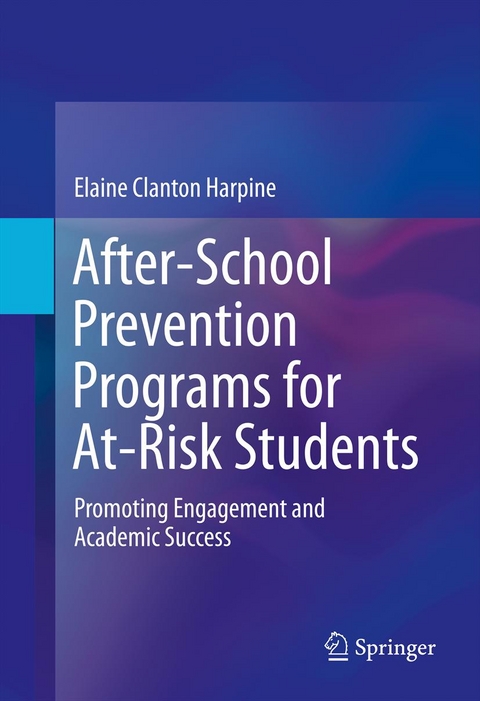
After-School Prevention Programs for At-Risk Students (eBook)
XX, 134 Seiten
Springer New York (Verlag)
978-1-4614-7416-6 (ISBN)
After-School Prevention Programs for At-Risk Students offers professionals a detailed framework for developing and enhancing after-school programs. Emphasizing a prevention focus and a group-centered interactive approach, the book's year-long model combines education and counseling, incorporating key therapeutic objectives to foster academic and behavior skills and reduce problems in and outside class. Practical step-by-step guidelines for creating and implementing programs include clear rationales, instructive design and case examples, and ready-to-use interventions. The author also provides guidance on developmental, gender, and cultural considerations, the challenges of maintaining progress over the course of the school year, and the handling of severe learning and emotional problems.
Among the topics covered:
- Organizing a group-centered after-school program.
- Combining learning and counseling into one curriculum.
- The role of motivation in an ongoing year-long program.
- Group process, self-efficacy, cohesion: applying the principles of change.
- Interaction in a year-long program.
- Solving problems and conflicts.
After-School Prevention Programs for At-Risk Students is an essential reference for scientist-practitioners, clinicians, and academics in such disciplines as school psychology, childhood education, social work, psychotherapy and counseling, and learning and instruction.
Elaine Clanton Harpine, Ph.D., is a motivational psychologist specializing in group-centered motivational program design. She has 41 years experience designing and conducting motivational prevention programs for children and youth. Dr. Clanton Harpine earned her doctorate in Educational Psychology, Counseling from the University of Illinois, Urbana-Champaign.
Dr. Clanton Harpine has published 14 nonfiction books, including Prevention Groups (2013), Group-Centered Prevention Programs for At-Risk Students (2011), Group Interventions in Schools: Promoting Mental Health for At-Risk Children and Youth (2008). And No Experience Necessary! which received an Award of Excellence in 1995 and was selected as one of the top five children's books in its class. Other published children's writings include a two volume series entitled, Come Follow Me, in 2001, a three-volume family series completed in 2003, a youth book in 1989 along with numerous articles for teenagers on peer pressure, coping with failure, alcohol abuse, parents, suicide, and more recently, articles on using group-centered interventions in the schools. Other published writings include a series on Erasing Failure in the Classroom, a series of ready-to-use group-centered program packets: Vol. 1, the Camp Sharigan program (2nd ed., 2010), Vol. 2, Vowel Clustering (2010), and Vol. 3, the Reading Orienteering Club (2013).
Dr. Clanton Harpine has been interviewed on local early morning TV and radio concerning her workshop 'Communication for Married Couples' and has been interviewed on local university radio concerning her work with inner-city children.
Her research for the past twelve years has focused on using group-centered interventions with at-risk readers. Dr. Clanton Harpine designed the motivational reading program called, Camp Sharigan, which she has used extensively in her work and research. She also designed the Reading Orienteering Club after-school prevention program and 4-Step Method for teaching at-risk children to read. Her research with these programs has been published in psychological journals and reported through presentations at the American Psychological Association's annual conventions.
In recent years, Dr. Clanton Harpine has been teaching Group Therapy and Counseling, Lifespan Development, and Human Growth and Development at the University of South Carolina Aiken and is continuing her research with group-centered prevention. She is the editor for the 'Prevention Corner' column which appears quarterly in The Group Psychologist. She was selected for inclusion in Who's Who of American Women, 2006-2013 for her work with children in inner-city neighborhoods and at-risk communities.
After-School Prevention Programs for At-Risk Students offers professionals a detailed framework for developing and enhancing after-school programs. Emphasizing a prevention focus and a group-centered interactive approach, the book's year-long model combines education and counseling, incorporating key therapeutic objectives to foster academic and behavior skills and reduce problems in and outside class. Practical step-by-step guidelines for creating and implementing programs include clear rationales, instructive design and case examples, and ready-to-use interventions. The author also provides guidance on developmental, gender, and cultural considerations, the challenges of maintaining progress over the course of the school year, and the handling of severe learning and emotional problems. Among the topics covered:Organizing a group-centered after-school program.Combining learning and counseling into one curriculum.The role of motivation in an ongoing year-long program.Group process, self-efficacy, cohesion: applying the principles of change.Interaction in a year-long program.Solving problems and conflicts.After-School Prevention Programs for At-Risk Students is an essential reference for scientist-practitioners, clinicians, and academics in such disciplines as school psychology, childhood education, social work, psychotherapy and counseling, and learning and instruction.
Elaine Clanton Harpine, Ph.D., is a motivational psychologist specializing in group-centered motivational program design. She has 41 years experience designing and conducting motivational prevention programs for children and youth. Dr. Clanton Harpine earned her doctorate in Educational Psychology, Counseling from the University of Illinois, Urbana-Champaign.Dr. Clanton Harpine has published 14 nonfiction books, including Prevention Groups (2013), Group-Centered Prevention Programs for At-Risk Students (2011), Group Interventions in Schools: Promoting Mental Health for At-Risk Children and Youth (2008). And No Experience Necessary! which received an Award of Excellence in 1995 and was selected as one of the top five children’s books in its class. Other published children’s writings include a two volume series entitled, Come Follow Me, in 2001, a three-volume family series completed in 2003, a youth book in 1989 along with numerous articles for teenagers on peer pressure, coping with failure, alcohol abuse, parents, suicide, and more recently, articles on using group-centered interventions in the schools. Other published writings include a series on Erasing Failure in the Classroom, a series of ready-to-use group-centered program packets: Vol. 1, the Camp Sharigan program (2nd ed., 2010), Vol. 2, Vowel Clustering (2010), and Vol. 3, the Reading Orienteering Club (2013).Dr. Clanton Harpine has been interviewed on local early morning TV and radio concerning her workshop "Communication for Married Couples" and has been interviewed on local university radio concerning her work with inner-city children.Her research for the past twelve years has focused on using group-centered interventions with at-risk readers. Dr. Clanton Harpine designed the motivational reading program called, Camp Sharigan, which she has used extensively in her work and research. She also designed the Reading Orienteering Club after-school prevention program and 4-Step Method for teaching at-risk children to read. Her research with these programs has been published in psychological journals and reported through presentations at the American Psychological Association's annual conventions.In recent years, Dr. Clanton Harpine has been teaching Group Therapy and Counseling, Lifespan Development, and Human Growth and Development at the University of South Carolina Aiken and is continuing her research with group-centered prevention. She is the editor for the "Prevention Corner" column which appears quarterly in The Group Psychologist. She was selected for inclusion in Who’s Who of American Women, 2006-2013 for her work with children in inner-city neighborhoods and at-risk communities.
Preface 8
Case Example 10
Easy Reference Guide to Group-Centered Learning Center Interventions 14
Acknowledgments 16
Contents 18
Chapter 1: Organizing an After-School Program 22
After-School Programs Must Change 23
Selecting a Group Approach for Your After-School Program 24
Looking at the Complete Program 25
Redesigning After-School Programs 25
Selecting a Group Format 26
Step 1: Establishing the Focus of Your After-School Program 28
Questions 29
Step 1, Design Example 30
Real-World Applications 31
Observational Extensions 32
Troubleshooting Checklists for Organizing a New After-School Program 32
A Ready-to-Use Group-Centered Learning Center Intervention, Designing a Learning Center to Meet the Cultural Needs of Your Participants: The Hat Cat 32
THE HAT CAT 34
ARE YOU READY FOR A CHALLENGE? 35
Chapter 2: The Group-Centered Approach 36
The Need for Individualized Instruction 37
Individual Learning Needs 38
How the Group-Centered Approach Meets Individual Learning Needs 40
How to Set Up and Develop a Group-Centered After-School Program 41
Step 2: Designing a Learning Center to Bring About Academic Improvement 42
Step 2, Design Example 43
ARE YOU READY FOR A CHALLENGE? 48
Real-World Applications 48
Observational Extensions 48
Troubleshooting Checklists for Organizing a New After-School Program 48
A Ready-to-Use Group-Centered Learning Center Intervention, An Example of How to Build Teaching Strategies into a Learning Center Format: I Am Happy 49
I AM HAPPY 50
ARE YOU READY FOR A CHALLENGE? 50
Chapter 3: Combining Learning and Counseling into One After-School Program 51
Perceptions and Past Experiences 52
Does Your After-School Program Enhance Mental Wellness? 55
Incorporating Mental Wellness into an After-School Program 56
How to Build Mentally Healthy Counseling Interventions into Your Program 60
Step 3: Designing a Learning Center to Enhance Mental Health and Wellness 60
Step 3, Design Example 61
Real-World Applications 65
Observational Extensions 65
Troubleshooting Checklists for Organizing a New After-School Program 65
A Ready-to-Use Group-Centered Learning Center Intervention, Designing a Learning Center to Meet the Mental Health Needs of Your Participants: Discovering the Meaning of the Word New 65
Discovering the Meaning of the Word New 66
ARE YOU READY FOR A CHALLENGE? 67
Chapter 4: The Role of Motivation in an Ongoing Year-Long Program 68
What Is Motivation? 69
What Is the Difference Between Intrinsic and Extrinsic Motivation? 70
Is the After-School Group Environment Important? 71
Building Motivation into Your After-School Program 73
Creating an Intrinsically Motivating After-School Program 75
Step 4: Designing a Learning Center to Enhance Intrinsic Motivation 76
Step 4, Design Example 77
Real-World Applications 80
Observational Extensions 80
Troubleshooting Checklists for Organizing a New After-School Program 80
A Ready-to-Use Group-Centered Learning Center Intervention, Designing a Learning Center to Meet the Intrinsic Motivational Needs of Your Participants: Matt the Rat 80
MATT THE RAT 81
ARE YOU READY FOR A CHALLENGE? 82
Chapter 5: Group Process, Self-Efficacy, and Cohesion: Applying the Principles of Change 83
The Role of the Group in Bringing About Change 84
Group Dynamics and Group Process 84
Group Process Encourages Change 85
Prevention Programs Lead to Change 86
Cohesion Guides Change 86
Group-Centered Creative Art Interventions 87
Self-Efficacy Brings About Change 88
Building Change into Your After-School Program 89
Step 5: Designing a Learning Center to Bring About Change 91
Step 5, Design Example 92
Real-World Applications 95
Observational Extensions 95
Troubleshooting Checklists for Organizing a New After-School Program 95
A Ready-to-Use Group-Centered Learning Center Intervention, Designing a Learning Center to Bring About Change: On the Air 95
ON THE AIR 96
ARE YOU READY FOR A CHALLENGE? 96
Chapter 6: Interaction in a Year-Long Program 98
Stages of Development 99
Unintentional Disruptions 100
Intentional Disruptions 101
Group Atmosphere Is Important 102
How to Build Constructive Interaction into a Year-Long After-School Program 102
Learning Centers 102
Puppet Plays 104
Action Stories 105
TV Studio 105
Service Projects 106
Step 6: Designing a Learning Center to Encourage Interaction 107
Step 6, Design Example 107
Real-World Applications 110
Observational Extensions 110
Troubleshooting Checklists for Organizing a New After-School Program 110
A Ready-to-Use Group-Centered Learning Center Intervention, Designing a Learning Center for Generating Interaction: Giving to Others 111
GIVING TO OTHERS 111
ARE YOU READY FOR A CHALLENGE? 112
Chapter 7: Solving Conflicts and Problems 113
Violence Teaches Violence 114
Changing Behavior 115
Create a Positive Cohesive Group Environment 115
Appropriate Behavior Must Be Taught 116
A Potential Fight 117
Teasing, Bullying, and Belittling 118
When to Use Designated Groups 119
Refusal to Work 121
Parents 121
Step 7: Designing a Learning Center to Change Behavior 123
Step 7, Design Example 123
Real-World Applications 124
Observational Extensions 124
Troubleshooting Checklists for Organizing a New After-School Program 125
A Ready-to-Use Group-Centered Learning Center Intervention, Designing a Learning Center for Changing Behavior: Painting Pictures in the Clouds 125
PAINTING PICTURES IN THE CLOUDS 126
ARE YOU READY FOR A CHALLENGE? 127
Chapter 8: After-School Programs and the School Mission 128
References 132
About the Author 143
Index 145
| Erscheint lt. Verlag | 12.6.2013 |
|---|---|
| Zusatzinfo | XX, 134 p. |
| Verlagsort | New York |
| Sprache | englisch |
| Themenwelt | Geisteswissenschaften ► Psychologie ► Entwicklungspsychologie |
| Medizin / Pharmazie ► Medizinische Fachgebiete ► Psychiatrie / Psychotherapie | |
| Sozialwissenschaften ► Pädagogik ► Sozialpädagogik | |
| Sozialwissenschaften ► Pädagogik ► Vorschulpädagogik | |
| Sozialwissenschaften ► Soziologie | |
| Schlagworte | Academic competence and after-school programs • After-school prevention programs • At-risk students and after-school activities • Cohesion and after-school programs • Efficacy retraining and after-school programs • Gender issues and after-school programs • Group-centered after-school prevention programs • Group-centered interventions after school • Group interventions after school • Group process in after-school programs • Interaction in after-school programs • Learning and Instruction • Mental wellness and after-school programs • Motivational strategies and after-school programs • Multicultural considerations and after-school programs • School mission and after-school programs • Self-efficacy and after-school programs • Skill-building and after-school programs • Social competence and after-school programs |
| ISBN-10 | 1-4614-7416-7 / 1461474167 |
| ISBN-13 | 978-1-4614-7416-6 / 9781461474166 |
| Informationen gemäß Produktsicherheitsverordnung (GPSR) | |
| Haben Sie eine Frage zum Produkt? |
 PDF (Wasserzeichen)
DRM: Digitales Wasserzeichen
Dieses eBook enthält ein digitales Wasserzeichen und ist damit für Sie personalisiert. Bei einer missbräuchlichen Weitergabe des eBooks an Dritte ist eine Rückverfolgung an die Quelle möglich.
Dateiformat: PDF (Portable Document Format)
Mit einem festen Seitenlayout eignet sich die PDF besonders für Fachbücher mit Spalten, Tabellen und Abbildungen. Eine PDF kann auf fast allen Geräten angezeigt werden, ist aber für kleine Displays (Smartphone, eReader) nur eingeschränkt geeignet.
Systemvoraussetzungen:
PC/Mac: Mit einem PC oder Mac können Sie dieses eBook lesen. Sie benötigen dafür einen PDF-Viewer - z.B. den Adobe Reader oder Adobe Digital Editions.
eReader: Dieses eBook kann mit (fast) allen eBook-Readern gelesen werden. Mit dem amazon-Kindle ist es aber nicht kompatibel.
Smartphone/Tablet: Egal ob Apple oder Android, dieses eBook können Sie lesen. Sie benötigen dafür einen PDF-Viewer - z.B. die kostenlose Adobe Digital Editions-App.
Buying eBooks from abroad
For tax law reasons we can sell eBooks just within Germany and Switzerland. Regrettably we cannot fulfill eBook-orders from other countries.
aus dem Bereich


