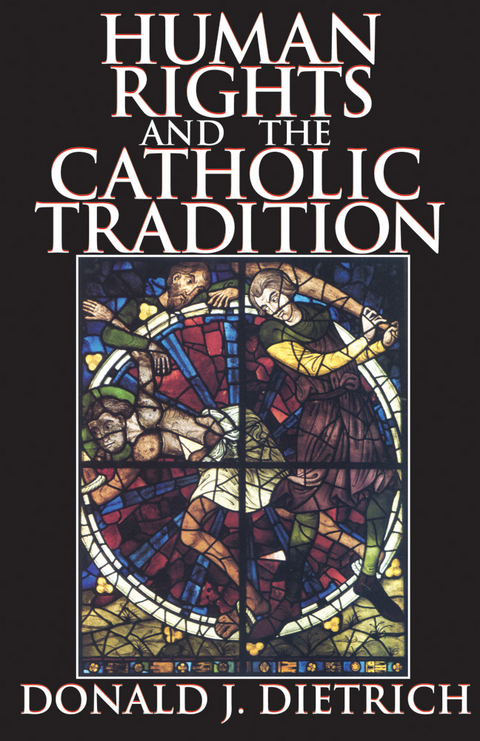
Human Rights and the Catholic Tradition (eBook)
234 Seiten
Transaction Publishers (Verlag)
978-1-4128-0922-1 (ISBN)
From the French Revolution to Vatican II, the institutional Catholic Church has opposed much that modernity has offered men and women constructing their societies. This book focuses on the experiences of German Catholics as they have worked to engage their faith with their culture in the midst of the two world wars, the barbarism of the Nazi era, and the uncertainties and conflicts of the post-World War II world.
German Catholics have confronted and challenged their Church's anti-modernism, two lost wars, the Weimar Republic, the Nazi Third Reich, the Cold War, German reunification and the impulses of globalization. Catholic theologians and those others nurtured by Catholicism, who resisted Nazism to create their own private spaces, developed a personal and existential theology that bore fruit after 1945. Such theologians as Karl Rahner, Johannes Metz, and Walter Kasper, were rooted in their political experiences and in the renewal movement built by those who attended Vatican II. These theologians were sensitive to the horrors of the Nazi brutalization, the positive contributions of democracy, and the need to create a Catholicism that could join the conversation on human rights following World War II. This dialogue meant accepting non-Catholic religious traditions as authentic expressions of faith, which in turn required that the sacred dignity of every man, woman, and child had to be respected. By the twenty-first century, Catholic theologians had made furthering a human rights agenda part of their tradition, and the German contribution to Catholic theology was crucial to that development. The current Catholic milieu has been forged through its defensive responses to the Enlightenment, through its resistance to ideologies that have supported sanctioned murder, and through an extensive dialogue with its own traditions.
In focusing on the German Catholic experience, Dietrich offers a cultural approach to the study of the religious and ethical issues that ground the human rights paradigm that will be of particular interest to students of religion, historians, sociologists, and human rights specialists.
| Erscheint lt. Verlag | 31.12.2011 |
|---|---|
| Reihe/Serie | Religion and Society |
| Sprache | englisch |
| Themenwelt | Geschichte ► Allgemeine Geschichte ► 1918 bis 1945 |
| Geisteswissenschaften ► Geschichte ► Regional- / Ländergeschichte | |
| Geisteswissenschaften ► Religion / Theologie ► Christentum | |
| Sozialwissenschaften ► Politik / Verwaltung | |
| ISBN-10 | 1-4128-0922-3 / 1412809223 |
| ISBN-13 | 978-1-4128-0922-1 / 9781412809221 |
| Informationen gemäß Produktsicherheitsverordnung (GPSR) | |
| Haben Sie eine Frage zum Produkt? |
 PDF (Adobe DRM)
Kopierschutz: Adobe-DRM
Adobe-DRM ist ein Kopierschutz, der das eBook vor Mißbrauch schützen soll. Dabei wird das eBook bereits beim Download auf Ihre persönliche Adobe-ID autorisiert. Lesen können Sie das eBook dann nur auf den Geräten, welche ebenfalls auf Ihre Adobe-ID registriert sind.
Details zum Adobe-DRM
Dateiformat: PDF (Portable Document Format)
Mit einem festen Seitenlayout eignet sich die PDF besonders für Fachbücher mit Spalten, Tabellen und Abbildungen. Eine PDF kann auf fast allen Geräten angezeigt werden, ist aber für kleine Displays (Smartphone, eReader) nur eingeschränkt geeignet.
Systemvoraussetzungen:
PC/Mac: Mit einem PC oder Mac können Sie dieses eBook lesen. Sie benötigen eine
eReader: Dieses eBook kann mit (fast) allen eBook-Readern gelesen werden. Mit dem amazon-Kindle ist es aber nicht kompatibel.
Smartphone/Tablet: Egal ob Apple oder Android, dieses eBook können Sie lesen. Sie benötigen eine
Geräteliste und zusätzliche Hinweise
Buying eBooks from abroad
For tax law reasons we can sell eBooks just within Germany and Switzerland. Regrettably we cannot fulfill eBook-orders from other countries.
aus dem Bereich