


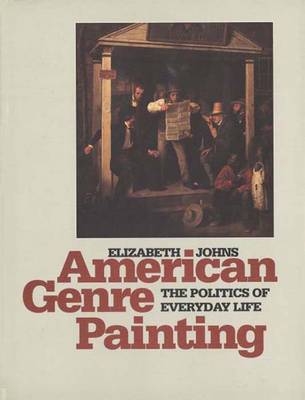
American Genre Painting
The Politics of Everyday Life
Seiten
1991
Yale University Press (Verlag)
978-0-300-05019-6 (ISBN)
Yale University Press (Verlag)
978-0-300-05019-6 (ISBN)
- Titel ist leider vergriffen;
keine Neuauflage - Artikel merken
American genre painting flourished in the 30 years before the Civil War and far from reflecting Jacksonian optimism and faith in the common man, Johns argues that these paintings had a social function that related in a more significant and less idealistic way to the cultural life of the times.
American genre painting flourished in the thirty years before the Civil War, a period of rapid social change that followed the election of President Andrew Jackson. It has long been assumed that these paintings - of farmers, western boatmen and trappers, blacks both slave and free, middle-class women, urban urchins, and other everyday folk - served as records of an innocent age, reflecting a Jacksonian optimism and faith in the common man. In this book Elizabeth Johns presents a different interpretation - arguing that genre paintings had a social function that related in a more significant and less idealistic way to the political and cultural life of the time. Analyzing works by William Sidney Mount, George Caleb Gingham, David Gilmore Blythe, Lilly Martin Spencer, and others, Johns reveals the humour and cynicism in the paintings and places them in the context of stories about the American character that appeared in sources ranging from almanacs and newpapers to joke books and political caricature. She compares the productions of American painters with those of earlier Dutch, English, and French genre artists, showing the distinctive interests of American viewers.
Arguing that art is socially constructed to meet the interests of its patrons and viewers, she demonstrates that the audience for American genre paintings consisted of New Yorkers with a highly developed ambition for political and social leadership, who enjoyed setting up citizens of the new democracy as targets of satire or condescension to satisfy their need for superiority. It was this network of social hierarchies and prejudices - and not a blissful celebration of American democracy - that informed the look and the richly ambiguous content of genre painting.
American genre painting flourished in the thirty years before the Civil War, a period of rapid social change that followed the election of President Andrew Jackson. It has long been assumed that these paintings - of farmers, western boatmen and trappers, blacks both slave and free, middle-class women, urban urchins, and other everyday folk - served as records of an innocent age, reflecting a Jacksonian optimism and faith in the common man. In this book Elizabeth Johns presents a different interpretation - arguing that genre paintings had a social function that related in a more significant and less idealistic way to the political and cultural life of the time. Analyzing works by William Sidney Mount, George Caleb Gingham, David Gilmore Blythe, Lilly Martin Spencer, and others, Johns reveals the humour and cynicism in the paintings and places them in the context of stories about the American character that appeared in sources ranging from almanacs and newpapers to joke books and political caricature. She compares the productions of American painters with those of earlier Dutch, English, and French genre artists, showing the distinctive interests of American viewers.
Arguing that art is socially constructed to meet the interests of its patrons and viewers, she demonstrates that the audience for American genre paintings consisted of New Yorkers with a highly developed ambition for political and social leadership, who enjoyed setting up citizens of the new democracy as targets of satire or condescension to satisfy their need for superiority. It was this network of social hierarchies and prejudices - and not a blissful celebration of American democracy - that informed the look and the richly ambiguous content of genre painting.
Ordering the body politic; an image of pure Yankeeism; from the outer verge of our civilization; standing outside the door; full of home love and simplicity; the washed, the unwashed and the unterrified; inspired from the higher classes.
| Erscheint lt. Verlag | 2.1.1992 |
|---|---|
| Zusatzinfo | 55 b&w and 25 colour illustrations, notes, index |
| Sprache | englisch |
| Maße | 215 x 279 mm |
| Gewicht | 1150 g |
| Themenwelt | Kunst / Musik / Theater ► Kunstgeschichte / Kunststile |
| Kunst / Musik / Theater ► Malerei / Plastik | |
| Sozialwissenschaften | |
| ISBN-10 | 0-300-05019-4 / 0300050194 |
| ISBN-13 | 978-0-300-05019-6 / 9780300050196 |
| Zustand | Neuware |
| Informationen gemäß Produktsicherheitsverordnung (GPSR) | |
| Haben Sie eine Frage zum Produkt? |
Mehr entdecken
aus dem Bereich



aus dem Bereich
kleine Kulturgeschichte einer brillanten Allianz
Buch | Softcover (2025)
Iudicium (Verlag)
CHF 33,90
Buch | Hardcover (2025)
Deutscher Kunstverlag
CHF 72,80


