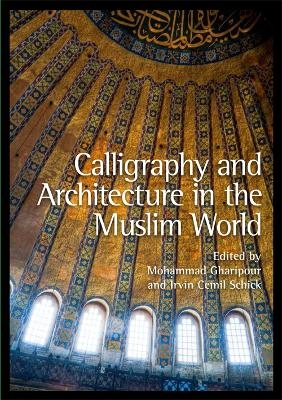
Calligraphy and Architecture in the Muslim World
Edinburgh University Press (Verlag)
978-0-7486-6922-6 (ISBN)
An ACSA Distinguished Professor, Mohammad Gharipour serves as a Professor and Director of the Architecture Program at the University of Maryland, USA. He has published 15 books and has received awards and grants from many organizations, including AIA, NEH, NIH, Fullbright, SAH, ARCC, and ACSA. He is the director and founder of the award-winning International Journal of Islamic Architecture (IJIA), the director and co-founder of the Epidemic Urbanism Initiative, and the president of the Society of Architectural Historians. İrvin Cemil Schick is Assistant Professor in Cultural Studies at Istanbul Şehir University. İrvin Cemil Schick holds a PhD from the Massachusetts Institute of Technology. He has taught at Harvard University and MIT, and is currently at İstanbul Şehir University.
A: Introduction; B: Sites; 1. Inscribing the Square: The Inscriptions on the Maidān-i Shāh in Iṣfahān, Sheila S. Blair; 2. Speaking Architecture: Poetry and Aesthetics in the Alhambra Palace, José Miguel Puerta Vílchez; 3. The Arabic Calligraphy on the Ceiling of the Twelfth-Century Cappella Palatina in Palermo, Sicily: Function and Identity, Hashim Al-Tawil; 4. Wall-Less Walls: The Calligraphy at the Hadži Sinanova Tekija in Sarajevo, Snježana Buzov; 5. Survey – The Qur’ānic Inscriptions Monument From Jām, Afghanistan, Ulrike-Christiane Lintz; C: Style vs. Content; 6. Multi-Sensorial Messages of the Divine and the Personal: Qur’an Inscriptions and Recitation in Sixteenth-Century Ottoman Mosques in Istanbul, Nina Ergin; 7. The Revival of Kūfī Script During the Reign of Sultan Abdülhamid II, İrvin Cemil Schick; 8. Calligraphy in Chinese Mosques: At the Intersection of Arabic and Chinese Calligraphy, Barbara Stöcker-Parnian; 9. Qur’anic Verses on Works of Architecture: The Ottoman Case, Murat Sülün; 10. Reading Qājār Epigraphs: Case Studies from Shīrāz and Iṣfahān, Bavand Behpoor; D: Patronage; 11. ‘The Pen Has Extolled Her Virtues’: Gender and Power within the Visual Legacy of Shajar al-Durr in Cairo, Caroline Olivia M. Wolf; 12. Sovereign Epigraphy in Location: Politics, Devotion and Legitimisation around the Quṭb Minār, Delhi, Johanna Blayac; 13. Archival Evidence on the Commissioning of Architectural Calligraphy in the Ottoman Empire, Talip Mert; 14. On the Renewal of the Calligraphy at the Mosque of the Prophet (al-Masjid al-Nabawī) under the Reign of Sultan Abdülmecid, Hilal Kazan; 15. Faṭimid Kūfī Epigraphy on the Gates of Cairo: Between Royal Patronage and Civil Utility, Bahia Shehab; E: Artists; 16. An Art Ambassador: The Inscriptions of ‘Alī Reżā ‘Abbāsī, Saeid Khaghani; 17. Mustafa Râkım Efendi’s Architectural Calligraphy, Süleyman Berk; 18. Yesârîzâde Mustafa İzzet Efendi and his Contributions to Ottoman Architectural Calligraphy, M. Uğur Derman; 19. The Visual Interpretation of Nasta‘līq in Architecture: Mīrzā Gholām Reżā’s Monumental Inscriptions for the Sepahsālār Mosque in Tehran, Sina Goudarzi; F: Regional; 20. Ma‘qilī Inscriptions on the Great Mosque of Mardin: Stylistic and Epigraphic Contexts, Tehnyat Majeed; 21. The Composition of Kūfī Inscriptions in Transitional and Early-Islamic Architecture of North Khurasan, Nasiba S. Baimatowa; 22. Space and Calligraphy in the Chinese Mosque, Sadiq Javer; 23. Medium and Message in the Monumental Epigraphy of Medieval Cairo, Bernard O’Kane; 24. Allegiance, Praise and Space: Monumental Inscriptions in Thirteenth-Century Anatolia as Architectural Guides, Patricia Blessing; 25. Symmetrical Compositions in Pre-Ottoman and Ottoman Architectural Inscriptions in Asia Minor, Abdülhamit Tüfekçioğlu; G: Modernity; 26. Writing Less, Saying More: Calligraphy and Modernisation in the Last Ottoman Century, Edhem Eldem; 27. The Absence and Emergence of Calligraphy in Najd: Calligraphy as a Modernist Component of Architecture in Riyadh, Sumayah Al-Solaiman; 28. Cairo to Canton and Back: Tradition in the Islamic Vernacular, Ann Shafer; H: Bibliography; I: List of Figures; J: About the Contributors.
| Erscheint lt. Verlag | 9.12.2013 |
|---|---|
| Zusatzinfo | 317 colour illustrations, 12 black and white tables |
| Verlagsort | Edinburgh |
| Sprache | englisch |
| Maße | 246 x 294 mm |
| Gewicht | 2634 g |
| Themenwelt | Sozialwissenschaften ► Soziologie ► Spezielle Soziologien |
| Technik ► Architektur | |
| ISBN-10 | 0-7486-6922-1 / 0748669221 |
| ISBN-13 | 978-0-7486-6922-6 / 9780748669226 |
| Zustand | Neuware |
| Informationen gemäß Produktsicherheitsverordnung (GPSR) | |
| Haben Sie eine Frage zum Produkt? |
aus dem Bereich