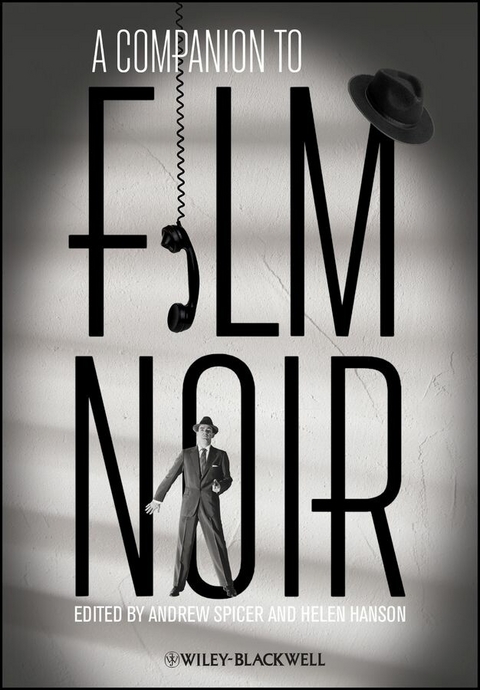
A Companion to Film Noir (eBook)
John Wiley & Sons (Verlag)
978-1-118-52375-9 (ISBN)
- Covers a wealth of new approaches to film noir and neo-noir that explore issues ranging from conceptualization to cross-media influences
- Features chapters exploring the wider 'noir mediascape' of television, graphic novels and radio
- Reflects the historical and geographical reach of film noir, from the 1920s to the present and in a variety of national cinemas
- Includes contributions from both established and emerging scholars
Andrew Spicer is Reader in Cultural History at the University of the West of England, UK. His principal research interests lie in film and cultural history, including genre, stardom and constructions of masculinity, British cinema, and the role of producers and screenwriters in film-making. He has published widely on all these topics, including Typical Men (2003) and Sydney Box (2006), and three volumes on film noir: Film Noir (2002), European Film Noir (2007), and the Historical Dictionary of Film Noir (2010). He is currently co-editing a volume about film producers, and writing a study of Sean Connery.
Helen Hanson is a Senior Lecturer in Film Studies at the University of Exeter, UK. Her research interests cover adaptation, gender and genre, film history, film style and technology, with a particular focus on the history of Hollywood. She has written articles and chapters on these topics, and has authored Hollywood Heroines: Film Noir and the Female Gothic Film (2007) and co-edited The Femme Fatale: Images, Histories, Contexts (2010). She also has a forthcoming book on the evolution of sound technology, sound craft and film style in Hollywood cinema from 1931-1950.
An authoritative companion that offers a wide-ranging thematic survey of this enduringly popular cultural form and includes scholarship from both established and emerging scholars as well as analysis of film noir's influence on other media including television and graphic novels. Covers a wealth of new approaches to film noir and neo-noir that explore issues ranging from conceptualization to cross-media influences Features chapters exploring the wider noir mediascape of television, graphic novels and radio Reflects the historical and geographical reach of film noir, from the 1920s to the present and in a variety of national cinemas Includes contributions from both established and emerging scholars
Andrew Spicer is Reader in Cultural History at the University of the West of England, UK. His principal research interests lie in film and cultural history, including genre, stardom and constructions of masculinity, British cinema, and the role of producers and screenwriters in film-making. He has published widely on all these topics, including Typical Men (2003) and Sydney Box (2006), and three volumes on film noir: Film Noir (2002), European Film Noir (2007), and the Historical Dictionary of Film Noir (2010). He is currently co-editing a volume about film producers, and writing a study of Sean Connery. Helen Hanson is a Senior Lecturer in Film Studies at the University of Exeter, UK. Her research interests cover adaptation, gender and genre, film history, film style and technology, with a particular focus on the history of Hollywood. She has written articles and chapters on these topics, and has authored Hollywood Heroines: Film Noir and the Female Gothic Film (2007) and co-edited The Femme Fatale: Images, Histories, Contexts (2010). She also has a forthcoming book on the evolution of sound technology, sound craft and film style in Hollywood cinema from 1931-1950.
List of Illustrations viii
Notes on Contributors x
Acknowledgments xviii
Foreword xix
James Naremore
Introduction: The Problem of Film Noir 1
Andrew Spicer
Part I Conceptualizing Film Noir 15
1 The Strange Case of Film Noir 17
Robert Porfirio
2 Genre, Hybridity, Heterogeneity: or, the
Noir-SF-Vampire-Zombie-Splatter-Romance-Comedy-Action-Thriller
Problem 33
Mark Bould
3 A Wet Emptiness: The Phenomenology of Film Noir 50
Henrik Gustafsson
4 Cinephilia and Film Noir 67
Corey K. Creekmur
Part II Hidden, Hybrid, and Transmedia Histories and
Influences 77
5 Precursors to Film Noir 79
Wheeler Winston Dixon
6 Crisscrossed? Film Noir and the Politics of Mobility and
Exchange 94
Alastair Phillips
7 Film Noir and Horror 111
Peter Hutchings
8 Borderings: The Film Noir Semi-Documentary 125
R. Barton Palmer
9 Crime Fiction and Film Noir 142
William Marling
10 Film Noir, American Painting and Photography: Questions of
Influence 158
Tom Ryall
Part III Social, Industrial, and Commercial Contexts
175
11 The Politics of Film Noir 177
Brian Neve
12 The Black Typewriter: Who Wrote Film Noir? 193
David Wilt
13 Film Noir and Studio Production Practices 211
Geoff Mayer
14 Film Noir and Post-Studio Production Practices 229
John Berra
15 Selling Noir: Stars, Gender, and Genre in Film Noir Posters
and Publicity 245
Mary Beth Haralovich
Part IV The Fabric of Film Noir: Style and Performance
265
16 Out of the Shadows: Noir Lighting and Hollywood
Cinematography 267
Patrick Keating
17 The Ambience of Film Noir: Soundscapes, Design, and Mood
284
Helen Hanson
18 In a Lonely Tone: Music in Film Noir 302
David Butler
19 Acting and Performance in Film Noir 318
Donna Peberdy
Part V Identities and Film Noir 335
20 Film Noir and Subjectivity 337
Christophe Gelly
21 Women in Film Noir 353
Yvonne Tasker
22 "The Corpse on Reprieve": Film Noir's Cautionary Tales of
"Tough Guy" Masculinity 369
Gaylyn Studlar
23 Ethnicity and Race in American Film Noir 387
Dan Flory
24 The Climb and the Chase: Film Noir and the Urban Scene
- Representations of the City in Three Classic Noirs
405
Murray Pomerance
Part VI Noir in Other Forms 421
25 Radio Noir in the USA 423
Jesse Schlotterbeck
26 Television Noir 440
Steven Sanders
27 "It Rhymes with Lust": The Twisted History of Noir Comics
458
James Lyons
Part VII New Geographies of Film Noir 477
28 Film Noir in Asia: Historicizing South Korean Crime Thrillers
479
Nikki J.Y. Lee and Julian Stringer
29 Bombay Noir 496
Lalitha Gopalan
Index 512
"This is recommended for film studies and for humanities collections." (Reference Reviews, 1 September 2015)
"The twenty-eight essays in this collection represent a landmark in noir criticism. Written by some of the most accomplished veterans in the field, as well as many new and promising voices, these essays are both deeply engaged with previously contested critical territory and agressively turned toward undiscovered and untilled terrain ... This is a collection that will be studied, cited, and, as with all of the most influential film noir criticism, contested for many years to come." (Wide Angle, 1 March 2014)
"A rich volume exploring the depth, breadth and scope of
scholarship on film noir from a diverse array of perspectives. A
valuable contribution to the evolving landscape of noir
criticism."
Sheri Chinen Biesen, Rowan University
"Wide-ranging yet historically specific, global in scope
but sensitive to local contexts of production, reception, and
style, Spicer and Hanson's collection is a superb guide to an
elusive category--the film noir--that continues to
fascinate students, scholars, and cinephiles alike."
Justus Nieland, Michigan State University
| Erscheint lt. Verlag | 24.6.2013 |
|---|---|
| Sprache | englisch |
| Themenwelt | Kunst / Musik / Theater ► Film / TV |
| Sozialwissenschaften ► Kommunikation / Medien ► Medienwissenschaft | |
| Schlagworte | Cinema reference, cinema research, cinema scholarship, neo-noir, popular culture, film noir scholarship, national cinema, noir beyond cinema, noir in media, topics in cinema, topics in film, noir in television, noir in graphic novels, noir in radio, film genre, genre studies, post World War II film, 1950's film, international film noir, film noir history, film history, cinema history • Cultural Studies • Filmforschung • Film noir • Film Studies • Filmtheorie • Film theory • Geschichte des Filmtheaters • History of Cinema • Kulturwissenschaften |
| ISBN-10 | 1-118-52375-X / 111852375X |
| ISBN-13 | 978-1-118-52375-9 / 9781118523759 |
| Informationen gemäß Produktsicherheitsverordnung (GPSR) | |
| Haben Sie eine Frage zum Produkt? |
 PDF (Adobe DRM)
Kopierschutz: Adobe-DRM
Adobe-DRM ist ein Kopierschutz, der das eBook vor Mißbrauch schützen soll. Dabei wird das eBook bereits beim Download auf Ihre persönliche Adobe-ID autorisiert. Lesen können Sie das eBook dann nur auf den Geräten, welche ebenfalls auf Ihre Adobe-ID registriert sind.
Details zum Adobe-DRM
Dateiformat: PDF (Portable Document Format)
Mit einem festen Seitenlayout eignet sich die PDF besonders für Fachbücher mit Spalten, Tabellen und Abbildungen. Eine PDF kann auf fast allen Geräten angezeigt werden, ist aber für kleine Displays (Smartphone, eReader) nur eingeschränkt geeignet.
Systemvoraussetzungen:
PC/Mac: Mit einem PC oder Mac können Sie dieses eBook lesen. Sie benötigen eine
eReader: Dieses eBook kann mit (fast) allen eBook-Readern gelesen werden. Mit dem amazon-Kindle ist es aber nicht kompatibel.
Smartphone/Tablet: Egal ob Apple oder Android, dieses eBook können Sie lesen. Sie benötigen eine
Geräteliste und zusätzliche Hinweise
Buying eBooks from abroad
For tax law reasons we can sell eBooks just within Germany and Switzerland. Regrettably we cannot fulfill eBook-orders from other countries.
aus dem Bereich