Peter E. Gordon is the Amabel B. James Professor of History at Harvard University. His books include Continental Divide and Rosenzweig and Heidegger. John P. McCormick is professor of political science at the University of Chicago. His books include Machiavellian Democracy and Weber, Habermas, and Transformations of the European State.
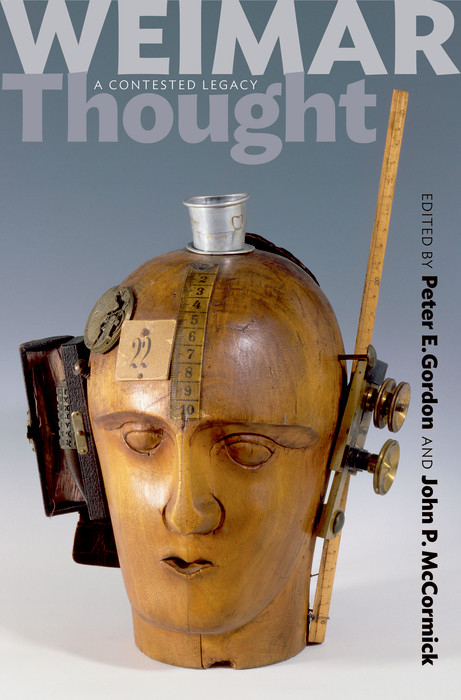
A comprehensive look at the intellectual and cultural innovations of the Weimar periodDuring its short lifespan, the Weimar Republic (1918-33) witnessed an unprecedented flowering of achievements in many areas, including psychology, political theory, physics, philosophy, literary and cultural criticism, and the arts. Leading intellectuals, scholars, and critics-such as Hannah Arendt, Walter Benjamin, Ernst Bloch, Bertolt Brecht, and Martin Heidegger-emerged during this time to become the foremost thinkers of the twentieth century. Even today, the Weimar era remains a vital resource for new intellectual movements. In this incomparable collection, Weimar Thought presents both the specialist and the general reader a comprehensive guide and unified portrait of the most important innovators, themes, and trends of this fascinating period.The book is divided into four thematic sections: law, politics, and society; philosophy, theology, and science; aesthetics, literature, and film; and general cultural and social themes of the Weimar period. The volume brings together established and emerging scholars from a remarkable array of fields, and each individual essay serves as an overview for a particular discipline while offering distinctive critical engagement with relevant problems and debates.Whether used as an introductory companion or advanced scholarly resource, Weimar Thought provides insight into the rich developments behind the intellectual foundations of modernity.
Peter E. Gordon is the Amabel B. James Professor of History at Harvard University. His books include Continental Divide and Rosenzweig and Heidegger. John P. McCormick is professor of political science at the University of Chicago. His books include Machiavellian Democracy and Weber, Habermas, and Transformations of the European State.
| Erscheint lt. Verlag | 30.6.2013 |
|---|---|
| Zusatzinfo | 12 halftones. |
| Verlagsort | Princeton |
| Sprache | englisch |
| Themenwelt | Geschichte ► Allgemeine Geschichte ► Neuzeit (bis 1918) |
| Geisteswissenschaften ► Geschichte ► Regional- / Ländergeschichte | |
| Geisteswissenschaften ► Philosophie ► Allgemeines / Lexika | |
| Geisteswissenschaften ► Philosophie ► Philosophie der Neuzeit | |
| Sozialwissenschaften ► Politik / Verwaltung ► Politische Theorie | |
| Schlagworte | Aby Warburg • Adolf Hitler • Adolf von Harnack • Aesthetics • Alfred Dblin • Allegory • anti-liberalism • architectural modernism • Arthur Schopenhauer • Article 48 (Weimar Constitution) • Bauhaus • Berlin School • Bertolt Brecht • Bla Balzs • Bohr • Bourgeoisie • Buber • Cambridge University Press • Carl Schmitt • Cohen • communism • Communist Party of Germany • comparative mythology • Consciousness • Cosmopolitanism • Criticism • critique • Cultural analysis • Cultural Criticism • Cultural History • Dada • Democracy • Dilthey • Disenchantment • Driesch • eastern wisdom • Edmund Husserl • Einstein • Emil Brunner • Ernst Bertram • Ernst Bloch • Ernst Cassirer • Ernst Kantorowicz • Ernst Troeltsch • Explanation • feminine subjectivity • film theorists • Film theory • formalist art history • Frankfurt School • Franz Rosenzweig • Friedrich Gogarten • George Circle • George-Kreis • Georgr Lukcs • Georg Simmel • German Democratic Party • German historical thinking • German Idealism • German Left • German Literature • German Romanticism • Gershom Scholem • Gestalt • Gleichschaltung • Great War • Hannah Arendt • Hans Kelsen • Hans Reichenbach • Heinrich Mann • Heinrich Rickert • Heisenberg • Helene Stcker • Hermann Graf Keyserling • Hermann Heller • Historicism • Holism • holistic thought • idealism • Ideology • Intellectual history • intellectual movement • interwar German architecture • Jews • John Heartfield • Jurisprudence • KANTIANISM • Karl Barth • Karl Mannheim • Karl Wolfskehl • Kulturphilosophie • Kurt Tucholsky • Law • Lecture • legal theory • Leni Riefenstahl • Liberalism • Literature • Lou Andreas-Salom • Marianne Weber • Martin Heidegger • Marxism • Max Horkheimer • Max Weber • modernism • Modernity • narrative • Nazi Germany • nazi ideology • Nazi Party • Nazism • Neo-Kantianism • neo-Kantians • new objectivity • Nietzsche • Nihilism • Orientalism • Oswald Spengler • Pacifism • pessimism • phenomenon • Philology • Philosopher • Philosophy • Philosophy of Culture • Philosophy of History • photography • Physiognomy • Planck • Plessner • poets • Political History • Political participation • Political Philosophy • Political Theology • Politics • Positivism • Post-War • Princeton University Press • professional psychology • Psychoanalysis • psychological practice • Public sphere • Religion • Religious Studies • rhetoric • Richard Thoma • Rosenzweig • Rudolf Arnheim • Schrdinger • Schule der Weisheit • Science • Siegfried Kracauer • Social Democracy • Social Democrats • Social Movements • Social Status • Society • Sociology • Sozialstatt • Stefan George • Technology • Teleology • temporality • Theodor W. Adorno • Theology • theory • Third Reich • Thomas Mann • Thought • trained intuition • von Uexkll • Walter Benjamin • Warburg Library • Weimar Constitution • Weimar culture • Weimar Republic • Weimar science • Weimar theology • Weimar thought • Welfare State • Wilhelm Dilthey • Wissenschaft • Women • World Culture • World View • Writing |
| ISBN-10 | 1-4008-4678-1 / 1400846781 |
| ISBN-13 | 978-1-4008-4678-8 / 9781400846788 |
| Informationen gemäß Produktsicherheitsverordnung (GPSR) | |
| Haben Sie eine Frage zum Produkt? |
 PDF (Wasserzeichen)
Größe: 2,8 MB
DRM: Digitales Wasserzeichen
Dieses eBook enthält ein digitales Wasserzeichen und ist damit für Sie personalisiert. Bei einer missbräuchlichen Weitergabe des eBooks an Dritte ist eine Rückverfolgung an die Quelle möglich.
Dateiformat: PDF (Portable Document Format)
Mit einem festen Seitenlayout eignet sich die PDF besonders für Fachbücher mit Spalten, Tabellen und Abbildungen. Eine PDF kann auf fast allen Geräten angezeigt werden, ist aber für kleine Displays (Smartphone, eReader) nur eingeschränkt geeignet.
Systemvoraussetzungen:
PC/Mac: Mit einem PC oder Mac können Sie dieses eBook lesen. Sie benötigen dafür einen PDF-Viewer - z.B. den Adobe Reader oder Adobe Digital Editions.
eReader: Dieses eBook kann mit (fast) allen eBook-Readern gelesen werden. Mit dem amazon-Kindle ist es aber nicht kompatibel.
Smartphone/Tablet: Egal ob Apple oder Android, dieses eBook können Sie lesen. Sie benötigen dafür einen PDF-Viewer - z.B. die kostenlose Adobe Digital Editions-App.
Buying eBooks from abroad
For tax law reasons we can sell eBooks just within Germany and Switzerland. Regrettably we cannot fulfill eBook-orders from other countries.
 EPUB (Adobe DRM)
Kopierschutz: Adobe-DRM
Adobe-DRM ist ein Kopierschutz, der das eBook vor Mißbrauch schützen soll. Dabei wird das eBook bereits beim Download auf Ihre persönliche Adobe-ID autorisiert. Lesen können Sie das eBook dann nur auf den Geräten, welche ebenfalls auf Ihre Adobe-ID registriert sind.
Details zum Adobe-DRM
Dateiformat: EPUB (Electronic Publication)
EPUB ist ein offener Standard für eBooks und eignet sich besonders zur Darstellung von Belletristik und Sachbüchern. Der Fließtext wird dynamisch an die Display- und Schriftgröße angepasst. Auch für mobile Lesegeräte ist EPUB daher gut geeignet.
Systemvoraussetzungen:
PC/Mac: Mit einem PC oder Mac können Sie dieses eBook lesen. Sie benötigen eine
eReader: Dieses eBook kann mit (fast) allen eBook-Readern gelesen werden. Mit dem amazon-Kindle ist es aber nicht kompatibel.
Smartphone/Tablet: Egal ob Apple oder Android, dieses eBook können Sie lesen. Sie benötigen eine
Geräteliste und zusätzliche Hinweise
Buying eBooks from abroad
For tax law reasons we can sell eBooks just within Germany and Switzerland. Regrettably we cannot fulfill eBook-orders from other countries.
aus dem Bereich