


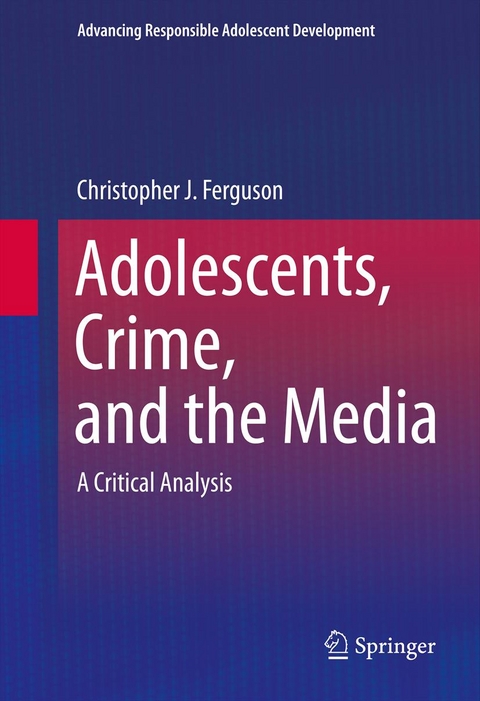
Adolescents, Crime, and the Media (eBook)
XV, 185 Seiten
Springer-Verlag
978-1-4614-6741-0 (ISBN)
A campus shooting. A gang assault. A school bus ambush. With each successive event, fingers are pointed at the usual suspects: violent films, bloody video games, explicit web sites. But to what extent can-or should-the media be implicated in youth crime? And are today's sophisticated young people really that susceptible to their influence?
Adolescents, Crime, and the Media critically examines perceptions of these phenomena through the lens of the ongoing relationship between generations of adults and youth. A wealth of research findings transcends the standard nature/nurture debate, analyzing media effects on young people's behavior, brain development in adolescence, ways adults can be misled about youth's participation in criminal acts, and how science can be manipulated by prevailing attitudes toward youth. The author strikes a necessary balance between the viewpoints of media providers and those seeking to restrict media or young people's access to them. And the book brings scientific and intellectual rigor to culturally and politically charged issues as it covers:
- Violence in the media.
- Media portrayals of crime and youth.
- Research on violent television programs, video games, and other media as causes of crime.
- Effects of pornography on behavior.
- Public policy, censorship, and First Amendment issues.
Adolescents, Crime, and the Media is an essential resource for researchers, graduate students, professionals, and clinicians across such interrelated disciplines as developmental psychology, sociology, educational policy, criminology/criminal justice, child and school psychology, and media law.
Christopher J. Ferguson, Ph.D., is an associate professor of clinical and forensic psychology at Texas A&M International University. He received his doctorate in clinical psychology from the University of Central Florida and is an internationally recognized researcher of video game and other media effects, his work having been published in leading journals in psychology, criminal justice, pediatrics, and psychiatry. He recently served as guest editor for the American Psychological Association journal Review of General Psychology's special issue on video game effects. He lives in Laredo, Texas with his wife and young son.
Christopher J. Ferguson, Ph.D., is an associate professor of clinical and forensic psychology at Texas A&M International University. He received his doctorate in clinical psychology from the University of Central Florida and is an internationally recognized researcher of video game and other media effects, his work having been published in leading journals in psychology, criminal justice, pediatrics, and psychiatry. He recently served as guest editor for the American Psychological Association journal Review of General Psychology’s special issue on video game effects. He lives in Laredo, Texas with his wife and young son.
Adolescents, Crime, and the Media 4
About the Author 8
Contents 10
List of Figures 14
List of Tables 16
Part I:Media Depictions of Crime 17
Chapter 1: Introduction: Crime and the Media 18
1.1 The Politics of Science: The Politics of Violence 20
1.2 The Causes of Youth Violence 21
1.3 The Misperception of Crime Rates 23
1.4 What Is Adolescence? 26
1.5 The Chapters Ahead 28
References 29
Chapter 2: A History of Violence in the Media 32
2.1 Violence in Premodern Media: The Greeks and Romans 33
2.2 Medieval Literature and the Printing Press 34
2.3 The Advent of Motion Pictures 37
2.4 The Rise of Television 39
2.5 The Age of Video Games 41
2.6 Conclusion 43
References 43
Chapter 3: Media Portrayals of Crime and Youth 46
3.1 Violence in Real Life 47
3.2 Violent Crime in the Media 50
3.3 How Much Violence Is There in Fictional Media? 50
3.4 Types of Media Influence 52
3.5 The Cultivation Hypothesis 54
3.6 The Presentation of Minorities in Crime Media 58
3.7 Adolescents in the Media 60
3.8 Concluding Statements 62
References 62
Chapter 4: Adolescents in the News Media 65
4.1 How Does the News Media Portray Crime? 67
4.1.1 Missing White Girl Syndrome 68
4.2 How Accurately Does the News Media Report on Crime? 70
4.3 The Follow-Through Failure Effect 72
4.4 Trial by Media 73
4.5 What Effects Do the News Media Have on Viewers? 75
4.6 Race and the News Media 77
4.7 Portrayals of Adolescents in News Media 77
4.8 Concluding Statements 79
References 79
Chapter 5: The CSI Effect 82
5.1 The Influence of Crime Shows on Career Choice 83
5.2 The Influence of Crime Shows on Juror Expectations 85
5.3 The Influence of Crime Shows on the Creation of Juvenile Superpredators 89
References 91
Part II:Research on Media as a Cause of Crime 94
Chapter 6: Television Violence 95
6.1 A History of Television and Violence 96
6.2 Empirical Research on Television Violence 98
6.3 Critical Mass in the 1970s? 101
6.4 Uncertainty Develops in the 1980s 103
6.5 The Turn of the Millennium Meta-Wars 104
6.6 Television Violence, Smoking, and Lung Cancer 108
6.7 Famous Television Violence Cases in the Courts 110
6.8 Conclusions 111
References 111
Chapter 7: Video Games 116
7.1 Measuring Aggression in Video Game Research 117
7.2 Measuring Video Game Violence 119
7.3 The ESRB 120
7.4 Comparing Violent and Nonviolent Games 121
7.5 Studies of Violent Video Game Effects 122
7.6 Do Violent Video Games Have Positive Effects? 126
7.7 Meta-analyses of Violent Video Game Effects 128
7.8 Why Do the Kids Play: Engagement and Addiction 130
7.9 Important Legal Cases Involving Video Games 131
7.10 Concluding Statements 133
References 133
Chapter 8: Other Media 138
8.1 Movies 138
8.2 Cartoons 141
8.3 Comic Books 143
8.4 Music 145
8.5 Religious Writings 147
8.6 Conclusions 148
References 149
Chapter 9: Pornography 151
9.1 A Brief History of Pornography in the Late Twentieth Century 155
9.2 Research on the Effects of Pornography on Violence Crimes 158
9.3 Porn Consumption and Sexual Assault Victimization 162
9.4 To What Extent Do Adolescents Consume Pornography? 165
9.5 Conclusions 165
References 166
Chapter 10: Public Policy, Censorship, and First Amendment Issues 169
10.1 Media Regulation in the USA 170
10.1.1 The Parents Music Resource Center 172
10.2 Violent Video Game Legislation 172
10.3 The Regulation of Sexual Content 176
10.4 Regulation of Media in Other Liberal Democracies 177
10.5 What Free Speech Rights to Adolescents Have? 178
10.6 Concluding Statements 179
References 180
Index 181
| Erscheint lt. Verlag | 29.3.2013 |
|---|---|
| Reihe/Serie | Advancing Responsible Adolescent Development | Advancing Responsible Adolescent Development |
| Zusatzinfo | XV, 175 p. 192 illus. |
| Verlagsort | New York |
| Sprache | englisch |
| Themenwelt | Geisteswissenschaften ► Psychologie ► Entwicklungspsychologie |
| Recht / Steuern ► EU / Internationales Recht | |
| Recht / Steuern ► Privatrecht / Bürgerliches Recht ► Medienrecht | |
| Recht / Steuern ► Strafrecht ► Kriminologie | |
| Sozialwissenschaften ► Pädagogik | |
| Sozialwissenschaften ► Politik / Verwaltung | |
| Sozialwissenschaften ► Soziologie | |
| Schlagworte | Adolescents and crime • Adolescents and media • Adolescents and movie violence • Adolescents and television violence • First amendment, public policy, and censorship • Juvenile Delinquency • Juvephobia • Media and crime • Pornography and youth crime • the • The “CSI Effect” • Video games and youth violence • Youth homicide • youth violence |
| ISBN-10 | 1-4614-6741-1 / 1461467411 |
| ISBN-13 | 978-1-4614-6741-0 / 9781461467410 |
| Informationen gemäß Produktsicherheitsverordnung (GPSR) | |
| Haben Sie eine Frage zum Produkt? |
 PDF (Wasserzeichen)
DRM: Digitales Wasserzeichen
Dieses eBook enthält ein digitales Wasserzeichen und ist damit für Sie personalisiert. Bei einer missbräuchlichen Weitergabe des eBooks an Dritte ist eine Rückverfolgung an die Quelle möglich.
Dateiformat: PDF (Portable Document Format)
Mit einem festen Seitenlayout eignet sich die PDF besonders für Fachbücher mit Spalten, Tabellen und Abbildungen. Eine PDF kann auf fast allen Geräten angezeigt werden, ist aber für kleine Displays (Smartphone, eReader) nur eingeschränkt geeignet.
Systemvoraussetzungen:
PC/Mac: Mit einem PC oder Mac können Sie dieses eBook lesen. Sie benötigen dafür einen PDF-Viewer - z.B. den Adobe Reader oder Adobe Digital Editions.
eReader: Dieses eBook kann mit (fast) allen eBook-Readern gelesen werden. Mit dem amazon-Kindle ist es aber nicht kompatibel.
Smartphone/Tablet: Egal ob Apple oder Android, dieses eBook können Sie lesen. Sie benötigen dafür einen PDF-Viewer - z.B. die kostenlose Adobe Digital Editions-App.
Buying eBooks from abroad
For tax law reasons we can sell eBooks just within Germany and Switzerland. Regrettably we cannot fulfill eBook-orders from other countries.
aus dem Bereich


