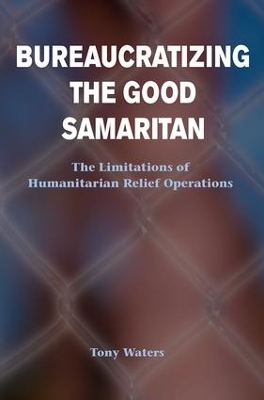
Bureaucratizing The Good Samaritan
Westview Press Inc (Verlag)
9780813367903 (ISBN)
Bureaucratizing the Good Samaritan is about the organization of refugee relief programs. It describes the practical, political, and moral assumptions of the ?international refugee relief regime.? Tony Waters emphasizes that the agencies delivering humanitarian relief are embedded in rationalized bureaucracies whose values are determined by their institutional frameworks. The demand for ?victims? is observed in the close relation between the interests of the popular press and the decisions made by bureaucracies.This presents a paradox in all humanitarian relief organizations, but perhaps no more so than in the Rwanda Relief Operations (1994-96) which ended in the largest mass forced repatriation since the end of World War II. This crisis is analyzed with an assumption that there is a basic contradiction between the demands of the bureaucratized organization and the need of relief agencies to generate the emotional publicity to sustain the interest of northern donors. The book concludes by noting that if refugee relief programs are to become more effective, the connection between the press's emotional demands for ?victims? and the bureaucratic organizations's decision processes need to be identified and reassessed.
Tony Waters teaches sociology at California State University, Chico. He is the author of Crime and Immigrant Youth (1999) and articles about refugees, migration, and development. He worked with refugee relief programs in Thailand and Tanzania for six years.
The International Refugee Relief Regime , Introduction: The Rwanda Refugee Relief Operation and the Bureaucratized Good Samaritan— A Personal Context , Refugees, International Politics, and the Good Samaritan , The Strength of Bureaucracy , Defining Sides: The Social Structure of Right and Wrong in International Refugee Relief , Making Comparisions Between and Within Emergencies , Explaining Rwandan Genocide, War, and Relief , October 1993-October 1994: The Relief Effort Winds Up , October 1994-December 1996: Normalized Crisis— The Operation Winds Down , Bureaucratizing the Good Samaritan , The Limitations of Contingency Planning , Bureaucratizing the Good Samaritan: Water Crises , Bureaucratizing the Good Samaritan: Defining Genocide , Why Only the Rwandans? Relief Operations and Politics , From World War II to Rwanda and Kosovo , A Broader Context: Overcoming the Limitations of the Bureaucratized Good Samaritan , Background Essays , The Demography of a Camp for Rwandans , Camp Management 1994-95 , The Chabalisa 2 Market Development Project , HIV and AIDS in the Ngara Refugee Camps , How Many Refugees Are There in Ngara? , Wishing for Repatriation, Late 1995 , A Bishop in Exile—The Anglican Church in the Ngara Camps , Some Practical Notes on a Names Taboo in Western Tanzania
| Erscheint lt. Verlag | 26.1.2001 |
|---|---|
| Sprache | englisch |
| Maße | 152 x 229 mm |
| Gewicht | 453 g |
| Themenwelt | Sozialwissenschaften ► Pädagogik ► Sozialpädagogik |
| Sozialwissenschaften ► Politik / Verwaltung | |
| Sozialwissenschaften ► Soziologie | |
| Wirtschaft ► Betriebswirtschaft / Management ► Planung / Organisation | |
| ISBN-13 | 9780813367903 / 9780813367903 |
| Zustand | Neuware |
| Informationen gemäß Produktsicherheitsverordnung (GPSR) | |
| Haben Sie eine Frage zum Produkt? |
aus dem Bereich