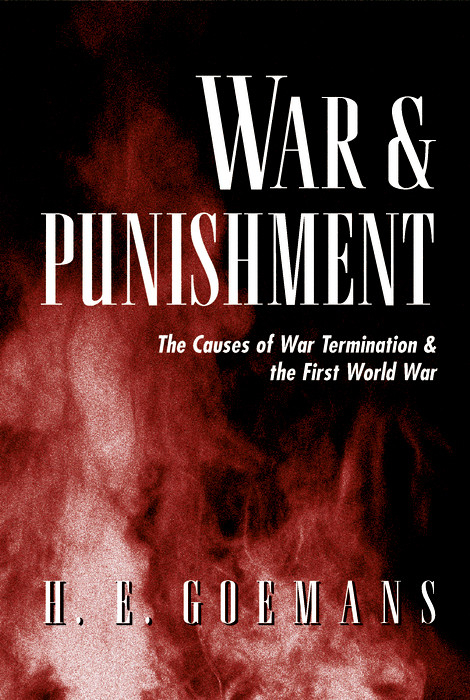
War and Punishment (eBook)
Princeton University Press (Verlag)
978-1-4008-2395-6 (ISBN)
H. E. Goemans is Assistant Professor of Political Science at Duke University.
What makes wars drag on and why do they end when they do? Here H. E. Goemans brings theoretical rigor and empirical depth to a long-standing question of securities studies. He explores how various government leaders assess the cost of war in terms of domestic politics and their own postwar fates. Goemans first develops the argument that two sides will wage war until both gain sufficient knowledge of the other's strengths and weaknesses so as to agree on the probable outcome of continued war. Yet the incentives that motivate leaders to then terminate war, Goemans maintains, can vary greatly depending on the type of government they represent. The author looks at democracies, dictatorships, and mixed regimes and compares the willingness among leaders to back out of wars or risk the costs of continued warfare. Democracies, according to Goemans, will prefer to withdraw quickly from a war they are not winning in order to appease the populace. Autocracies will do likewise so as not to be overthrown by their internal enemies. Mixed regimes, which are made up of several competing groups and which exclude a substantial proportion of the people from access to power, will likely see little risk in continuing a losing war in the hope of turning the tide. Goemans explores the conditions and the reasoning behind this "e;gamble for resurrection"e; as well as other strategies, using rational choice theory, statistical analysis, and detailed case studies of Germany, Britain, France, and Russia during World War I. In so doing, he offers a new perspective of the Great War that integrates domestic politics, international politics, and battlefield developments.
H. E. Goemans is Assistant Professor of Political Science at Duke University.
| Erscheint lt. Verlag | 6.1.2012 |
|---|---|
| Reihe/Serie | Princeton Studies in International History and Politics | Princeton Studies in International History and Politics |
| Zusatzinfo | 2 line illus., 20 tables |
| Verlagsort | Princeton |
| Sprache | englisch |
| Themenwelt | Sachbuch/Ratgeber ► Geschichte / Politik ► Allgemeines / Lexika |
| Geschichte ► Allgemeine Geschichte ► Neuzeit (bis 1918) | |
| Geschichte ► Allgemeine Geschichte ► 1918 bis 1945 | |
| Geisteswissenschaften ► Geschichte ► Regional- / Ländergeschichte | |
| Geschichte ► Teilgebiete der Geschichte ► Militärgeschichte | |
| Sozialwissenschaften ► Politik / Verwaltung ► Politische Theorie | |
| Schlagworte | absolute war • Allies of World War I • Allies of World War II • Alsace-Lorraine • Annexation • anti-war movement • armistice • Austria-Hungary • Battle of Passchendaele • belgium in world war II • belligerent • Blockade • Blockade of Germany (1939–45) • bolsheviks • brusilov offensive • Capture of Baghdad (1534) • Central Powers • Combatant • consent of the governed • Constitutional Democratic Party • Crimean War • decisive victory • declaration of war • defection • Demobilization • Democratic Peace Theory • Demoralization (warfare) • deterrence theory • Dictatorship • Erich Ludendorff • Ferdinand Foch • Fourteen Points • Franco-Prussian War • French army • Fritz Fischer • Gambling for resurrection • German resistance to Nazism • Germany's Aims in the First World War • Gustav Stresemann • Hindenburg Line • imperialism • International crisis • International Relations • Italian Front (World War I) • John Mearsheimer • Joseph Joffre • Karl Kautsky • Kerensky Offensive • Kommandogewalt • Left Bank of the Rhine • Lithuania • Macedonian front • Matthias Erzberger • Max Bauer • Max Hoffmann • Military Dictatorship • military history • Napoleon III • National policy • Nivelle Offensive • on war • Ottoman Empire • Pacifism • Peace treaty • Plan XVII • police state • Polish Border Strip • political revolution • Politique • Probability • prussia • regime change • Reichstag Peace Resolution • result • Revolution of 1905 • Road to Canossa • Russian Revolution • Schlieffen Plan • Secret treaty • security dilemma • Separate peace • siegfried line • Superiority (short story) • Sykes–Picot Agreement • Tax • That Justice Be Done • Treaty of Alliance (1778) • Treaty of Brest-Litovsk • Treaty of Prague (1973) • Treaty of San Stefano • u-boat • Unrestricted submarine warfare • war • war cabinet • warfare • war reparations • War Termination • War-weariness • World War I • Zimmermann Telegram |
| ISBN-10 | 1-4008-2395-1 / 1400823951 |
| ISBN-13 | 978-1-4008-2395-6 / 9781400823956 |
| Informationen gemäß Produktsicherheitsverordnung (GPSR) | |
| Haben Sie eine Frage zum Produkt? |
 PDF (Wasserzeichen)
Größe: 2,0 MB
DRM: Digitales Wasserzeichen
Dieses eBook enthält ein digitales Wasserzeichen und ist damit für Sie personalisiert. Bei einer missbräuchlichen Weitergabe des eBooks an Dritte ist eine Rückverfolgung an die Quelle möglich.
Dateiformat: PDF (Portable Document Format)
Mit einem festen Seitenlayout eignet sich die PDF besonders für Fachbücher mit Spalten, Tabellen und Abbildungen. Eine PDF kann auf fast allen Geräten angezeigt werden, ist aber für kleine Displays (Smartphone, eReader) nur eingeschränkt geeignet.
Systemvoraussetzungen:
PC/Mac: Mit einem PC oder Mac können Sie dieses eBook lesen. Sie benötigen dafür einen PDF-Viewer - z.B. den Adobe Reader oder Adobe Digital Editions.
eReader: Dieses eBook kann mit (fast) allen eBook-Readern gelesen werden. Mit dem amazon-Kindle ist es aber nicht kompatibel.
Smartphone/Tablet: Egal ob Apple oder Android, dieses eBook können Sie lesen. Sie benötigen dafür einen PDF-Viewer - z.B. die kostenlose Adobe Digital Editions-App.
Buying eBooks from abroad
For tax law reasons we can sell eBooks just within Germany and Switzerland. Regrettably we cannot fulfill eBook-orders from other countries.
PDF (Adobe DRM)Kopierschutz: Adobe-DRM
Adobe-DRM ist ein Kopierschutz, der das eBook vor Mißbrauch schützen soll. Dabei wird das eBook bereits beim Download auf Ihre persönliche Adobe-ID autorisiert. Lesen können Sie das eBook dann nur auf den Geräten, welche ebenfalls auf Ihre Adobe-ID registriert sind.
Details zum Adobe-DRM
Dateiformat: PDF (Portable Document Format)
Mit einem festen Seitenlayout eignet sich die PDF besonders für Fachbücher mit Spalten, Tabellen und Abbildungen. Eine PDF kann auf fast allen Geräten angezeigt werden, ist aber für kleine Displays (Smartphone, eReader) nur eingeschränkt geeignet.
Systemvoraussetzungen:
PC/Mac: Mit einem PC oder Mac können Sie dieses eBook lesen. Sie benötigen eine
eReader: Dieses eBook kann mit (fast) allen eBook-Readern gelesen werden. Mit dem amazon-Kindle ist es aber nicht kompatibel.
Smartphone/Tablet: Egal ob Apple oder Android, dieses eBook können Sie lesen. Sie benötigen eine
Geräteliste und zusätzliche Hinweise
Buying eBooks from abroad
For tax law reasons we can sell eBooks just within Germany and Switzerland. Regrettably we cannot fulfill eBook-orders from other countries.
aus dem Bereich