


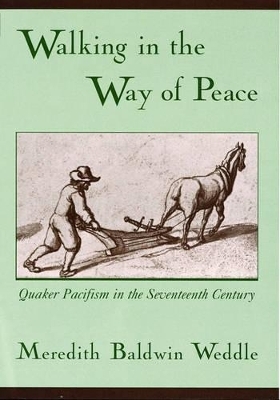
Walking in the Way of Peace
Quaker Pacifism in the Seventeenth Century
Seiten
2001
Oxford University Press Inc (Verlag)
978-0-19-513138-3 (ISBN)
Oxford University Press Inc (Verlag)
978-0-19-513138-3 (ISBN)
This work investigates the historical context, meaning, and expression of early Quaker pacifism in England and its colonies. Weddle focuses primarily on one historical moment - King Philip's War, which confronted the New England Quakers with the practical need to define the parameters of their peace testimony.
This book investigates the historical context, meaning, and expression of early Quaker pacifism in England and its colonies. Weddle focuses primarily on one historical moment - King Philip's War, which confronted the New England Quakers with the practical need to define the parameters of their peace testimony. Weddle has uncovered records of many Quakers engaged in or abetting acts of violence, thus debunking the traditional historiography of Quakers as saintly pacifists. Weddle shows that Quaker pacifism existed as a doctrinal position before the 1660 crackdown on religious sectarians, but that it was a radical theological position rather than a pragmatic strategy. She thus convincingly refutes the Marxist argument that Quakers acted from economic and political, and not religious motives. She examines in detail how the Quakers' theology worked - how, for example, their interpretation of certain biblical passages affected their politics - and traces the evolution of the concept of pacifism from a doctrine that was essentially about protecting the state of one's own soul to one concerned with the consequences of violence to other human beings.
This book investigates the historical context, meaning, and expression of early Quaker pacifism in England and its colonies. Weddle focuses primarily on one historical moment - King Philip's War, which confronted the New England Quakers with the practical need to define the parameters of their peace testimony. Weddle has uncovered records of many Quakers engaged in or abetting acts of violence, thus debunking the traditional historiography of Quakers as saintly pacifists. Weddle shows that Quaker pacifism existed as a doctrinal position before the 1660 crackdown on religious sectarians, but that it was a radical theological position rather than a pragmatic strategy. She thus convincingly refutes the Marxist argument that Quakers acted from economic and political, and not religious motives. She examines in detail how the Quakers' theology worked - how, for example, their interpretation of certain biblical passages affected their politics - and traces the evolution of the concept of pacifism from a doctrine that was essentially about protecting the state of one's own soul to one concerned with the consequences of violence to other human beings.
Meredith Baldwin Weddle is an independent scholar who has taught at Yale, the State University of New York at Purchase, and Ahmadu Bello University in Nigeria.
| Erscheint lt. Verlag | 24.5.2001 |
|---|---|
| Zusatzinfo | 12 halftones, 2 maps |
| Verlagsort | New York |
| Sprache | englisch |
| Maße | 157 x 231 mm |
| Gewicht | 658 g |
| Themenwelt | Geschichte ► Allgemeine Geschichte ► Neuzeit (bis 1918) |
| Geisteswissenschaften ► Geschichte ► Regional- / Ländergeschichte | |
| Geisteswissenschaften ► Religion / Theologie ► Christentum | |
| Sozialwissenschaften ► Politik / Verwaltung ► Europäische / Internationale Politik | |
| ISBN-10 | 0-19-513138-X / 019513138X |
| ISBN-13 | 978-0-19-513138-3 / 9780195131383 |
| Zustand | Neuware |
| Informationen gemäß Produktsicherheitsverordnung (GPSR) | |
| Haben Sie eine Frage zum Produkt? |
Mehr entdecken
aus dem Bereich


aus dem Bereich
Geschichte einer wilden Handlung
Buch | Hardcover (2024)
C.H.Beck (Verlag)
CHF 47,60


