


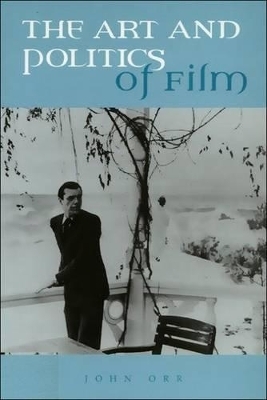
The Art and Politics of Film
Seiten
2000
Edinburgh University Press (Verlag)
978-0-7486-1199-7 (ISBN)
Edinburgh University Press (Verlag)
978-0-7486-1199-7 (ISBN)
This is the final part of a critical trilogy that explores cinema in the latter half of the twentieth century. It fuses analysis of objective form with a subsequent critique of subjective form, and reassesses the close ties of the aesthetic and the political right up to today.
The Art and Politics of Film is the final part of a critical trilogy that explores cinema in the latter half of the twentieth century. It fuses analysis of objective form in Cinema and Modernity with a subsequent critique of subjective form in Contemporary Cinema, and reassesses the close ties of the aesthetic and the political right up to the present time. Film not only engages the question of power. Its narratives also dissect the conflicts between public and personal identity in a changing world. Different filmmakers take on different dimensions of this universal theme. The book examines the cinematic city in Kieslowski and Cronenberg; the cinema of wonder in Tarkovsky and Angelopoulos; the hyper-modern world of science fiction and horror; the time-image in Resnais, Rivette, Lynch and Stone; and the art of identity in Jarman and Jordan. At the turn of the century, film is seen as a component of a hyper-modern culture, which has displaced the modernist aesthetic of the 1960s, and now plays a key role in our mapping of the information age.Features* Offers a theory of film as an art form framed by social and political change* Provides a critical assessment of the crisis of modernism, and the role of the information age in the rise of hyper-modern film* Offers new insights into the rise and fall of the Cold War upon Hollywood genres and upon Eastern European cinema* Illuminates transformations of time, identity and sexuality in film narrative* Examines the interlocking roles of speed, space and paranoia in the renewal of the cinematic city
The Art and Politics of Film is the final part of a critical trilogy that explores cinema in the latter half of the twentieth century. It fuses analysis of objective form in Cinema and Modernity with a subsequent critique of subjective form in Contemporary Cinema, and reassesses the close ties of the aesthetic and the political right up to the present time. Film not only engages the question of power. Its narratives also dissect the conflicts between public and personal identity in a changing world. Different filmmakers take on different dimensions of this universal theme. The book examines the cinematic city in Kieslowski and Cronenberg; the cinema of wonder in Tarkovsky and Angelopoulos; the hyper-modern world of science fiction and horror; the time-image in Resnais, Rivette, Lynch and Stone; and the art of identity in Jarman and Jordan. At the turn of the century, film is seen as a component of a hyper-modern culture, which has displaced the modernist aesthetic of the 1960s, and now plays a key role in our mapping of the information age.Features* Offers a theory of film as an art form framed by social and political change* Provides a critical assessment of the crisis of modernism, and the role of the information age in the rise of hyper-modern film* Offers new insights into the rise and fall of the Cold War upon Hollywood genres and upon Eastern European cinema* Illuminates transformations of time, identity and sexuality in film narrative* Examines the interlocking roles of speed, space and paranoia in the renewal of the cinematic city
The late John Orr was Emeritus Professor at the University of Edinburgh and published widely in the areas of modern culture, cinema, theatre and literature. He was also a reviewer for a wide number of periodicals and online journals including Screen, Studies in French Cinema, Film International and Senses of Cinema.
| Erscheint lt. Verlag | 17.7.2000 |
|---|---|
| Verlagsort | Edinburgh |
| Sprache | englisch |
| Maße | 156 x 234 mm |
| Gewicht | 327 g |
| Themenwelt | Kunst / Musik / Theater ► Film / TV |
| Sozialwissenschaften ► Kommunikation / Medien ► Medienwissenschaft | |
| ISBN-10 | 0-7486-1199-1 / 0748611991 |
| ISBN-13 | 978-0-7486-1199-7 / 9780748611997 |
| Zustand | Neuware |
| Informationen gemäß Produktsicherheitsverordnung (GPSR) | |
| Haben Sie eine Frage zum Produkt? |
Mehr entdecken
aus dem Bereich


aus dem Bereich


