


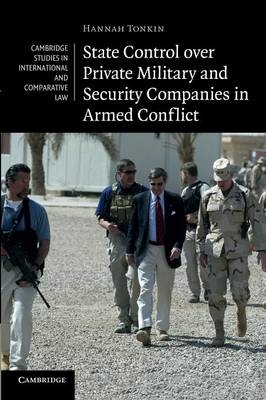
State Control over Private Military and Security Companies in Armed Conflict
Seiten
2013
Cambridge University Press (Verlag)
978-1-107-61314-0 (ISBN)
Cambridge University Press (Verlag)
978-1-107-61314-0 (ISBN)
The proliferation of private military and security companies (PMSCs) in armed conflict raises concerns about state control of military/security activities. Hannah Tonkin critically analyses the key international obligations on states to control PMSCs in armed conflict and identifies the circumstances in which PMSC misconduct may lead to state responsibility.
The past two decades have witnessed the rapid proliferation of private military and security companies (PMSCs) in armed conflicts around the world, with PMSCs participating in, for example, offensive combat, prisoner interrogation and the provision of advice and training. The extensive outsourcing of military and security activities has challenged conventional conceptions of the state as the primary holder of coercive power and raised concerns about the reduction in state control over the use of violence. Hannah Tonkin critically analyses the international obligations on three key states - the hiring state, the home state and the host state of a PMSC - and identifies the circumstances in which PMSC misconduct may give rise to state responsibility. This analysis will facilitate the assessment of state responsibility in cases of PMSC misconduct and set standards to guide states in developing their domestic laws and policies on private security.
The past two decades have witnessed the rapid proliferation of private military and security companies (PMSCs) in armed conflicts around the world, with PMSCs participating in, for example, offensive combat, prisoner interrogation and the provision of advice and training. The extensive outsourcing of military and security activities has challenged conventional conceptions of the state as the primary holder of coercive power and raised concerns about the reduction in state control over the use of violence. Hannah Tonkin critically analyses the international obligations on three key states - the hiring state, the home state and the host state of a PMSC - and identifies the circumstances in which PMSC misconduct may give rise to state responsibility. This analysis will facilitate the assessment of state responsibility in cases of PMSC misconduct and set standards to guide states in developing their domestic laws and policies on private security.
Hannah Tonkin completed a masters and doctorate in international law at the University of Oxford on a Rhodes Scholarship, after having previously completed degrees in science and law at the University of Adelaide, Australia. She is now a lawyer in the Trial Chamber of the United Nations International Criminal Tribunal for Rwanda in Arusha, Tanzania.
Introduction; 1. The private security industry uncovered; 2. State obligations and state responsibility; 3. The attribution of PMSC conduct to the hiring state; 4. Obligations of the host state; 5. Obligations of the hiring state; 6. Obligations of the home state; Conclusion.
| Erscheint lt. Verlag | 18.7.2013 |
|---|---|
| Reihe/Serie | Cambridge Studies in International and Comparative Law |
| Verlagsort | Cambridge |
| Sprache | englisch |
| Maße | 152 x 229 mm |
| Gewicht | 460 g |
| Themenwelt | Recht / Steuern ► EU / Internationales Recht |
| Recht / Steuern ► Öffentliches Recht ► Völkerrecht | |
| Sozialwissenschaften ► Politik / Verwaltung ► Europäische / Internationale Politik | |
| Wirtschaft | |
| ISBN-10 | 1-107-61314-0 / 1107613140 |
| ISBN-13 | 978-1-107-61314-0 / 9781107613140 |
| Zustand | Neuware |
| Informationen gemäß Produktsicherheitsverordnung (GPSR) | |
| Haben Sie eine Frage zum Produkt? |
Mehr entdecken
aus dem Bereich

aus dem Bereich
Die Rechtsprechung des Gerichtshofs der Europäischen Union, deutscher …
Buch | Softcover (2025)
Nomos (Verlag)
CHF 53,50


