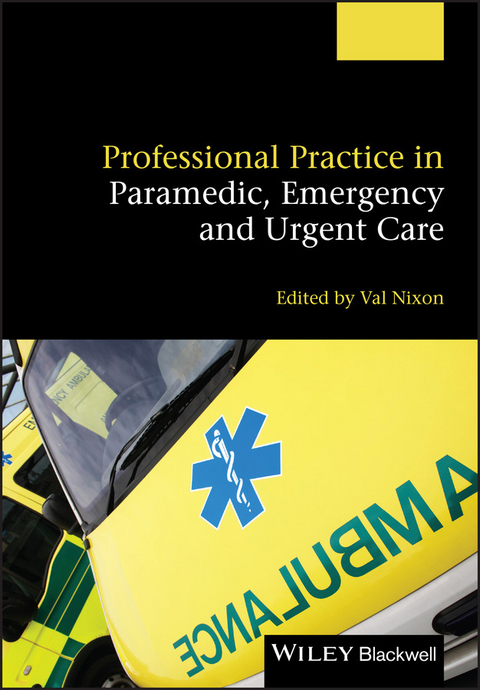
Professional Practice in Paramedic, Emergency and Urgent Care (eBook)
John Wiley & Sons (Verlag)
978-1-118-48823-2 (ISBN)
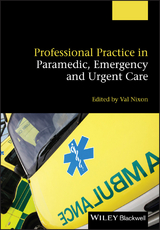
Professional Practice in Paramedic, Emergency and Urgent Care explores a range of contemporary relevant topics fundamental to professional practice. Written for both pre- and post-registration paramedic students, it is also ideal for existing practitioners looking to develop their CPD skills as well as nursing and other health professionals working in emergency and urgent care settings.
- Each chapter includes examples, practical exercises and clinical scenarios, helping the reader relate theory to practice and develop critical thinking skills
- Covers not only acute patient management but also a range of additional topics to provide a holistic approach to out-of-hospital care
- Completion of the material in the book can be used as evidence in professional portfolios as required by the Health and Care Professions Council
Professional Practice in Paramedic, Emergency and Urgent Care is a comprehensive, theoretical underpinning to professional practice at all levels of paramedic and out-of-hospital care.
About the Editor
Val Nixon is Academic Group Lead for Adult Nursing at Staffordshire University, Staffordshire, UK. Paramedic Education was a large part of her previous role as Principal Lecturer in Acute and Emergency Care at this institution, and she has also acted as Project Lead/Manager for Emergency & Urgent Care (Consultancy) at West Midlands Strategic Health Authority.
Professional Practice in Paramedic, Emergency and Urgent Care explores a range of contemporary relevant topics fundamental to professional practice. Written for both pre- and post-registration paramedic students, it is also ideal for existing practitioners looking to develop their CPD skills as well as nursing and other health professionals working in emergency and urgent care settings. Each chapter includes examples, practical exercises and clinical scenarios, helping the reader relate theory to practice and develop critical thinking skills Covers not only acute patient management but also a range of additional topics to provide a holistic approach to out-of-hospital care Completion of the material in the book can be used as evidence in professional portfolios as required by the Health and Care Professions Council Professional Practice in Paramedic, Emergency and Urgent Care is a comprehensive, theoretical underpinning to professional practice at all levels of paramedic and out-of-hospital care.
About the Editor Val Nixon is Academic Group Lead for Adult Nursing at Staffordshire University, Staffordshire, UK. Paramedic Education was a large part of her previous role as Principal Lecturer in Acute and Emergency Care at this institution, and she has also acted as Project Lead/Manager for Emergency & Urgent Care (Consultancy) at West Midlands Strategic Health Authority.
Professional Practice in Paramedic, Emergency and Urgent Care 3
Contents 7
List of Contributors 8
Introduction 11
Acknowledgements 13
1 History Taking 15
Introduction 15
Obtaining the information 15
Identifying the data 17
The presenting complaint 18
History of presenting complaint 18
Onset 20
Provocative/palliative 20
Quality 20
Region/radiation 20
Severity 21
Timing 21
Mechanism of injury 22
Red flags 22
Past medical history 23
Previous illnesses and surgery 23
Drug history 24
Allergies 25
Family history 26
Social history 27
Smoking 27
Alcohol and recreational drugs 28
Mental health history 30
Sexual health 31
Review of systems 32
Summary 33
References 33
2 Consultation and Communication Skills 36
Introduction 36
Consultation/communication skills in a diagnostic context 37
Aims of the consultation 38
Consultation/communication skills 40
Verbal communication 41
Pace 42
Pitch of voice 43
Tone of voice 43
Fluency of speech 43
Non-verbal communication 44
Body language 45
Facial expressions 46
Assertiveness 46
Communication breakdown and barriers 47
Educational standard, level of healthcare knowledge and use of jargon 48
Language barriers and cultural or ethical differences 48
Age 49
Cognitive limitations 50
Stress related to clinical status 51
Power imbalance 52
Imbalance of power 52
Other barriers to communication 53
Communication/consultation models 53
Transactional analysis model 54
Pendleton et al seven task model 57
Neighbour’s five checkpoint model 58
Calgary-Cambridge model 59
Summary 60
References 61
3 Clinical Decision Making 64
Introduction 64
A brief introduction to decision making theories 65
Decision-making theories 66
Decision-making models 66
Intuitive framework – heuristics approach 67
Intuition 67
Pattern recognition 69
Analytical frameworks – rationalist approach 70
The hypothetico-deductive framework 71
Hypothetico-deductive method 71
Cognitive continuum framework 74
Further decision-making methods 76
Naturalistic decision making 76
Group decision making 76
Tools to support clinical decision making 77
Clinical guidelines 77
Protocols 77
Algorithms 78
Decision trees 78
Decision matrix 78
The Bayesian approach 78
Clinical decision-making skills 79
Uncertainty within critical decision making 81
How do you measure the uncertainty? 83
Factors affecting your decision making 84
Summary 87
References 87
4 Evidence Based Practice 91
Introduction 91
Historical background of evidence based practice 92
What is evidence based practice? 93
Why do we need to use evidence based practice? 94
The process and skills required when undertaking evidence based practice 96
Stage 1: Formulate and clarify the question to be asked 96
Stage 2: Identify potential evidence sources 99
Stage 3: Finding the evidence 101
Stage 4: Critically appraise the evidence 105
Stage 5: Apply the evidence in practice 107
Stage 6: Evaluate the effect and generate further questions 112
Professional standards in relation to evidence based practice 113
Conclusion 116
References 116
5 Reflection and Reflective Practice 121
Introduction 121
What is reflection? 122
Reflection on action 126
Reflection in action 126
Group reflection 127
Action learning 128
Problem based learning 129
Clinical supervision 130
Reflective writing and models of reflection 131
Gibbs’ reflective model 133
Johns’ reflective model 139
Aesthetics 139
Driscoll’s reflective model 140
What? Returning to the situation 141
So what? Understanding the context 141
Now what? Modifying future outcomes 141
Summary 141
References 142
6 Professional and Legal Issues 146
Introduction 146
Registration and professional standards 147
Accountability 148
Duty of care 149
Clinical negligence 149
What is clinical negligence? 151
Patient autonomy 154
Consent to treatment 154
Informed consent 154
Consent for children 156
Confidentiality 157
Confidentiality for minors 159
Mental health and mental capacity 159
Mental Capacity Act 161
Ethical theories 162
Consequentialism 164
Utilitarianism 164
Deontology 164
Do not attempt resuscitation 165
Summary 165
References 166
Case Law 167
Table of Statutes 167
7 Anti-discriminatory Practice 168
Introduction 168
Definitions and theory of anti-discriminatory practice 169
Ethical and legal basis of anti-discriminatory practice 172
Definitions of discrimination and oppression 174
Discrimination 174
Negative discrimination 175
Positive discrimination 176
Direct and indirect discrimination 177
Prejudice 178
Oppression 179
Equality and diversity 180
Factors associated with equality 181
Poly-discrimination 182
Promoting equality 182
Cultural competence/cultural awareness 183
Education 184
Summary 186
References 188
Table of Statutes 189
8 Medicines Management 190
Introduction to medicines management 190
Introduction to the Medicines Act 191
Prescribing, supplying and administering drugs 192
Categorisation of drugs 192
Non-medical prescribing 193
POMs exemptions 195
Amendments to the medicines act 197
Patient group directions 198
Training for PGDs 200
Grey areas in medicines management 201
Controlled drugs 202
Classification of controlled drugs 203
Safety and security of controlled drugs in practice 204
The Accountable Officer 205
Joint Royal Colleges Liaison Committee 208
Professional accountability in medicines management 208
Continuous professional development 211
Sources of drug information 211
Summary 212
References 212
Websites 216
9 Continuing Professional Development and Portfolio Development 217
Introduction 217
Continuous professional development 218
What is a professional portfolio? 220
Starting your portfolio 222
Self-assessment against professional development 222
SWOT analysis 223
Goal setting and action plan 225
Specific – Clear objectives that identify What, Why and How 226
Measurable 226
Achievable 227
Relevant or realistic goals 227
Timely goals 228
Organising your portfolio 229
Summary 234
References 235
Index 237
"This interesting text will serve well those looking to
start, or those already beginning, a career or education in
unscheduled care." (Emergency Nurse, 1 October
2013)
| Erscheint lt. Verlag | 16.4.2013 |
|---|---|
| Sprache | englisch |
| Themenwelt | Medizin / Pharmazie ► Allgemeines / Lexika |
| Medizin / Pharmazie ► Gesundheitsfachberufe | |
| Medizin / Pharmazie ► Medizinische Fachgebiete ► Notfallmedizin | |
| Medizin / Pharmazie ► Pflege ► Ausbildung / Prüfung | |
| Sozialwissenschaften ► Soziologie | |
| Schlagworte | Acute, Critical & Emergency Care • acute patient • Comprehensive • contemporary relevant topics • CPD • Develop • fundamental • Health • Ideal • Intensiv- u. Notfallpflege • Krankenpflege • levels • nursing • paramedic • Practice • Practitioners • PRE • Professional • Range • Reader • relate • Scenarios • Skills • theory |
| ISBN-10 | 1-118-48823-7 / 1118488237 |
| ISBN-13 | 978-1-118-48823-2 / 9781118488232 |
| Informationen gemäß Produktsicherheitsverordnung (GPSR) | |
| Haben Sie eine Frage zum Produkt? |
 PDF (Adobe DRM)
Kopierschutz: Adobe-DRM
Adobe-DRM ist ein Kopierschutz, der das eBook vor Mißbrauch schützen soll. Dabei wird das eBook bereits beim Download auf Ihre persönliche Adobe-ID autorisiert. Lesen können Sie das eBook dann nur auf den Geräten, welche ebenfalls auf Ihre Adobe-ID registriert sind.
Details zum Adobe-DRM
Dateiformat: PDF (Portable Document Format)
Mit einem festen Seitenlayout eignet sich die PDF besonders für Fachbücher mit Spalten, Tabellen und Abbildungen. Eine PDF kann auf fast allen Geräten angezeigt werden, ist aber für kleine Displays (Smartphone, eReader) nur eingeschränkt geeignet.
Systemvoraussetzungen:
PC/Mac: Mit einem PC oder Mac können Sie dieses eBook lesen. Sie benötigen eine
eReader: Dieses eBook kann mit (fast) allen eBook-Readern gelesen werden. Mit dem amazon-Kindle ist es aber nicht kompatibel.
Smartphone/Tablet: Egal ob Apple oder Android, dieses eBook können Sie lesen. Sie benötigen eine
Geräteliste und zusätzliche Hinweise
Buying eBooks from abroad
For tax law reasons we can sell eBooks just within Germany and Switzerland. Regrettably we cannot fulfill eBook-orders from other countries.
aus dem Bereich