


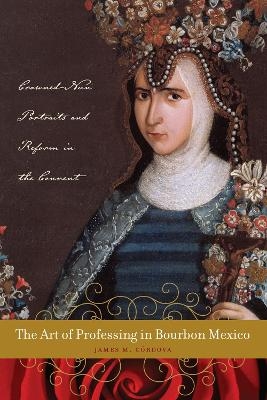
The Art of Professing in Bourbon Mexico
Crowned-Nun Portraits and Reform in the Convent
Seiten
2014
University of Texas Press (Verlag)
978-0-292-75315-0 (ISBN)
University of Texas Press (Verlag)
978-0-292-75315-0 (ISBN)
By the eighteenth century, New Spaniards (colonial Mexicans) so lauded their nuns that they developed a local tradition of visually opulent portraits, called monjas coronadas or "crowned nuns," that picture their subjects in regal trappings at the moment of their religious profession and in death. This study identifies these portraits.
In the eighteenth century, New Spaniards (colonial Mexicans) so lauded their nuns that they developed a local tradition of visually opulent portraits, called monjas coronadas or “crowned nuns,” that picture their subjects in regal trappings at the moment of their religious profession and in death. This study identifies these portraits as markers of a vibrant and changing society that fused together indigenous and Euro-Christian traditions and ritual practices to construct a new and complex religious identity that was unique to New Spain.
To discover why crowned-nun portraits, and especially the profession portrait, were in such demand in New Spain, this book offers a pioneering interpretation of these works as significant visual contributions to a local counter-colonial discourse. James M. CÓrdova demonstrates that the portraits were a response to the Spanish crown’s project to modify and modernize colonial society-a series of reforms instituted by the Bourbon monarchs that threatened many nuns’ religious identities in New Spain. His analysis of the portraits’ rhetorical devices, which visually combined Euro-Christian and Mesoamerican notions of the sacred, shows how they promoted local religious and cultural values as well as client-patron relations, all of which were under scrutiny by the colonial Church. Combining visual evidence from images of the “crowned nun” with a discussion of the nuns’ actual roles in society, CÓrdova reveals that nuns found their greatest agency as Christ’s brides, a title through which they could, and did, challenge the Church’s authority when they found it intolerable.
In the eighteenth century, New Spaniards (colonial Mexicans) so lauded their nuns that they developed a local tradition of visually opulent portraits, called monjas coronadas or “crowned nuns,” that picture their subjects in regal trappings at the moment of their religious profession and in death. This study identifies these portraits as markers of a vibrant and changing society that fused together indigenous and Euro-Christian traditions and ritual practices to construct a new and complex religious identity that was unique to New Spain.
To discover why crowned-nun portraits, and especially the profession portrait, were in such demand in New Spain, this book offers a pioneering interpretation of these works as significant visual contributions to a local counter-colonial discourse. James M. CÓrdova demonstrates that the portraits were a response to the Spanish crown’s project to modify and modernize colonial society-a series of reforms instituted by the Bourbon monarchs that threatened many nuns’ religious identities in New Spain. His analysis of the portraits’ rhetorical devices, which visually combined Euro-Christian and Mesoamerican notions of the sacred, shows how they promoted local religious and cultural values as well as client-patron relations, all of which were under scrutiny by the colonial Church. Combining visual evidence from images of the “crowned nun” with a discussion of the nuns’ actual roles in society, CÓrdova reveals that nuns found their greatest agency as Christ’s brides, a title through which they could, and did, challenge the Church’s authority when they found it intolerable.
James M. Córdova is Assistant Professor of Art History at the University of Colorado at Boulder, where he teaches pre-Columbian and colonial Latin American art.
List of Illustrations
List of Abbreviations
Acknowledgments
Introduction
Chapter 1. Women's Religious Pathways in New Spain
Chapter 2. New Spanish Portraiture and Portraits of Nuns
Chapter 3. Euro-Christian Precedents in the Crowned-Nun Image
Chapter 4. Indigenous Contributions to Convent Arts and Culture
Chapter 5. The Profession Portrait in a Time of Crisis
Chapter 6. Colonial Identity Rhetorics
Epilogue
Notes
Glossary
Bibliography
Index
| Erscheint lt. Verlag | 6.1.2014 |
|---|---|
| Reihe/Serie | Latin American and Caribbean Arts and Culture Publication Initiative, Mellon Foundation |
| Verlagsort | Austin, TX |
| Sprache | englisch |
| Maße | 152 x 229 mm |
| Gewicht | 626 g |
| Themenwelt | Kunst / Musik / Theater ► Kunstgeschichte / Kunststile |
| Kunst / Musik / Theater ► Malerei / Plastik | |
| Geisteswissenschaften ► Geschichte ► Regional- / Ländergeschichte | |
| Sozialwissenschaften ► Soziologie | |
| ISBN-10 | 0-292-75315-2 / 0292753152 |
| ISBN-13 | 978-0-292-75315-0 / 9780292753150 |
| Zustand | Neuware |
| Informationen gemäß Produktsicherheitsverordnung (GPSR) | |
| Haben Sie eine Frage zum Produkt? |
Mehr entdecken
aus dem Bereich


aus dem Bereich
die Geschichte meiner Urgroßmutter
Buch | Hardcover (2025)
C.H.Beck (Verlag)
CHF 32,15
Träume und Macht : eine Biografie
Buch | Hardcover (2025)
C.H.Beck (Verlag)
CHF 61,60


