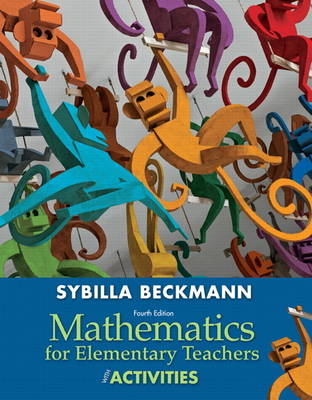
Mathematics for Elementary Teachers, plus MyMathLab with Pearson eText
Pearson Education Limited
978-1-4479-5365-4 (ISBN)
- Titel ist leider vergriffen;
keine Neuauflage - Artikel merken
by Beckmann as well as access to the eText and MyMathLab. Your instructor will need to provide you with a course ID in order for you to access the eText and MyMathLab.
An inquiry-based approach to this course allows future teachers to learn through exploration and group work, leading to a deeper understanding of mathematics. Known for her contributions in math education, Sybilla Beckmann writes the leading text for the inquiry approach-in Mathematics for Elementary Teachers with Activities, students engage, explore, discuss, and ultimately reach a true understanding of mathematics.
The Fourth Edition provides a new full-color design, making the math come alive. For the first time, the content and activities are combined into the same text, creating a self-contained resource for this course and beyond. Common Core State Standards are integrated to complement the National Council of Teachers of Mathematics (NCTM) Focal Points and Standards that appear where appropriate. New From the Field features highlight the latest research, Integrating Mathematics and Pedagogy (IMAP) videos, children's literature, views from the classroom, and lesson planning to prepare future teachers for their teaching careers.
MyMathLab (R) is available for the first time with exercises that review the key math skills relevant for each chapter, helping students to prepare for the activities and group work within the text itself. In addition, MyMathLab offers learning tools and resources for future teachers, including the full eText, Integrating Mathematics and Pedagogy (IMAP) videos, eManipulatives, and more.
Sybilla Beckmann earned her undergraduate degree in mathematics from Brown University and her PhD in mathematics from the University of Pennsylvania. For two years, she researched and taught mathematics as the J.W. Gibbs Instructor of Mathematics at Yale University. Since then, she has been at the University of Georgia, where she was recently awarded the Josiah Meigs Distinguished Teaching Professor of Mathematics, and directs the Mathematicians Educating Future Teachers (MEFT) component of the University of Georgia math department's VIGRE II grant. Sybilla is actively involved in helping prospective teachers understand and appreciate the mathematics they will teach. She was a member of the writing team of NCTM's Curriculum Focal Points for pre-kindergarten through 8th grade mathematics. She was also a member of the Committee on Early Childhood Mathematics of the National Research Council, and co-author of its report, Mathematics Learning in Early Childhood: Path toward Excellence and Equity; she has worked on the development of several state mathematics standards; and she was a member of the Mathematics Writing Team for the Common Core State Standards Initiative. Several years ago, Dr. Beckmann taught daily at an average sixth grade math class at a local public school in order to better understand teaching mathematics at the school level. In her spare time, she enjoys playing the piano, weaving, attending classical music concerts, and traveling with her family.
1. Numbers and the Base-Ten System
1.1 The Counting Numbers
1.2 Decimals and Negative Numbers
1.3 Comparing Numbers in Base-Ten
1.4 Rounding Numbers
Chapter Summary
2. Fractions and Problem-Solving
2.1 Solving Problems and Explaining Solutions
2.2 Defining and Reasoning About
2.3 Equivalent Fractions
2.4 Comparing Fractions
2.5 Percent
Chapter Summary
3. Addition and Subtraction
3.1 Interpretations of Addition and Subtraction
3.2 The Commutative and Associative Properties of Addition, Mental Math, and Single-Digit Facts
3.3 Why the Common Algorithms for Adding and Subtracting Numbers in the Base-Ten System Work
3.4 Adding and Subtracting Fractions
3.5 Adding and Subtracting Negative Numbers
Chapter Summary
4. Multiplication
4.1 Interpretations of Multiplication
4.2 Why Multiplying by 10 is Special in Base-Ten
4.3 The Commutative and Associate Properties of Multiplication, Areas of Rectangles, and Volumes of Boxes
4.4 The Distributive Property
4.5 Properties of Arithmetic, Mental Math, and Single-Digit Multiplication Facts
4.6 Why Algorithms for Multiplying Whole Numbers Work
Chapter Summary
5. Multiplication of Fractions, Decimals, and Negative Numbers
5.1 Multiplying Fractions
5.2 Multiplying Decimals
5.3 Multiplying Negative Numbers
5.4 Powers and Scientific Notation
Chapter Summary
6. Division
6.1 Interpretations of Division
6.2 Division and Fractions and Division with Remainder
6.3 Why Division Algorithms Work
6.4 Fraction Division from the "How Many Groups?" Perspective
6.5 Fraction Division from the "How Many in One Group?" Perspective
6.6 Dividing Decimals
Chapter Summary
7. Ratio and Proportional Relationships
7.1 Motivating and Defining Ratio and Proportional Relationships
7.2 Solving Proportion Problems by Reasoning with Multiplication and Division
7.3 Unit Rates and the Values of a Ratio
7.4 Proportional Relationships Versus Inversely Proportional Relationships
7.5 Percent Revisited: Percent Increase and Decrease
Chapter Summary
8. Number Theory
8.1 Factors and Multiples
8.2 Even and Odd
8.3 Divisibility Tests
8.4 Prime Numbers
8.5 Greatest Common Factor and Least Common Multiple
8.6 Rational and Irrational Numbers
8.7 Looking Back at the Number Systems
Chapter Summary
9. Algebra
9.1 Numerical Expressions
9.2 Numerical Expressions with Variables
9.3 Equations for Different Purposes
9.4 Solving Equations
9.5 Solving Algebra Word Problems with Strip Diagrams and with Algebra
9.6 Sequences
9.7 Functions
9.8 Linear Functions
Chapter Summary
10. Geometry
10.1 Visualization
10.2 Angles
10.3 Angles and Phenomena in the World
10.4 Circles and Spheres
10.5 Quadrilaterals, Triangles, and Polygons
Chapter Summary
11. Measurement
11.1 Fundamentals of Measurement
11.2 Length, Area, Volume, and Dimension
11.3 Error and Precision in Measurements
11.4 Converting from One Unit of Measurement to Another
Chapter Summary
12. Area of Shapes
12.1 Areas of Rectangles Revisited
12.2 Moving and Additivity Principles About Area
12.3 Areas of Triangles
12.4 Areas of Paralellograms and Other Polygons
12.5 Shearing: Changing Shapes Without Changing Area
12.6 Areas of Circles and the Number Pi
12.7 Approximating Areas of Irregular Shapes
12.8 Contrasting and Relating the Perimeter and Area of Shapes
12.9 Using Moving and Additivity Principles to Prove the Pythagorean Theorem
Chapter Summary
13. Solid Shapes and Their Volume and Surface Area
13.1 Polyhedra and Other Solid Shapes
13.2 Patterns and Surface Area
13.3 Volumes of Solid Shapes
13.4 Volume of Submersed Objects versus Weight of Floating Objects
Chapter Summary
14. Geometry of Motion and Change
14.1 Reflections, Translations, and Rotations
14.2 Symmetry
14.3 Congruence
14.4 Constructions with Straightedge and Compass
14.5 Similarity
14.6 Areas, Volumes, and Scaling
Chapter Summary
15. Statistics
15.1 Formulating Statistical Questions, Gathering Data, and Using Samples
15.2 Displaying Data and Interpreting Data Displays
15.3 The Center of Data: Mean, Median, and Mode
15.4 Summarizing, Describing, and Comparing Data Distributions
Chapter Summary
16. Probability
16.1 Basic Principles of Probability
16.2 Counting the Number of Outcomes
16.3 Calculating Probabilities in Multi-Stage Experiments
16.4 Using Fraction Arithmetic to Calculate Probabilities
Chapter Summary
Bibliography
Index
Downloads
| Erscheint lt. Verlag | 5.2.2014 |
|---|---|
| Verlagsort | Harlow |
| Sprache | englisch |
| Maße | 230 x 284 mm |
| Gewicht | 2440 g |
| Themenwelt | Mathematik / Informatik ► Mathematik |
| Sozialwissenschaften ► Pädagogik | |
| ISBN-10 | 1-4479-5365-7 / 1447953657 |
| ISBN-13 | 978-1-4479-5365-4 / 9781447953654 |
| Zustand | Neuware |
| Informationen gemäß Produktsicherheitsverordnung (GPSR) | |
| Haben Sie eine Frage zum Produkt? |
aus dem Bereich