


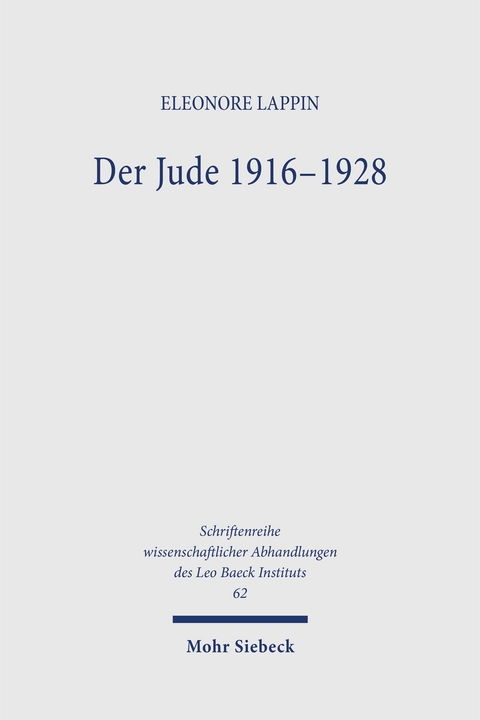
Der Jude 1916-1928
Jüdische Moderne zwischen Universalismus und Partikurlarismus
Seiten
Eleonore Lappin untersucht Martin Bubers Zeitschrift 'Der Jude'. Sie leistet damit einen wichtigen Beitrag zum Verständnis des Zionismus und der konkreten politischen, sozialen und wirtschaftlichen Entwicklungen der Juden in Europa und Palästina.
Eleonore Lappin untersucht Martin Bubers Zeitschrift 'Der Jude'. Sie leistet damit einen wichtigen Beitrag zum Verständnis des Zionismus und der konkreten politischen, sozialen und wirtschaftlichen Entwicklungen der Juden in Europa und Palästina. 'Der Jude' was founded in 1919 by members of the World Zionist Organization and Martin Buber. Its aims, advocating the rights of Jews to settle in Palestine, cultural autonomy for the Jews in Eastern Europe and the recognition of the Jews as a nation, were regarded as radical in Germany at that time. The founders and funders of the journal were aware that they could only succeed if their publication was of a high literary quality and covered not only political but also cultural issues. Special emphasis was placed on the Eastern European Jews in order to justify their national demands at home and to improve the situation of the war refugees in Germany and Austria. The 'Jewish Renewal' in Europe, documented by 'Der Jude', was not restricted to Zionist or Jewish-nationalist issues; it also showed the broad spectrum of Jewish culture in the German-speaking area at that time.
Eleonore Lappin untersucht Martin Bubers Zeitschrift 'Der Jude'. Sie leistet damit einen wichtigen Beitrag zum Verständnis des Zionismus und der konkreten politischen, sozialen und wirtschaftlichen Entwicklungen der Juden in Europa und Palästina. 'Der Jude' was founded in 1919 by members of the World Zionist Organization and Martin Buber. Its aims, advocating the rights of Jews to settle in Palestine, cultural autonomy for the Jews in Eastern Europe and the recognition of the Jews as a nation, were regarded as radical in Germany at that time. The founders and funders of the journal were aware that they could only succeed if their publication was of a high literary quality and covered not only political but also cultural issues. Special emphasis was placed on the Eastern European Jews in order to justify their national demands at home and to improve the situation of the war refugees in Germany and Austria. The 'Jewish Renewal' in Europe, documented by 'Der Jude', was not restricted to Zionist or Jewish-nationalist issues; it also showed the broad spectrum of Jewish culture in the German-speaking area at that time.
Geboren 1951; Studium der Volkswirtschaftslehre, der deutschen, englischen und vergleichenden Literaturwissenschaften sowie der jüdischen Geistesgeschichte in Österreich, den USA und Israel; seit 1989 Mitarbeiterin am Institut für Geschichte der Juden in Österreich; seit 1995 Dozentin an der Karl Franzens Universität Graz.
| Erscheint lt. Verlag | 13.6.2000 |
|---|---|
| Reihe/Serie | Schriftenreihe wissenschaftlicher Abhandlungen des Leo Baeck Instituts |
| Verlagsort | Tübingen |
| Sprache | deutsch |
| Maße | 169 x 245 mm |
| Gewicht | 845 g |
| Themenwelt | Geisteswissenschaften ► Religion / Theologie ► Judentum |
| Sozialwissenschaften ► Soziologie ► Spezielle Soziologien | |
| Schlagworte | HC/Religion/Theologie/Judentum • Jude • Juden • Mohr Siebeck |
| ISBN-10 | 3-16-147035-4 / 3161470354 |
| ISBN-13 | 978-3-16-147035-6 / 9783161470356 |
| Zustand | Neuware |
| Informationen gemäß Produktsicherheitsverordnung (GPSR) | |
| Haben Sie eine Frage zum Produkt? |
Mehr entdecken
aus dem Bereich
aus dem Bereich


