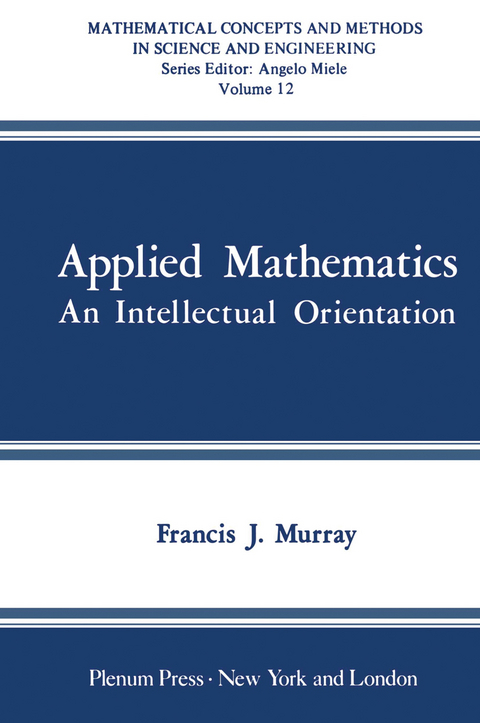
Applied Mathematics
Springer-Verlag New York Inc.
978-1-4684-3314-2 (ISBN)
1. Introduction.- 1.1. Vocational Aspects.- 1.2. Intellectual Attitudes.- 1.3. Opportunities in Applied Mathematics.- 1.4. Course Objectives.- Exercises.- 2. Simulations.- 2.1. Organized Efforts.- 2.2. Staging.- 2.3. Simulations.- 2.4. Influence Block Diagram and Math Model.- 2.5. Temporal Patterns.- 2.6. Operational Flight Trainer.- 2.7. Block Diagrams.- 2.8. Equipment.- 2.9. The Time Pattern of the Simulation.- 2.10. Programming.- 2.11. Management Considerations.- 2.12. Validity.- Exercises.- References.- 3. Understanding and Mathematics.- 3.1. Experience and Understanding.- 3.2. Unit Experience.- 3.3. The Exact Sciences.- 3.4. Scientific Understanding.- 3.5. Logic and Arithmetic.- 3.6. Algebra.- 3.7. Axiomatic Developments.- 3.8. Analysis.- 3.9. Modern Formal Logic.- 3.10. Pure and Applied Mathematics.- 3.11. Vocational Aspects.- Exercises.- References.- 4. Ancient Mathematics.- 4.1. Ancient Arithmetic.- 4.2. Egyptian Mathematics.- 4.3. Babylonian Mathematics.- 4.4. Greece.- 4.5. Euclid’s Elements.- 4.6. Magnitudes.- 4.7. Geometry and Philosophy.- 4.8. The Conic Sections.- 4.9. Parabolic Areas.- Exercises.- References.- 5. Transition and Developments.- 5.1. Algebra.- 5.2. Non-Euclidean Geometry.- 5.3. Geometric Developments.- 5.4. Geometry and Group Theory.- 5.5. Arithmetic.- 5.6. The Celestial Sphere.- 5.7. The Motion of the Sun.- 5.8. Synodic Periods.- 5.9. Babylonian Tables.- 5.10. Geometric Formulations.- 5.11. Astronomical Experience in Terms of Accuracy.- 5.12. Optical Instruments and Developments.- Exercises.- References.- 6. Natural Philosophy.- 6.1. Analysis.- 6.2. The Calculus.- 6.3. The Transformation of Mathematics.- 6.4. The Method of Fluxions.- 6.5. The Behavior of Substance in the Eulerian Formulation.- 6.6. The Generalized Stokes’ Theorem.- 6.7.The Calculus of Variations.- 6.8. Dynamics.- 6.9. Manifolds.- 6.10. The Weyl Connection.- 6.11. The Riemannian Metric.- Exercises.- References.- 7. Energy.- 7.1. The Motion of Bodies.- 7.2. The Stress Tensor.- 7.3. Deformation and Stress.- 7.4. An Elastic Collision.- 7.5. Thermodynamic States and Reversibility.- 7.6. Thermodynamic Functions.- 7.7. The Carnot Cycle and Entropy.- 7.8. The Relation with Applied Mathematics.- Exercises.- References.- 8. Probability.- 8.1. The Development of Probability.- 8.2. Applications.- 8.3. Probability and Mechanics.- 8.4. Relation to Thermodynamics.- 8.5. The Fine Structure of Matter.- 8.6. Analysis.- Exercises.- References.- 9. The Parado.- 9.1. Intellectual Ramifications.- 9.2. The Paradox.- 9.3. Final Comment.- Exercises.- References.
| Reihe/Serie | Mathematical Concepts in Science and Engineering ; 12 |
|---|---|
| Zusatzinfo | XIV, 225 p. |
| Verlagsort | New York, NY |
| Sprache | englisch |
| Maße | 152 x 229 mm |
| Themenwelt | Schulbuch / Wörterbuch |
| Geisteswissenschaften | |
| Naturwissenschaften | |
| Sozialwissenschaften | |
| ISBN-10 | 1-4684-3314-8 / 1468433148 |
| ISBN-13 | 978-1-4684-3314-2 / 9781468433142 |
| Zustand | Neuware |
| Informationen gemäß Produktsicherheitsverordnung (GPSR) | |
| Haben Sie eine Frage zum Produkt? |
aus dem Bereich