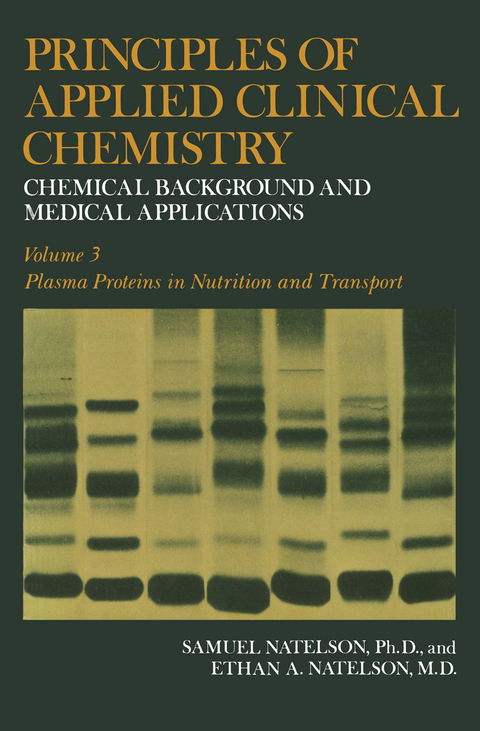
Principles of Applied Clinical Chemistry
Springer-Verlag New York Inc.
978-1-4684-3586-3 (ISBN)
This book, the third volume in the series, continues to explore the application of chemistry to our understanding of the functioning of the human in health and disease. It is the objective of the authors to continue to present, in this and subsequent volumes, the biochemical aspects of clinical chemistry, and to indicate how this knowledge applies to the diagnosis of disease and the treatment of the patient. For this purpose, the literature is reviewed carefully and the findings of the different study groups are integrated, to present an overall view of the present status of the various fields. The text is written with the intent to serve in the training of clinical chemists, clinical pathologists, and medical students in clinical biochemistry. It is also intended to serve as a reference text for the practicing physician who desires a more rational approach to the use of the clinical chemistry laboratory, as an aid in understanding (1) the chemical changes in disease and (2) the logical use of the laboratory data in the treatment of the patient. This volume is concerned with the plasma proteins and their significance in normal human metabolism. The immunoglobulins are not included in this study since, along with complement and clotting factors, they form an integrated system concerned with defense against invading organisms. These will be discussed in Volume 4 of this series. A historical introduction (Chapter I) is followed by a general presentation of the composition and properties of proteins (Chapter 2).
A Plasma Protein Properties and Metabolism.- Section I. Nature of the Plasma Proteins.- 1 Introduction.- 2 Protein Composition and Properties.- 3 Plasma Protein Survey.- Section II. Plasma Protein Metabolism.- 4 Albumin in Nutrition and Transport.- 5 Glycoproteins and Proteoglycans.- 6 Lipoproteins in Nutrition and Transport.- B Plasma Proteins in Transport of Intermediates, Minerals, and Hormones.- Section III. Plasma Transport Proteins.- 7 Transferrin: Iron Metabolism.- 8 Ceruloplasmin: Copper Metabolism.- 9 Haptoglobins: Hemoglobin Binding.- 10 Hemopexin: Iron Recycling.- 11 Prealbumin I: Iodothyronine-Binding Proteins.- 12 Prealbumin II: Vitamin A(Retinol)-Binding Protein.- 13 Vitamin D Transport: Gc Globulins.- 14 Steroid Hormone-Binding Proteins.- 15 Transcobalamins: Vitamin B12 Transport.- Section IV. Appendix.- A.1 Steroid Nomenclature.- A.1.1 Progesterone and the Corticosteroids.- A.1.2 The Steroid Sex Hormones.- A.1.3 The Bile Acids.- A.2 Mechanism of Cholesterol Formation.- A.3 Neutral and Phosphorylated Glyceride Structures.- A.3.1 Diglyceride Pathway for Glyceride Synthesis.- A.3.2 Monoglyceride Pathway for Glyceride Synthesis.- A.4 Nature of the Lipases.- A.4.1 Pancreatic Lipase.- A.4.2 Lipoprotein Lipase.- A.4.3 Hormone-Sensitive Lipase (HSL).- A.4.4 Other Tissue Lipases.- A.4.5 Phospholipases.- A.4.5.3 Lysophospholipase.- A.4.5.4 Phospholipase B.- A.4.5.5 Phospholipase C.- A.4.5.6 Phospholipase D.- A.5 Protein Parameters.- A.5.1 Absorptivity of the Plasma Proteins.- A.5.2 Partial Specific Volume of Proteins.- A.5.3 Viscosity and Frictional Resistance of Protein Molecules.- A.5.4 Plasma Protein Diffusion Coefficient.- A.5.5 Osmotic Pressure and Molecular Weight of Proteins.- A.5.6 Molecular Weight of Proteins by Diffusion.- A.5.7 Molecular Weight of Proteins by Sedimentation in the Ultracentrifuge.- A.5.8 Electrophoretic Mobility.- A.5.9 Selected Reading.
| Zusatzinfo | 78 Illustrations, black and white |
|---|---|
| Verlagsort | New York, NY |
| Sprache | englisch |
| Maße | 152 x 229 mm |
| Themenwelt | Schulbuch / Wörterbuch |
| Geisteswissenschaften | |
| Naturwissenschaften | |
| Sozialwissenschaften | |
| ISBN-10 | 1-4684-3586-8 / 1468435868 |
| ISBN-13 | 978-1-4684-3586-3 / 9781468435863 |
| Zustand | Neuware |
| Informationen gemäß Produktsicherheitsverordnung (GPSR) | |
| Haben Sie eine Frage zum Produkt? |
aus dem Bereich