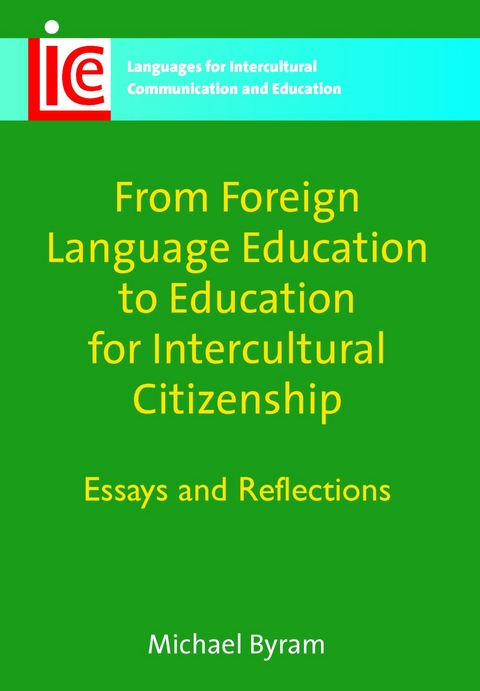
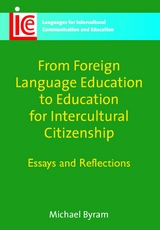
From Foreign Language Education to Education for Intercultural Citizenship (eBook)
Channel View Publications (Verlag)
978-1-84769-883-4 (ISBN)
This book analyses the evolution of theory of intercultural competence and its relationship to education for citizenship. It analyses the concepts of intercultural competence by discussing the ways in which language education policy develops and by comparing the theories and purposes of foreign language education and education for citizenship.
This collection of essays and reflections starts from an analysis of the purposes of foreign language teaching and argues that this should include educational objectives which are ultimately similar to those of education for citizenship. It does so by a journey through reflections on what is possible and desirable in the classroom and how language teaching has a specific role in education systems which have long had, and often still have, the purpose of encouraging young people to identify with the nation-state. Foreign language education can break through this framework to introduce a critical internationalism. In a 'globalised' and 'internationalised' world, the importance of identification with people beyond the national borders is crucial. Combined with education for citizenship, foreign language education can offer an education for 'intercultural citizenship'.
lt;p>Michael Byram is Professor of Education at Durham University, England. He studied French, German and Danish at King’s College Cambridge, and wrote a PhD on Danish literature. He then taught French and German at secondary school level and in adult education in an English comprehensive school. Since being appointed to a post in teacher education at Durham in 1980, he has carried out research into the education of linguistic minorities, foreign language education and student residence abroad. His books include Teaching and Assessing Intercultural Communicative Competence (1997) and he is the editor of the Routledge Encyclopedia of Language Teaching and Learning. He is also an Adviser to the Council of Europe Language Policy Division.
Acknowledgements
Introduction
I FOREIGN LANGUAGE EDUCATION
Purposes
1 Foreign Language Education in Context
2 Purposes for Foreign Language Education
Possibilities
3 Is Language Learning Possible at School?
4 The Intercultural Speaker – Acting Interculturally or Being Bicultural
5 Intercultural Competence and Foreign Language Learning in the Primary School
6 Analysis and Advocacy: Researching the Cultural Dimensions of Foreign Language Education
Perspectives
7 Nationalism and Internationalism in Language Education
8 Language Learning in Europe
9 Foreign Language Teaching as Political Action
II INTERCULTURAL CITIZENSHIP EDUCATION
10 Language Education, Political Education and Intercultural Citizenship
11 Education for Intercultural Citizenship
12 Policies for Intercultural Citizenship Education
13 Curricula for Intercultural Citizenship Education
14 Assessment and/or Evaluation of Intercultural Competence and Intercultural Citizenship
Conclusion
References
Appendix
| Erscheint lt. Verlag | 27.5.2008 |
|---|---|
| Reihe/Serie | Languages for Intercultural Communication and Education | Languages for Intercultural Communication and Education |
| Verlagsort | Bristol |
| Sprache | englisch |
| Themenwelt | Schulbuch / Wörterbuch ► Lektüren / Interpretationen |
| Geisteswissenschaften ► Sprach- / Literaturwissenschaft ► Sprachwissenschaft | |
| Sozialwissenschaften ► Pädagogik | |
| Sozialwissenschaften ► Politik / Verwaltung | |
| Schlagworte | Citizenship Education • Foreign Language Teaching • Intercultural Learning |
| ISBN-10 | 1-84769-883-2 / 1847698832 |
| ISBN-13 | 978-1-84769-883-4 / 9781847698834 |
| Informationen gemäß Produktsicherheitsverordnung (GPSR) | |
| Haben Sie eine Frage zum Produkt? |
 EPUB (Adobe DRM)
Kopierschutz: Adobe-DRM
Adobe-DRM ist ein Kopierschutz, der das eBook vor Mißbrauch schützen soll. Dabei wird das eBook bereits beim Download auf Ihre persönliche Adobe-ID autorisiert. Lesen können Sie das eBook dann nur auf den Geräten, welche ebenfalls auf Ihre Adobe-ID registriert sind.
Details zum Adobe-DRM
Dateiformat: EPUB (Electronic Publication)
EPUB ist ein offener Standard für eBooks und eignet sich besonders zur Darstellung von Belletristik und Sachbüchern. Der Fließtext wird dynamisch an die Display- und Schriftgröße angepasst. Auch für mobile Lesegeräte ist EPUB daher gut geeignet.
Systemvoraussetzungen:
PC/Mac: Mit einem PC oder Mac können Sie dieses eBook lesen. Sie benötigen eine
eReader: Dieses eBook kann mit (fast) allen eBook-Readern gelesen werden. Mit dem amazon-Kindle ist es aber nicht kompatibel.
Smartphone/Tablet: Egal ob Apple oder Android, dieses eBook können Sie lesen. Sie benötigen eine
Geräteliste und zusätzliche Hinweise
Buying eBooks from abroad
For tax law reasons we can sell eBooks just within Germany and Switzerland. Regrettably we cannot fulfill eBook-orders from other countries.
aus dem Bereich