Constructing Spain (eBook)
352 Seiten
Bucknell University Press (Verlag)
978-1-61148-397-0 (ISBN)
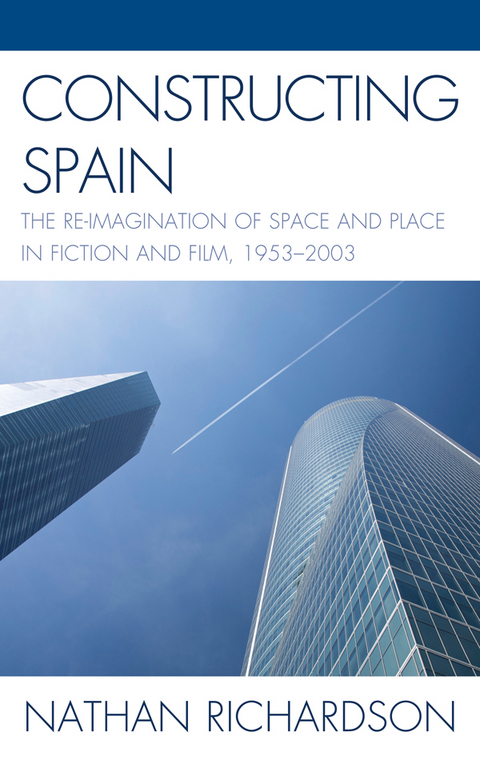
Does fiction do more than just represent space? Can our experiences with fictional storytelling be in themselves spatial? In Constructing Spain: The Re-imagination of Space and Place in Fiction and Film, Nathan Richardson explores relations between cultural representation and spatial transformation across fifty years of Spanish culture. Beginning in 1953, the year Spanish space was officially reopened to Western thought and capital, and culminating in 2003, the year of Aznar's unpopular involvement of his country in the second Iraq War, Richardson traces in popular and critically acclaimed fiction and film an evolution in Spanish storytelling that, while initially representative in nature, increasingly engages its audience in spatial practices that go beyond mere perception or conception of local material geographies.In original readings of films by Luis Berlanga, Luis Bunuel, Alex de la Iglesia, Alejandro Amenabar, and Julio Medem, and novels by Juan Goytisolo, Antonio Munoz Molina, and Javier Marias, Richardson shows this formal evolution as a necessary response to developments, restorations, and transformations of local landscapes that resulted during these years from various human migrations, tourist-invasions, urban development plans, resurgent nationalisms, and finally globalization. As these changes occur, Richardson traces a shift in the works studied from mere representation of spatial change toward actual engagement with shifting physical and social geographies, as they inch ever closer toward the production of an actual spatial experience for their audiences. In the final chapters of this book, Richardson offers in-depth and highly original readings of the storytelling projects of Medem and Marias in particular, showing how these two artists invite readers to not only reconceive hegemonic notions of space and place, but to practice alternative notions of being-in-place. In these final readings, Constructing Spain, points to the newest developments in contemporary Spanish narrative and film, a rise of new grammars of creation to challenge the ongoing capital-driven creative destruction of globalized Spanish geography.
Nathan Richardson is associate professor of Spanish at Bowling Green State University.
Preface1. Introduction: Spanish Territories, Global Geographies: Exploring Space and Place in a New SpainA Short Spatial History of SpainMaking Money Different(ly): Space and Capital, or the Urbanization of ConsciousnessCreating Space/Making Reality in a Third Millennium2. The Production of Space and Place in Franco’s Spain, 1953-1970Once Upon a Place: ¡Bienvenido, Mr. Marshall!Este cuento se ha acabado: the Spanish State in the Late Francoist Era, 1953-1970The Ends of Spanish Space: Reivindicación del Conde don Julián3. Building Beyond Spain: Readings from the Spanish Novel, 1970-1989The Beginning of a Promising Friendship: El invierno en Lisboa and the Flows of Postmodern SpaceA Nation-State of Shadows: Muñoz Molina’s Beltenebros, 1944–1989Antonio Muñoz Molina (1991- ): Riding Beyond the Storm4. Sacred Spain: Creative Destruction in the Spanish Cinema, 1961-2000The Postsecularization Thesis, or Buñuel’s Desperate Call for Life: Viridiana1975-1990: Secular Disenchantment and Sacred Movidas1990–2000: The Rituals of Design, Corruption, and Consumption in El día de la bestia1990-2000, II: Cyber-Messiahs in a New Spain: Alejandro Amenábar’s Abre los ojos5. The World Will Be Redonda, or the Dark Back of Community: the Narrative World of Javier Marías, 1989-1996Searching for Community in a Syrup-preserved World: Todas las almasThe Rise of a Kingdom: Corazón tan blanco, Mañana en la batalla piensa en mí, and other Marías challenges, 1989–1996Arriving at Redonda: Negra espalda del tiempo6. Preserving the House While Pursuing the World: Julio Medem’s Engagement with Basque Space, from Vacas to La Pelota Vasca, 1992-2003Vacas: Rethinking (Again and Again) Intimate Basque SpaceExpanding Basqueland: La ardilla roja and TierraCircling Eden: Los amantes del círculo polarFrom Euskal Herria to Euskal Hirria, or How to Build a New Basque City: La pelota vascaAfterward: Spanish Grammars of Creation: Re-conceiving, Perceiving, and Practicing Space for the Twenty-First CenturyNotesBibliographyIndex
| Erscheint lt. Verlag | 16.12.2011 |
|---|---|
| Zusatzinfo | 1 Illustrations including: - 1 Tables. |
| Sprache | englisch |
| Themenwelt | Kunst / Musik / Theater ► Allgemeines / Lexika |
| Geschichte ► Allgemeine Geschichte ► Neuzeit (bis 1918) | |
| Geschichte ► Allgemeine Geschichte ► Zeitgeschichte | |
| Geisteswissenschaften ► Geschichte ► Regional- / Ländergeschichte | |
| Geisteswissenschaften ► Sprach- / Literaturwissenschaft ► Anglistik / Amerikanistik | |
| Geisteswissenschaften ► Sprach- / Literaturwissenschaft ► Literaturwissenschaft | |
| Sozialwissenschaften ► Ethnologie ► Volkskunde | |
| Sozialwissenschaften ► Soziologie ► Spezielle Soziologien | |
| Schlagworte | Film, Television, & Stage • Literary Studies |
| ISBN-10 | 1-61148-397-2 / 1611483972 |
| ISBN-13 | 978-1-61148-397-0 / 9781611483970 |
| Informationen gemäß Produktsicherheitsverordnung (GPSR) | |
| Haben Sie eine Frage zum Produkt? |
 EPUB (Adobe DRM)
Kopierschutz: Adobe-DRM
Adobe-DRM ist ein Kopierschutz, der das eBook vor Mißbrauch schützen soll. Dabei wird das eBook bereits beim Download auf Ihre persönliche Adobe-ID autorisiert. Lesen können Sie das eBook dann nur auf den Geräten, welche ebenfalls auf Ihre Adobe-ID registriert sind.
Details zum Adobe-DRM
Dateiformat: EPUB (Electronic Publication)
EPUB ist ein offener Standard für eBooks und eignet sich besonders zur Darstellung von Belletristik und Sachbüchern. Der Fließtext wird dynamisch an die Display- und Schriftgröße angepasst. Auch für mobile Lesegeräte ist EPUB daher gut geeignet.
Systemvoraussetzungen:
PC/Mac: Mit einem PC oder Mac können Sie dieses eBook lesen. Sie benötigen eine
eReader: Dieses eBook kann mit (fast) allen eBook-Readern gelesen werden. Mit dem amazon-Kindle ist es aber nicht kompatibel.
Smartphone/Tablet: Egal ob Apple oder Android, dieses eBook können Sie lesen. Sie benötigen eine
Geräteliste und zusätzliche Hinweise
Buying eBooks from abroad
For tax law reasons we can sell eBooks just within Germany and Switzerland. Regrettably we cannot fulfill eBook-orders from other countries.
aus dem Bereich