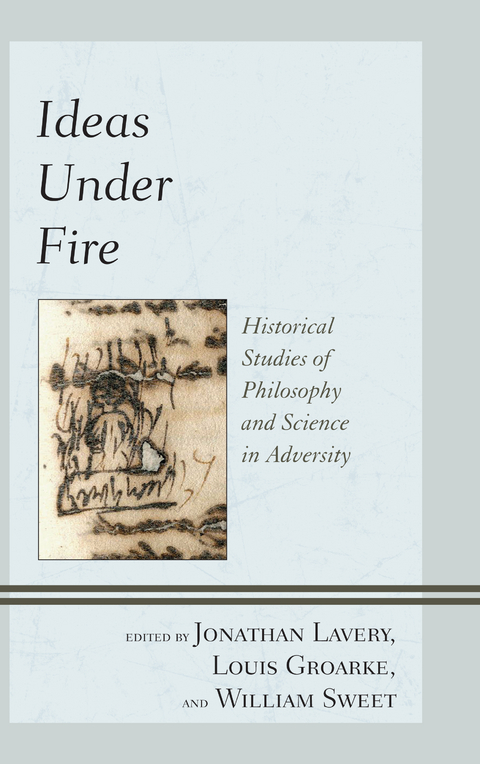
Ideas under Fire (eBook)
386 Seiten
Fairleigh Dickinson University Press (Verlag)
978-1-61147-543-2 (ISBN)
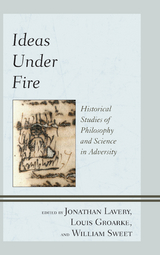
Since Aristotle's famous declaration that the speculative sciences originated with the emergence of a leisure class, it has been accepted as a truism that intellectual activity requires political stability and leisure in order to flourish. Paradoxically, however, some of the most powerful and influential contributions to Western intellectual culture have been produced in conditions that were adverse-indeed hostile-to intellectual activity. Examples include Socrates' stirring defense of the examined life before a hostile Athenian jury, Boethius writing The Consolation of Philosophy under the specter of impending torture and execution, Galileo devising key notions for modern mechanics while under house arrest, and Jean-Paul Sartre drafting portions of Being and Nothingness in his war diaries, to name only a few of the most famous incidents-all extraordinary achievements spawned, developed or completed in adversity. In cases such as these, a philosopher or scientist must manage somehow to remain intellectually creative and focused despite living in conditions that are adverse or hostile to thought. In brief, they are working on ideas under fire.This book is a survey of several momentous cases of philosophers and scientists working under fire. Each chapter of Ideas Under Fire explores a particular case or set of related cases. For each case contributors consider two questions: How did the individual at the center of a particular moment of discovery overcome such formidable obstacles to leisure and conceptually abstract thought? And how did adversity shape their thinking under fire?Each chapter has been written by a specialist on its respective subject, and the book covers every period of Western history. All the chapters are written in an accessible style that is intended to appeal to both specialists and generalists.
Jonathan Lavery is associate professor at Wilfrid Laurier University in Ontario, Canada Louis Groarke is associate professor of philosophy at St. Francis Xavier University, Nova Scotia, Canada. William Sweet is professor of philosophy at St Francis Xavier University, Nova Scotia, Canada.
Foreword 1. Prophets and Gadflies, Leisure and AdversityJonathan Lavery; WLU (Philosophy)Section I: Ancient & Mediaeval2. Plato in the CritoSteven Robinson; Brandon University (Philosophy)3. Grief and Homecoming in Boetheus' Consolation of PhilosophyJames Crooks; Bishop’s University (Philosophy)4. A Universe Created and Eternal: the Crisis in Faith in the 13th CenturyWilliam Carroll; Blackfriars College,Oxford (Theology)Section II: Renaissance & Modern5. Why Giordano Bruno’s ‘Tranquil Philosophy’ Ended in a FireHilary Gatti; Universita di Roma, "La Sapienza" (Literature/Philosophy)6. Galileo under Fire and under Patronage Maurice Finocchiaro; University of Nevada, Las Vegas (Philosophy)7. Science during the French RevolutionMaurice Crosland; University of Kent (History)8. Hegel and the Crises of His TimesWilliam Conklin; University of Windsor (Law)Section III: Twentieth Century9. Henri Bergson and the Question of the Philosopher’s Political Commitment Jean-Benoît Ghenne; l’Université Catholique de Louvain (Philosophy) Louis Groarke; St. Francis Xavier University (Philosophy)10. Simone Weil and the Traps of Intellectual Engagement Robin Lathangue; Trent University (Head of Colleges)11. The Impact of World War II on Jean-Paul Sartre’s WritingsChristine Daigle; Brock University (Philosophy)12. Political Philosophy under ApartheidWilliam Sweet; St. Francis Xavier University (Philosophy)Section IV: Contemporary13. Guerrilla Theory and the Origins of the Second Wave: FBI and CIA harassment of radical second wave feminists in the 1960s and 1970sHilary Davis; York University (Philosophy)14. Was Science Under Fire in Bush's America?Stephen Haller; Wilfrid Laurier University (Contemporary Studies) James Gerrie; University College of Cape Breton (Philosophy)15. The Limits of Philosophy: setting out the legal framework for dissentPaul Groarke; St Thomas University(Endowed Chair of Criminal Justice)BibliographyAbout the Contributors
| Erscheint lt. Verlag | 26.10.2012 |
|---|---|
| Sprache | englisch |
| Themenwelt | Geisteswissenschaften ► Geschichte ► Allgemeine Geschichte |
| Geisteswissenschaften ► Philosophie ► Geschichte der Philosophie | |
| Geisteswissenschaften ► Philosophie ► Philosophie der Neuzeit | |
| Naturwissenschaften | |
| Sozialwissenschaften | |
| Schlagworte | Philosophy • theory |
| ISBN-10 | 1-61147-543-0 / 1611475430 |
| ISBN-13 | 978-1-61147-543-2 / 9781611475432 |
| Informationen gemäß Produktsicherheitsverordnung (GPSR) | |
| Haben Sie eine Frage zum Produkt? |
 EPUB (Adobe DRM)
Kopierschutz: Adobe-DRM
Adobe-DRM ist ein Kopierschutz, der das eBook vor Mißbrauch schützen soll. Dabei wird das eBook bereits beim Download auf Ihre persönliche Adobe-ID autorisiert. Lesen können Sie das eBook dann nur auf den Geräten, welche ebenfalls auf Ihre Adobe-ID registriert sind.
Details zum Adobe-DRM
Dateiformat: EPUB (Electronic Publication)
EPUB ist ein offener Standard für eBooks und eignet sich besonders zur Darstellung von Belletristik und Sachbüchern. Der Fließtext wird dynamisch an die Display- und Schriftgröße angepasst. Auch für mobile Lesegeräte ist EPUB daher gut geeignet.
Systemvoraussetzungen:
PC/Mac: Mit einem PC oder Mac können Sie dieses eBook lesen. Sie benötigen eine
eReader: Dieses eBook kann mit (fast) allen eBook-Readern gelesen werden. Mit dem amazon-Kindle ist es aber nicht kompatibel.
Smartphone/Tablet: Egal ob Apple oder Android, dieses eBook können Sie lesen. Sie benötigen eine
Geräteliste und zusätzliche Hinweise
Buying eBooks from abroad
For tax law reasons we can sell eBooks just within Germany and Switzerland. Regrettably we cannot fulfill eBook-orders from other countries.
aus dem Bereich