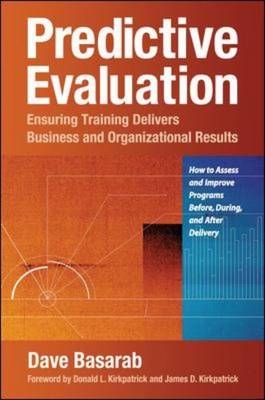
Predictive Evaluation (eBook)
200 Seiten
Berrett-Koehler Publishers (Verlag)
978-1-60509-857-9 (ISBN)
This work supports a process called Predictive Evaluation (PE) which enables practitioners to provide executives with compelling training data around the success of training in the three areas of Intention, Adoption, and Impact. PEalso works to determine whether success has been achieved, and provides lead indicators of future adoption (transfer of learning) along with recommendations for continuous improvement. PE provides measurement dashboard along with tactics for improving results. Predicting, the core operational concept in this approach, is a 'before-the-fact' method which allows key decision makers to select the best training programs to support company strategy and operating plans. Another way to think about this model is:
Predicting is before-the-fact to decide if to train.
Evaluating is after-the-fact measurement against the predictions.
There are four ways that the PE approach differs from other models in the field, namely:
1. Whereas traditional approaches focus on costs and numbers, not on forecasting financial return, PE focuses on the predicted impact and its value-add to the organization.
2. Whereas traditional approaches view evaluation as after-the-fact with no measures of success, PE employs repeated measures that mirror employees' path to improved performance with predicted 'success gates'.
3. Whereas ROI and/or Cost-Benefit evaluations traditionally rely on subjective estimates, PE provides concrete, business-focused and evidence-based data on return on investment and does not use statistical averages based on subjective estimates of improved performance or productivity.
4. Whereas existing approaches work on an after-the-fact basis with one-off programs, PE offers a determined prediction of the extent of transfer and impact and works well with programs that have repeated deliveries over a period of time.
Lacking the information that PE provides, decision makers could fail to support those training programs that have the greatest potential for producing significant value to the company.
When decision makers decide to spend large sums of money on training, they seek to evaluate their options as they evaluate other large investments - that is so on the basis on financial returns to the company. This work shows those decision makers how to accurately determine the potential ROI on such training programs before committing to the
At last, an answer to the question that has bedeviled trainers for decades. Predictive evaluation enables you to effectively and accurately forecast training's value to your company, measure against these predictions, establish indicators to track your progress, make midcourse corrections, and report the results in a language that business executives respond to and understand. Dave Basarab explains how to begin by identifying the specific goals and beliefs you want to instill in participants. The next step is to determine exactly what these will look like when put into action. Finally you develop quantifiable measures of how employees' adopting the target beliefs and goals will impact the business. A key strength of this process is that it is profoundly collaborativesupervisors and employees work together to establish standards for success each step of the way. A how-to guide filled with worksheets, examples, and other tools, Predictive Evaluation ensures that, rather than being regarded as an expense and an act of faith, training will be seen as an investment with a concrete payoff.
| Erscheint lt. Verlag | 13.12.2010 |
|---|---|
| Sprache | englisch |
| Themenwelt | Sachbuch/Ratgeber |
| Sozialwissenschaften ► Pädagogik ► Berufspädagogik | |
| Wirtschaft ► Betriebswirtschaft / Management ► Personalwesen | |
| ISBN-10 | 1-60509-857-4 / 1605098574 |
| ISBN-13 | 978-1-60509-857-9 / 9781605098579 |
| Informationen gemäß Produktsicherheitsverordnung (GPSR) | |
| Haben Sie eine Frage zum Produkt? |
 PDF (Adobe DRM)
Kopierschutz: Adobe-DRM
Adobe-DRM ist ein Kopierschutz, der das eBook vor Mißbrauch schützen soll. Dabei wird das eBook bereits beim Download auf Ihre persönliche Adobe-ID autorisiert. Lesen können Sie das eBook dann nur auf den Geräten, welche ebenfalls auf Ihre Adobe-ID registriert sind.
Details zum Adobe-DRM
Dateiformat: PDF (Portable Document Format)
Mit einem festen Seitenlayout eignet sich die PDF besonders für Fachbücher mit Spalten, Tabellen und Abbildungen. Eine PDF kann auf fast allen Geräten angezeigt werden, ist aber für kleine Displays (Smartphone, eReader) nur eingeschränkt geeignet.
Systemvoraussetzungen:
PC/Mac: Mit einem PC oder Mac können Sie dieses eBook lesen. Sie benötigen eine
eReader: Dieses eBook kann mit (fast) allen eBook-Readern gelesen werden. Mit dem amazon-Kindle ist es aber nicht kompatibel.
Smartphone/Tablet: Egal ob Apple oder Android, dieses eBook können Sie lesen. Sie benötigen eine
Geräteliste und zusätzliche Hinweise
Buying eBooks from abroad
For tax law reasons we can sell eBooks just within Germany and Switzerland. Regrettably we cannot fulfill eBook-orders from other countries.
aus dem Bereich