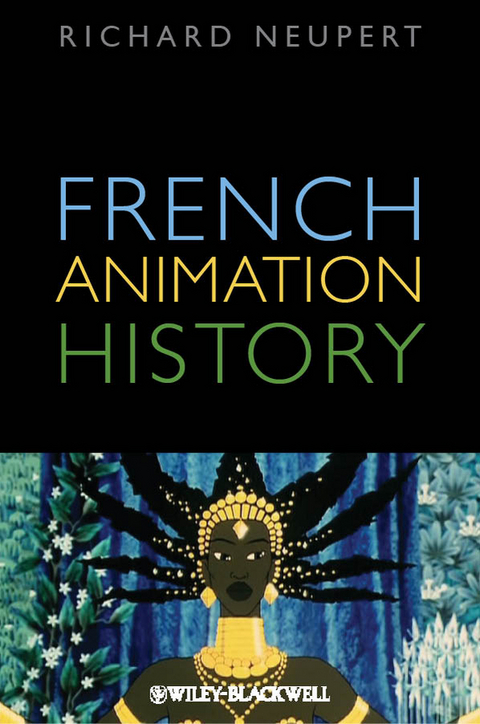
History of Animated Cinema (eBook)
216 Seiten
Wiley-Blackwell (Verlag)
9781444392579 (ISBN)
The overall structure of Animation: History and Narration is chronological, with considerable attention given to the rise of American animation, including its rocky transition from a creative, disorganized cottage industry in the 1910s to a more rigid studio system by the 1930s, where individual studios including Disney, Paramount’s Fleischer, and Warner Brothers, launched their own house styles. The stability of classical American animation in the 1930s, 40s, and 50s, however, was challenged during the 1960s when television permanently altered animation’s norms for production, distribution, and exhibition. The volume emphasizes innovative and transitional animators, such as Chuck Jones, Tex Avery, and Jay Ward, who helped rethink American animation but also struggled as the systems changed in the face of declining budgets and series formats.
Animation: History and Narration also addresses the aesthetic range of computer animation, including the non-representational work of John Whitney in the 1960s, and the experimentation of Disney’s Tron (1982), up to feature films today. Central to the study of recent animation is Pixar, whose approach to story, character movement, and hyper-realistic details has proven so dominant today, paralleling Disney’s role during the classical era. Pixar’s films, including Toy Story (1995) and Finding Nemo (2003), build upon slightly different classic traditions than their contemporaries such as Dreamworks’ Shrek (2001) and Blue Sky’s Ice Age (2002)
While this study is centered on American animation, the volume also investigates distinctive international animators and several important national cinemas for expanded understanding of viable options over the past 100 years, including Len Lye, Norman McLaren Caroline Leaf, and Robert Breer. Neupert considers those cartoons that forge lively alternatives to commercial American conventions, including Canada’s long history of prestigious output by Marv Newland and John Weldon, England’s Nick Park (Chicken Run, Wallace and Gromit), France’s renaissance (Triplets of Belleville, Kirikou...), and Hong Kong (My Life as McDull). The field of Japanese anime is investigated in its own crucial chapter, which outlines key moments and genres, including exemplary motion pictures, sexually transgressive and violent films, and the phenomenally successful work of auteur Hayao Miyazaki.
Recurring thematic concerns include gender and ethnic representations, but the book’s overall chronological organization privileges the historical development of story structures and stylistic markers, making the reader acutely aware of fundamental technical and artistic issues involved in the appreciation of animated motion pictures. While there is regular reference to television and other media, the book remains focused on cinema. Finally, Animation: History and Narration helps situate animation as a vibrant, essential facet of cinema studies.
Richard Neupert is the Wheatley Professor of the Arts and a Josiah Meigs Distinguished Teaching Professor in Film Studies at the University of Georgia. His previous books include A History of the French New Wave Cinema (2007) and The End: Narration and Closure in the Cinema, as well as translations from French of Aesthetics of Film (Aumont, et al) and The French New Wave (Marie).
Richard Neupert is the Wheatley Professor of the Arts and a Josiah Meigs Distinguished Teaching Professor in Film Studies at the University of Georgia.
Figures ix
Plates xiii
Acknowledgments xvii
1 Introduction: The Rise of Animation in France 1
The Beginnings of Animation 4
Stop-Motion Animation Attractions 19
2 Silent Animation: Emile Cohl and his Artisanal Legacy 22
Emile Cohl, Caricature, and the Rise of Studio Animation 22
Emile Cohl at Pathé, Eclipse, and Eclair Studios 36
Graphic Art and the Cartoon: Lortac and O'Galop 45
But is it "Animation?" French Avant-Garde and Moving Pictures 54
3 French Animation and the Coming of Sound 60
Ladislas Starewich's Fabled Puppets 61
Berthold Bartosch's L'Idée: A Working-Class Allegory 73
Jean Painlevé's La Barbe bleue 78
Alexandre Alexeieff, Claire Parker, and the Pinscreen 82
Niche Cartoons: Lyrical Joie de vivre and the Surreal La Fortune enchantée 90
4 Toward an Alternative Studio Structure 99
Paul Grimault and the Artist-Owned Animation Studio 100
Transitional Animation: From High Art to Made-for-TV 107
Toward a New Era of Micro-Studios: Laguionie and Laloux 114
5 French Animation's Renaissance 124
Le Cartoon Plan 124
Michel Ocelot's Alternative Mode of Production 127
Comic Book Aesthetics and Niche Studios 139
Contemporary French Animation: 2006 and Beyond 149
6 Conclusion: French Animation Today 162
References 171
Further Reading 178
Index 181
"Neupert expertly integrates the lives and exploits of the
animators with the plots of films they produced and with the trends
and issues in the profession...Summing Up: Highly recommended."
- Choice
"French Animation History is a richly informed and
highly readable scholarly book that will appeal both to specialists
in the field and to the curious interested in this popular, and
often neglected, dimension of French filmmaking." -
H-France Review
"French Animation History helps the reader discover
a coherent but diverse world, starting in the nineteenth century, a
chain of independent craftsmen and artists, leading to an active
twenty-first century, and pushing us - from any country
- towards more perseverance, creativity, humanity, freedom,
passion." - Michel Ocelot
"Neupert expertly integrates the lives and exploits of the
animators with the plots of films they produced and with the trends
and issues in the profession." - Choice
Chapter 1
Introduction
The Rise of Animation in France
If cinema marvelously expresses an age dominated by science, it is because cinema is “scientifically founded on movement.” In effect, cinema relies upon a series of mechanisms designed to produce an illusion of animation. (Guido 2007: 28)
Images remained fixed for 32,000 years. Drawings could only move once the camera was invented and put to work reproducing them 24 times a second, filming and projecting them. That is the real cinematic revolution! Animation is a completely virtual art which logically leads into the synthetic image and the modern world. The modern revolution was born with Emile Reynaud and his projected animation in 1892. Live action cinema with actors is merely a pale copy of reality. It is moving photography. … But the moving photograph will never be as magical as the moving drawing! (René Laloux, in Blin 2004: 148)
From the very beginning there was great potential for animation in France. Importantly, the French had built up strong traditions in the visual and graphic arts, scientific inquiry, and theatrical spectacles during the late 1800s and early 1900s. Artists from around the world came to Paris to study the fine arts and decorative arts, leading to one of the richest eras for aesthetic experimentation across the media. A number of avant-garde artists, including Marcel Duchamp, Man Ray, and Fernand Léger, were drawn toward experimenting with the representation of time and motion and became fascinated with animated cinema's potential. It is true that France never possessed large specialized commercial animation studios during the silent or classical sound eras. Nonetheless, French animation has always existed and its animators have managed to turn out some incredibly creative and influential animation over the years. The bulk of that work has been produced by a relatively limited number of small animation firms and individual animators, often working parallel to other modern artists, exploring their media and looking for unique aesthetic approaches to animating images. Until fairly recently, animation remained on the economic periphery of French film production. French animation has also suffered from film critics and historians who have concentrated almost exclusively on France's famed avant-garde movements and narrative auteurism. Yet the history of animation is essential for understanding French film culture, its history, and its reception. Fortunately, there has been something of a renaissance in animation production within France over the past 20 years, which has motivated new interest in the long and, and as we shall see, frequently torturous history of French cartoons.
Animation has always been a more highly visible component of American film production than in France, and Hollywood cartoons have also received much more attention from film studies over the years. American animation began with a wide range of styles, techniques, and subjects during the silent era, much like in France. But American animation quickly became standardized as cartoons shifted from ink on paper to clear cels over painted backdrops. In Hollywood, animation fell into step with many conventions of live action filmmaking. By the 1930s, some major studios, including Warner Bros. and MGM, established their own animation wings while others, such as RKO and Paramount, entered into production and distribution deals with specialized animation companies like Disney and Fleischer. Hollywood's cartoon industry was built around division of labor, recurring characters and cartoon series, fixed durations of 6 to 8 minutes. American cartoons also received guaranteed distribution and thus predictable income. Most animation was commercially viable and highly capitalized. While there was creative differentiation from studio to studio, the output remained relatively similar, as even the series titles such as Merry Melodies and Looney Tunes (Warners), Silly Symphonies (Disney), and Happy Harmonies (MGM), suggest. Further, since the cartoons were produced under the institutionalized conditions of classical Hollywood cinema, they were also subject to regulation by the Motion Picture Producers and Distributors Association, which included censorship at the hands of the Production Code Administration. Cartoons were a very stable, successful, family friendly component of the American film industry.
By contrast, French animators worked more independently, like their colleagues in the plastic arts, or they formed small firms to create short animated motion picture commercials to be shown before the regular shows in theaters. These advertising contracts could ideally provide regular income and help bankroll more personal sorts of animated films on the side. Yet, as we shall see, animation remained a fragile cottage industry in France, an artisanal practice produced by individual auteurs or very small teams of animators. Although France was home to the world's first large movie studios, Pathé and Gaumont, animation was never a large part of their output. By the 1920s and 1930s, Pathé and Gaumont were primarily distributing independent and foreign films, including American cartoons. They did not have any sort of in-house animation unit during the years of classical cinema. Unlike Disney's animators or directors such as Chuck Jones and Tex Avery at Warner Bros., French animators never had access to long-term contracts, crews of assistants and in-betweeners, professional music and sound effects departments, or staff camera operators to compile and photograph their work. In France, animation teams were small and necessarily self-sufficient, working within an art cinema mode of production. The result is a fascinating cluster of films by individual stylists struggling to survive on the margins of a national film industry that was not really built to support their productions. Despite those conditions and challenges, the contributions of French animation have managed to be strong and varied over the past 120 years. Moreover, even before the first movies by Louis Lumière in 1895, France proved instrumental to the rise of animation and the representation of movement.
Motion picture animation fully exploits the potential of the cinematic apparatus, from camera to lab to projector. Thus, it seems valuable to situate cartoons at the very heart of cinematic technology and practice, rather than treating them as some marginal side-show or second-tier subset of national cinema. French Animation History investigates the rise and development of French animation, chronicles the norms and conventions of particular animators and their small, niche studios, and tests how story structures, graphic style, and sound strategies have shifted across time. Importantly, French animation exploits a wide range of techniques, some of which, from the earliest modes of animated pictures to the most contemporary computer generated and motion capture technology, even defy narrow definitions of animated cinema. While there is some reference here to television and other media, this study remains focused on cinema, helping situate animation as a vibrant, essential facet of film studies. France has also been a major player in exploring and exploiting new technologies. With the advances in computer generated imaging and digital compositing, the distinction “live action/not live” becomes less functional every day with each new development, further shifting various forms of animation to the core of film production today (Denslow 1997: 2). But even from the very earliest forms of motion devices, animation was a fundamental component for the successful recording and projection of moving images.
The Beginnings of Animation
Explanations of the origins of animation typically do not differ much from summaries of the origins of cinema itself. Survey histories often begin by mentioning cave paintings, magic lantern shows, and nineteenth-century motion devices. For many, when Ice Age's (Wedge, Saldanha, 2002) wooly mammoth Manfred wanders into a cave only to discover primitive sketches of men killing his ancestors, it is a poignant self-referential acknowledgment of modern animation's place in the history of humanity's deep-seated desire to represent movement. Paul Wells agrees that animation, in one form or another, has almost always been with us and cites Lucretius as describing a mechanism for projecting hand-drawn images onto a screen as early as 70 bc (Wells 1998: 11). Much later, optics and magic lantern shows during the seventeenth and eighteenth centuries were often initiated by scientists but adapted for public presentations of various sorts of lectures and entertainment spectacles. Some historians even argue that once the magic lantern was mass produced in the 1800s, it became “the first medium to contest the printed word as a primary mode of information and instruction” (Gunning 2000: xxvii). Certainly, by the nineteenth century, when the illusion of motion became quite common thanks to a wide variety of toys, scientific devices, and serial photography experiments, there were many amusements and businesses devoted to replicating movement, rather than just presenting series of images.
Paris, along with London, Berlin, and Brussels, was among the cities boasting networks of important scientists specializing in experiments involving the capturing of fixed images and replication of motion. One of the earliest instruments was the spinning thaumatrope, which might have a drawing of an empty bird cage on one side, and a painted bird on the other. When the device is spun around fast enough, the viewer's perception joins the two images and a...
| Erscheint lt. Verlag | 8.3.2011 |
|---|---|
| Sprache | englisch |
| Themenwelt | Kunst / Musik / Theater ► Film / TV |
| Sozialwissenschaften ► Kommunikation / Medien ► Medienwissenschaft | |
| Schlagworte | Cultural Studies • Filmforschung • Film Studies • Geschichte des Filmtheaters • History of Cinema • Kulturwissenschaften • Pathé, animated film, Cohl, Grimault, Ocelot, Fantastic Planet, Triplets of Belleville, Persepolis, stop-motion animation, studio animation, French avant-garde, cartoons, comics, graphic novels |
| ISBN-13 | 9781444392579 / 9781444392579 |
| Informationen gemäß Produktsicherheitsverordnung (GPSR) | |
| Haben Sie eine Frage zum Produkt? |
 EPUB (Adobe DRM)
Kopierschutz: Adobe-DRM
Adobe-DRM ist ein Kopierschutz, der das eBook vor Mißbrauch schützen soll. Dabei wird das eBook bereits beim Download auf Ihre persönliche Adobe-ID autorisiert. Lesen können Sie das eBook dann nur auf den Geräten, welche ebenfalls auf Ihre Adobe-ID registriert sind.
Details zum Adobe-DRM
Dateiformat: EPUB (Electronic Publication)
EPUB ist ein offener Standard für eBooks und eignet sich besonders zur Darstellung von Belletristik und Sachbüchern. Der Fließtext wird dynamisch an die Display- und Schriftgröße angepasst. Auch für mobile Lesegeräte ist EPUB daher gut geeignet.
Systemvoraussetzungen:
PC/Mac: Mit einem PC oder Mac können Sie dieses eBook lesen. Sie benötigen eine
eReader: Dieses eBook kann mit (fast) allen eBook-Readern gelesen werden. Mit dem amazon-Kindle ist es aber nicht kompatibel.
Smartphone/Tablet: Egal ob Apple oder Android, dieses eBook können Sie lesen. Sie benötigen eine
Geräteliste und zusätzliche Hinweise
Buying eBooks from abroad
For tax law reasons we can sell eBooks just within Germany and Switzerland. Regrettably we cannot fulfill eBook-orders from other countries.
aus dem Bereich