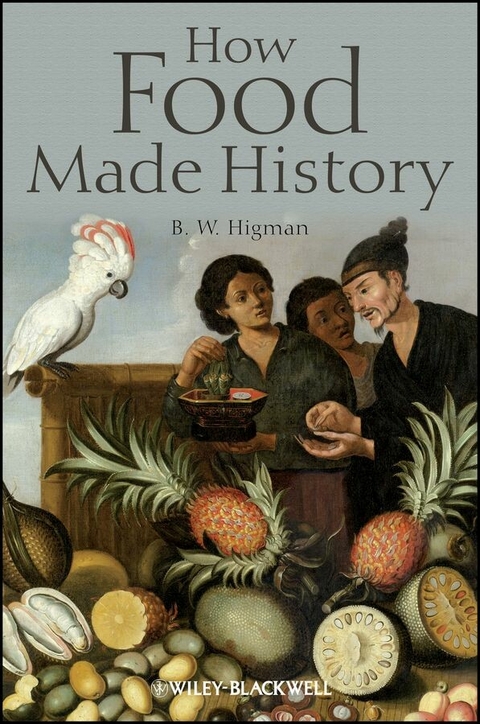
How Food Made History (eBook)
John Wiley & Sons (Verlag)
978-1-4443-4465-3 (ISBN)
- Charts the changing technologies that have increased crop yields, enabled the industrial processing and preservation of food, and made transportation possible over great distances
- Considers social attitudes towards food, religious prohibitions, health and nutrition, and the politics of distribution
- Offers a fresh understanding of world history through the discussion of food
B. W. Higman is Emeritus Professor of the Australian National University and Emeritus Professor of the University of the West Indies. He has published several books on the history of slavery and the social and economic history of the Caribbean. He has taught courses on world food history, and is the author of Jamaican Food: History, Biology, Culture (2008).
Covering 5,000 years of global history, How Food Made History traces the changing patterns of food production and consumption that have molded economic and social life and contributed fundamentally to the development of government and complex societies. Charts the changing technologies that have increased crop yields, enabled the industrial processing and preservation of food, and made transportation possible over great distances Considers social attitudes towards food, religious prohibitions, health and nutrition, and the politics of distribution Offers a fresh understanding of world history through the discussion of food
B. W. Higman is Emeritus Professor of the Australian National University and Emeritus Professor of the University of the West Indies. He has published several books on the history of slavery and the social and economic history of the Caribbean. He has taught courses on world food history, and is the author of Jamaican Food: History, Biology, Culture (2008).
Illustrations viii
Preface ix
Prologue: Questions of choice? 1
References 5
1 The Creation of Food Worlds 7
Making the ancient world food map 8
The origins of domestication, agriculture, and urbanization
11
Food worlds at 5000 BP 15
Seven claims 29
References 31
2 Genetics and Geography 35
Genetic modification, ancient and modern 36
Prohibitions and taboos 43
Geographical redistribution 47
Three claims 53
References 53
3 Forest, Farm, Factory 57
Forest gardens 58
Crop farming landscapes 62
Industrialized agriculture 70
Five claims 77
References 78
4 Hunting, Herding, Fishing 81
Hunting 83
Herding 91
Fishing 94
Two claims 100
References 100
5 Preservation and Processing 103
Ancient preservation 103
Ancient processing 106
Modern milling 108
Packaging 111
Freezing and chilling 112
Milk, butter, yoghurt, and cheese 115
Three claims 123
References 123
6 Trade 125
Ancient trades 126
Modern trades 131
The global supermarket 136
Two claims 140
References 141
7 Cooking, Class, and Consumption 143
Cooks 143
Cooking 146
Eating places 149
Meals and mealtimes 156
References 158
8 National, Regional, and Global Cuisines 161
Cuisine, high and low 164
The origins of cuisines 168
Megaregions and pan-ethnicity 182
Global foods 185
Three claims and counterclaims 188
References 188
9 Eating Well, Eating Badly 191
Nutrition and diet 191
Stature 195
Obesity 199
Dieting 203
Denial 204
Vegetarianism 207
References 211
10 Starving 215
Famine 217
Famine foods 224
Survival strategies 226
Food aid 228
Impact 232
Two claims 234
References 235
Conclusion: Cornucopia or Pandora's Box? 237
References 241
Suggested Further Reading 243
Index 251
". . . an excellent short introduction for the general
reader." (BBC History Magazine, 1
October 2012)
'How Food Made History is a magisterial work. Using an
impressive array of sources, Higman situates the
20th-century green revolution within the context of the
agricultural revolution that occurred in prehistory and offers
surprising insights into our relationship with the natural world.
This book argues convincingly that our food choices today remain
remarkably similar to those that faced our distant forebears. A
must-read for anyone interested in the larger history of
food.'
--Darra Goldstein, Editor in Chief, Gastronomica: The
Journal of Food and Culture
'Higman has done an admirable job of synthesizing a vast
array of material into a readable account spanning millennia...
a very impressive book and an enjoyable read.'
--Rebecca Earle, University of Warwick
'A fascinating history of food but more as well: an
exploration of how human beings have interacted with and affected
their environment in trying to obtain enough to eat as well as
seeking pleasure and variety.'
--Paul Freedman, Yale University
| Erscheint lt. Verlag | 8.8.2011 |
|---|---|
| Sprache | englisch |
| Themenwelt | Geisteswissenschaften ► Geschichte ► Allgemeine Geschichte |
| Geschichte ► Teilgebiete der Geschichte ► Kulturgeschichte | |
| Sozialwissenschaften | |
| Schlagworte | Abundance • Book • Broader • Center • Centrality • Cultural • Developments • enjoy • examines • Food • Geschichte • Global • History • illuminates • Life • Patterns • Social & Cultural History • Societies • Sozial- u. Kulturgeschichte • Time • Transition • USA /Gesellschaft, Sozialwissenschaften • vital driver • wideranging overview |
| ISBN-10 | 1-4443-4465-X / 144434465X |
| ISBN-13 | 978-1-4443-4465-3 / 9781444344653 |
| Informationen gemäß Produktsicherheitsverordnung (GPSR) | |
| Haben Sie eine Frage zum Produkt? |
 EPUB (Adobe DRM)
Kopierschutz: Adobe-DRM
Adobe-DRM ist ein Kopierschutz, der das eBook vor Mißbrauch schützen soll. Dabei wird das eBook bereits beim Download auf Ihre persönliche Adobe-ID autorisiert. Lesen können Sie das eBook dann nur auf den Geräten, welche ebenfalls auf Ihre Adobe-ID registriert sind.
Details zum Adobe-DRM
Dateiformat: EPUB (Electronic Publication)
EPUB ist ein offener Standard für eBooks und eignet sich besonders zur Darstellung von Belletristik und Sachbüchern. Der Fließtext wird dynamisch an die Display- und Schriftgröße angepasst. Auch für mobile Lesegeräte ist EPUB daher gut geeignet.
Systemvoraussetzungen:
PC/Mac: Mit einem PC oder Mac können Sie dieses eBook lesen. Sie benötigen eine
eReader: Dieses eBook kann mit (fast) allen eBook-Readern gelesen werden. Mit dem amazon-Kindle ist es aber nicht kompatibel.
Smartphone/Tablet: Egal ob Apple oder Android, dieses eBook können Sie lesen. Sie benötigen eine
Geräteliste und zusätzliche Hinweise
Buying eBooks from abroad
For tax law reasons we can sell eBooks just within Germany and Switzerland. Regrettably we cannot fulfill eBook-orders from other countries.
aus dem Bereich