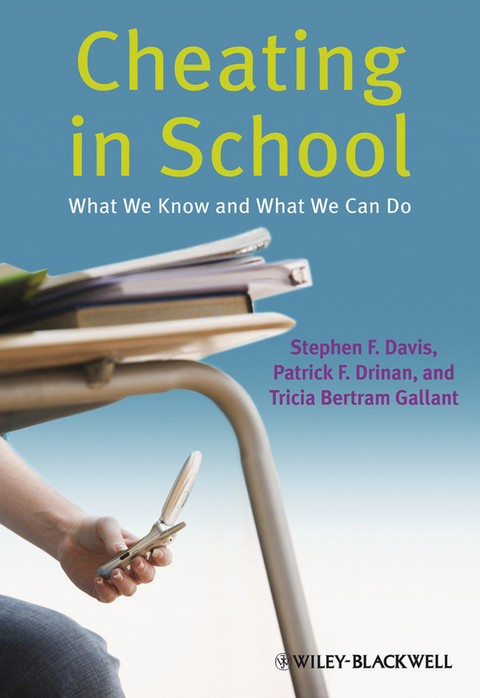
Cheating in School (eBook)
John Wiley & Sons (Verlag)
978-1-4443-1026-9 (ISBN)
Stephen F. Davis is Emeritus Professor at Emporia State University. In 2002-2003 he served as the Knapp Distinguished Professor of Arts and Sciences at the University of San Diego. In 2007 he was awarded the Doctor of Humane Letters degree by Morningside College (Sioux City, IA). Currently he is the Distinguished Guest Professor at Morningside College and Visiting Distinguished Professor of Psychology at Texas Wesleyan University. Since 1966 he has published over 300 articles on various research topics and 27 textbooks and presented over 900 professional papers; the vast majority of these publications and presentations include student coauthors. He has served as President of APA Division 2, Southern Society for Philosophy and Psychology, Southwestern Psychological Association, and Psi Chi (the National Honor Society in Psychology). Additionally, he was selected as the first recipient of the Psi Chi Florence L. Denmark Faculty Advisor Award. He is a Fellow of APA Divisions 1 (General), 2 (Society for the Teaching of Psychology), 3 (Experimental), and 6 (Behavioral Neuroscience and Comparative Psychology). Patrick F. Drinan, Professor of Political Science at the University of San Diego, completed his Ph.D. in 1972 at the University of Virginia, and it was there that he first developed his interest in academic integrity. Drinan served as the dean of the College of Arts and Sciences at the University of San Diego from 1989-2007 and has been active in the Center for Academic Integrity since the mid-1990s. He has authored and co-authored many articles on academic integrity this last decade and has served as a consultant on academic integrity at the university level. He is the 2006 recipient of the Donald McCabe Award for Liftime Achievement in the firld of academic integrity. Tricia Bertram Gallant serves as the Academic Integrity Coordinator at the University of California, San Diego. In this capacity, she is responsible for managing the university's Policy on Integrity of Scholarship and its corresponding processes, educating the campus community on academic integrity, assisting faculty in implementing short-term cheating deterrents, and working with key campus constituencies on long-term deterrents and initiatives to create a culture of academic integrity on campus. Bertram Gallant has also been active with the Center for Academic Integrity since 2002, having served as a member of its Board of Directors and as the chair of its Advisory Council. She has authored and co-authored (with Patrick Drinan) many articles on academic integrity, which have been published in The Journal of Higher Education, The Review of Higher Education, NASPA, and the Canadian Journal of Higher Education, and is the sole author of Academic Integrity in the Twenty-First Century: A Teaching and Learning Imperative, published by Jossey-Bass in 2008.
About the Authors.
Preface.
1 Cheating in Our Schools, Colleges, and Universities: A
Critical Problem for the Twenty-First Century.
2 The Nature and Prevalence of Student Cheating.
3 Reasons for Academic Dishonesty: Situation, Disposition, and
Changing Times.
4 From Cheat Sheet to Text Messaging: The Evolution of
Techniques.
5 Short-Term Deterrents: Strategies for Class, Labs, and Online
Testing.
6 Long-Term Deterrents: Development of Individual and
Institutional Integrity.
7 The Call for Action and Wisdom: Conversations That Make a
Difference.
8 Refining Our Tactics and Strategies.
9 An Optimistic (and Provocative) Conclusion: Finding the Good
in Student Cheating.
Notes.
Author index.
Subject index.
"The plan includes infusing academic integrity into the fabric of
schools, colleges or universities, developing student character and
integrity, responding to cheating, reducing temptations and
opportunities for cheating, and acknowledging that cheating happens
and it is a problem." (Suite101.com, 23 November 2010)
"A comprehensive look at the cheating phenomenon from primary
through graduate school." (Faculty Focus, October 2009)
"[The authors] combine their years of interest in and experience
with issues of academic integrity to provide an overview of the
problem of academic dishonesty at all levels of education.... This
is the first attempt to synthesize all levels and several nations
in a concise, readable format accessible to the general reader.The
authors cite plenty of real-world examples and suggest usable
tactics and strategies ... thus making the book useful for
educators as well as lay readers.... A great overview of a
significant subject, accessibly accomplished." (Library
Journal, October 2009)
"I found Cheating in School to be a good read.... I recommend
this book to both faculty and administrators who must deal with
this issue in their work." (International Higher Education
Consulting Blog, October 2009)
"Although much of the specific advice in the book is U.S.
focused, the genuine and broad-ranging vision offered by the
authors make the lessons applicable internationally."
(International Journal for Educational Integrity, June
2009)
"In a high-stakes society where the ends are often valued more than
the means, cheating has permeated all levels of education. This
book is a must-have for anyone wishing to understand the causes of
cheating and find ways to prevent its occurrence."
-Bryan K. Saville, James Madison University
"Cheating in School provides a compelling call to action.
Rather than simply sensationalizing individual cases of cheating,
it provides a broad and balanced perspective and outlines
reasonable short and long-term actions we can all take."
-Lauren Scharff, Ph.D, Director of the Center
for the Scholarship of Teaching and Learning (SoTL), U. S. Air
Force Academy
"This book combines the work of experienced authors who have
unique knowledge of different facets of academic integrity and its
attendant problems. Working together, they have created a volume
that brings together the various stakeholders concerned with
academic cheating. They articulate the problem and define it in all
its myriad forms, from the student who copies another's exam
to the parent who 'helps' more than she should.
The book prompts the reader to wonder why cheating is not central
to the 21st-century education agenda, and how our values become
circumvented or distorted in relation to this issue."
-Ken Keith, University of San Diego
"Cheating in school: What we know and what we can do, is
perhaps the most comprehensive and accessible text on the topic of
academic integrity that I have read. What makes this book
special is the clear intention of the authors to look beyond the
individual to the broader institutional and societal milieu within
which student cheating occurs, but always with clearly articulated
optimism. Stephen Davis, Patrick Drinan and Tricia Bertram Gallant
should be congratulated on this carefully and elegantly constructed
presentation of the field."
-Tracey Bretag, Editor, International Journal for
Educational Integrity, University of South Australia
| Erscheint lt. Verlag | 8.10.2009 |
|---|---|
| Sprache | englisch |
| Themenwelt | Geisteswissenschaften ► Psychologie |
| Sozialwissenschaften ► Pädagogik ► Didaktik | |
| Schlagworte | Cheating, school, academic, dishonesty, cheating behavior • Learning Theory & Research • Lerntheorie u. -forschung • plagiarism, academic integrity, detecting cheating, preventing cheating, honor code, school cheating, academic honesty, behavior, education, high school, college, higher education, educators, administrators, honor code, cheat sheets. • Psychologie • Psychology |
| ISBN-10 | 1-4443-1026-7 / 1444310267 |
| ISBN-13 | 978-1-4443-1026-9 / 9781444310269 |
| Informationen gemäß Produktsicherheitsverordnung (GPSR) | |
| Haben Sie eine Frage zum Produkt? |
 PDF (Adobe DRM)
Kopierschutz: Adobe-DRM
Adobe-DRM ist ein Kopierschutz, der das eBook vor Mißbrauch schützen soll. Dabei wird das eBook bereits beim Download auf Ihre persönliche Adobe-ID autorisiert. Lesen können Sie das eBook dann nur auf den Geräten, welche ebenfalls auf Ihre Adobe-ID registriert sind.
Details zum Adobe-DRM
Dateiformat: PDF (Portable Document Format)
Mit einem festen Seitenlayout eignet sich die PDF besonders für Fachbücher mit Spalten, Tabellen und Abbildungen. Eine PDF kann auf fast allen Geräten angezeigt werden, ist aber für kleine Displays (Smartphone, eReader) nur eingeschränkt geeignet.
Systemvoraussetzungen:
PC/Mac: Mit einem PC oder Mac können Sie dieses eBook lesen. Sie benötigen eine
eReader: Dieses eBook kann mit (fast) allen eBook-Readern gelesen werden. Mit dem amazon-Kindle ist es aber nicht kompatibel.
Smartphone/Tablet: Egal ob Apple oder Android, dieses eBook können Sie lesen. Sie benötigen eine
Geräteliste und zusätzliche Hinweise
Buying eBooks from abroad
For tax law reasons we can sell eBooks just within Germany and Switzerland. Regrettably we cannot fulfill eBook-orders from other countries.
aus dem Bereich