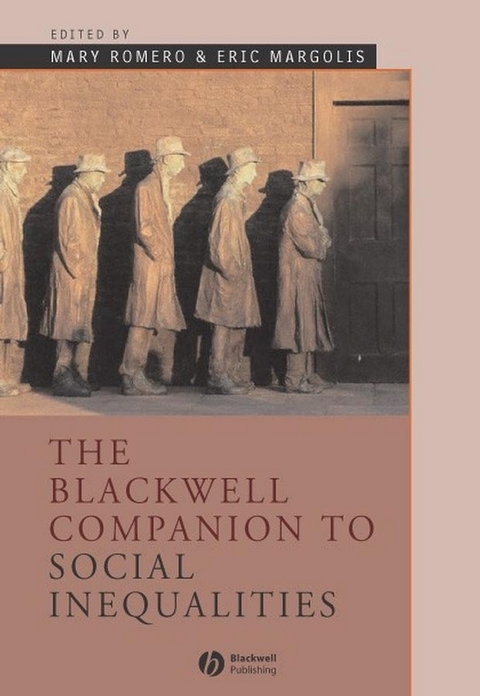
The Blackwell Companion to Social Inequalities (eBook)
John Wiley & Sons (Verlag)
978-1-4051-5206-8 (ISBN)
Mary Romero is Professor at Arizona State University and the 2004 recipient of the Lee Founders Award given by the Society for the Study of Social Problems. She is currently co-chair elect of LatCrit Inc. She is the author of Maid in the USA (1992) and her coedited books include Challenging Fronteras (1997), Women's Untold Stories (1999), and Latina and Latino Popular Culture (2002). Eric Margolis is Associate Professor in the Division of Educational Leadership and Policy Studies at Arizona State University. His recent publications include: AIDS Research/AIDS Policy: Competing Paradigms of Science and Public Policy, Researchin Social Policy, Volume 6 (1998), and The Hidden Curriculum in Higher Education (2001).
List of Figures.
List of Tables.
Notes on Contributors.
Acknowledgements.
Introduction.
Part I: Conceptualizing Inequalities:.
1. Historical Perspectives on Inequality: Charles Tilly
(Columbia University).
2. Social Exclusion: New Inequality Paradigm for the Era of
Globalization?: Ronaldo Munck (University of Liverpool).
3. Unequal Nations: Race, Citizen, and the Politics of
Recognition: Sallie Westwood (University of Manchester).
4. Intimate Citizenship in an Unjust World: Ken Plummer
(University of Essex).
5. Domination, Resistance, and Subjectivity: Barry D. Adam
(University of Windsor).
Part II: Epistemology, Method, and Inequality:.
6. Conceptualizing a Critical Race Theory in Sociology: Tara J.
Yosso (University of California, Santa Barbara) and Daniel G.
Solórzano (University of California, Los Angeles).
7. Environmental Racism: Inequality in a Toxic World: David
Pellow (University of California, San Diego).
8. Labor-market Inequality: Intersections of Gender, Race, and
Class: Irene Browne (Emory University) and Joya Misra (University
of Massachusetts-Amherst).
9. What Counts? Definition, Measurement, and Legitimacy in
Studies of Homelessness: Malcolm Williams (University of
Plymouth).
Part III: Family, Community, and Education:.
10. Children and Inequality: Julia Wrigley and Joanna Dreby
(both City University of New York).
11. Parenting and Inequality: Rachel Grob (Sarah Lawrence
College) and Barbara Katz Rothman (City University of New
York).
12. Migrant Networks: A Summary and Critique of Relational
Approaches to International Migration: Steven J. Gold (Michigan
State University).
13. Race, Education, and Inequality: Caroline Hodges Persell and
Giselle F. Hendrie (both New York University).
Part IV: Policy Responses to Inequalities:.
14. Beyond Dependency: Welfare States and the Configuration of
Social Inequality: Lynne Haney (New York University) and Robin
Rogers-Dillon (City University of New York).
15. Inequalities, Crime, and Citizenship: Nigel South
(University of Essex).
16. Disability and Social Inequalities: Mark Priestley
(University of Leeds).
17. Culture of Medicine and Racial, Ethnic, and Class
Disparities in Healthcare: Mary-Jo DelVecchio Good (Harvard Medical
School), Cara James (Harvard University), Byron J. Good (Harvard
Medical School), and Anne E. Becker(Harvard Medical School).
18. The Nervous Gaze: Backpacking in Africa: Claudia Bell
(University of Auckland).
19. Origins and Contours of the Population Debate: Inequality,
Population.
Politics, and NGOs: Tulsi Patel: University of Delhi and Navtej
Purewal (University of Manchester).
Part V: Media, Technology, and Inequalities:.
20. Selling Images of Inequality: Hollywood Cinema and the
Reproduction of Racial and Gender Stereotypes: Norman K. Denzin
(University of Illinois, Urbana-Champaign).
21. In the Shadow of Cultural Imperialism: Television and
National Identities in the Era of Globalization: Chris Barker
(University of Wollongong).
22. Minding the Cyber-Gap, The Internet and Social Inequality:
Wenhong Chen (University of Toronto) and Barry Wellman (University
of Toronto).
23. New Global Technologies of Power: Cybernetic Capitalism and
Social Inequality: Stephen Pfohl (Boston College).
Index
"The topic of social inequality is so vast that no one
collection of articles will ever be definitive. Having said that,
this collection is as close to that mark as I have seen since
Bendix and Lipset's Class, Status and Power."
Troy Duster, New York University
"The editors and the diverse group of scholars they have
brought together give us one of today's definitive
sociological examinations of inequality. They remind us that
inequalities are produced, and they revisit the multiple
interpretations we have come up with over the decades."
Saskia Sassen, author of Globalization and its
Discontents
"The Blackwell Companion to Social Inequalities is
one of those unique texts that transcend the limits of earlier
efforts, transforming learning and teaching opportunities in its
area. Highly recommended." Howard Winant, University of
California at Santa Barbara
"The book is an excellent international and up to date reference
volume on social inequality." Reference Reviews
| Erscheint lt. Verlag | 8.5.2008 |
|---|---|
| Reihe/Serie | Blackwell Companions to Sociology |
| Blackwell Companions to Sociology | Wiley Blackwell Companions to Sociology |
| Sprache | englisch |
| Themenwelt | Sozialwissenschaften ► Ethnologie |
| Sozialwissenschaften ► Politik / Verwaltung | |
| Sozialwissenschaften ► Soziologie ► Makrosoziologie | |
| Sozialwissenschaften ► Soziologie ► Spezielle Soziologien | |
| Schlagworte | attention • Bildung von Klassen u. Schichten • Blackwell • Class & Stratification • Collection • Companion • debates • Field • firstrate • Highlights • Inequalities • international • Orientations • Philosophie • Philosophy • Range • scholars • Scholarship • Science • Scope • Social • social inequalities • Social Philosophy • Sociology • Sozialphilosophie • Soziologie • Special • Themes • Theoretical • Topics • Volume |
| ISBN-10 | 1-4051-5206-0 / 1405152060 |
| ISBN-13 | 978-1-4051-5206-8 / 9781405152068 |
| Informationen gemäß Produktsicherheitsverordnung (GPSR) | |
| Haben Sie eine Frage zum Produkt? |
 PDF (Adobe DRM)
Kopierschutz: Adobe-DRM
Adobe-DRM ist ein Kopierschutz, der das eBook vor Mißbrauch schützen soll. Dabei wird das eBook bereits beim Download auf Ihre persönliche Adobe-ID autorisiert. Lesen können Sie das eBook dann nur auf den Geräten, welche ebenfalls auf Ihre Adobe-ID registriert sind.
Details zum Adobe-DRM
Dateiformat: PDF (Portable Document Format)
Mit einem festen Seitenlayout eignet sich die PDF besonders für Fachbücher mit Spalten, Tabellen und Abbildungen. Eine PDF kann auf fast allen Geräten angezeigt werden, ist aber für kleine Displays (Smartphone, eReader) nur eingeschränkt geeignet.
Systemvoraussetzungen:
PC/Mac: Mit einem PC oder Mac können Sie dieses eBook lesen. Sie benötigen eine
eReader: Dieses eBook kann mit (fast) allen eBook-Readern gelesen werden. Mit dem amazon-Kindle ist es aber nicht kompatibel.
Smartphone/Tablet: Egal ob Apple oder Android, dieses eBook können Sie lesen. Sie benötigen eine
Geräteliste und zusätzliche Hinweise
Buying eBooks from abroad
For tax law reasons we can sell eBooks just within Germany and Switzerland. Regrettably we cannot fulfill eBook-orders from other countries.
aus dem Bereich