James Hitchcock is Professor of History at St. Louis University. He is the author of six books, including Catholicism and Modernity.
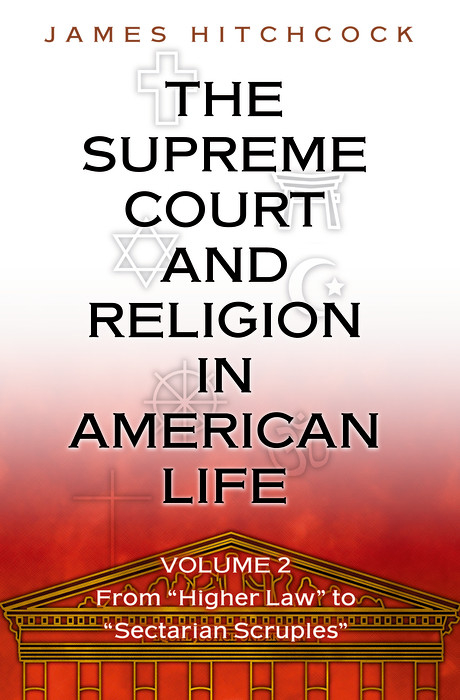
School vouchers. The Pledge of Allegiance. The ban on government grants for theology students. The abundance of church and state issues brought before the Supreme Court in recent years underscores an incontrovertible truth in the American legal system: the relationship between the state and religion in this country is still fluid and changing. This, the second of two volumes by historian and legal scholar James Hitchcock, offers a complete analysis and interpretation of the Court's historical understanding of religion, explaining the revolutionary change that occurred in the 1940s. In Volume I: The Odyssey of the Religion Clauses (Princeton), Hitchcock provides the first comprehensive survey of the court cases involving the Religion Clauses, including a number that scholars have ignored. Here, Hitchcock examines how, in the early history of our country, a strict separation of church and state was sustained through the opinions of Jefferson and Madison, even though their views were those of the minority. Despite the Founding Fathers' ideas, the American polity evolved on the assumption that religion was necessary to a healthy society, and cooperation between religion and government was assumed. This view was seldom questioned until the 1940s, notes Hitchcock. Then, with the beginning of the New Deal and the appointment of justices who believed they had the freedom to apply the Constitution in new ways, the judicial climate changed. Hitchcock reveals the personal histories of these justices and describes how the nucleus of the Court after World War II was composed of men who were alienated from their own faiths and who looked at religious belief as irrational, divisive, and potentially dangerous, assumptions that became enshrined in the modern jurisprudence of the Religion Clauses. He goes on to offer a fascinating look at how the modern Court continues to grapple with the question of whether traditional religious liberty is to be upheld.
James Hitchcock is Professor of History at St. Louis University. He is the author of six books, including Catholicism and Modernity.
| Erscheint lt. Verlag | 10.1.2009 |
|---|---|
| Reihe/Serie | New Forum Books | New Forum Books |
| Verlagsort | Princeton |
| Sprache | englisch |
| Themenwelt | Geschichte ► Teilgebiete der Geschichte ► Militärgeschichte |
| Geisteswissenschaften ► Religion / Theologie | |
| Recht / Steuern ► Allgemeines / Lexika | |
| Recht / Steuern ► EU / Internationales Recht | |
| Recht / Steuern ► Öffentliches Recht | |
| Recht / Steuern ► Rechtsgeschichte | |
| Sozialwissenschaften ► Ethnologie | |
| Sozialwissenschaften ► Soziologie | |
| Schlagworte | agnosticism • Amendment • anti-catholicism • Antonin Scalia • Atheism • attempt • Baptists • Blasphemy law • Blue law • Calvinism • Catechism • Catholic Church • Catholicism • Catholic school • Ceremonial deism • Chaplain • Christian Ethics • Christianity • Civil Religion • Clergy • concurrence • congregational church • Conscience • conscientious objector • Constitutionality • Criticism • de facto • Definition of religion • Deism • Deliberation • Dissenter • Doctrine • Establishment Clause • Exclusion • Fraud • freedom of religion • freedom of speech • Heresy • hypocrisy • Ideology • indoctrination • Institution • Irreligion • Jehovah's Witnesses • Jews • Judaism • Jurisprudence • Law and Religion • Legislation • Lemon v. Kurtzman • Liberalism • Majority opinion • Methodism • moment of silence • Morality • mormons • nonbeliever • of education • Old Testament • original intent • Orthodoxy • Pacifism • parochial school • Paul Blanshard • piety • plaintiff • Political System • Politics • Precedent • Prejudice • Presbyterianism • proclamation • Protestantism • Public morality • Public Policy • Religion • Religiosity • Religious Community • Religious education • religious experience • religious persecution • School Prayer • Sectarianism • Secularism • Secularization • seminary • separation of church and state • Separation of church and state in the United States • separatism • State law (United States) • State Religion • Subsidy • Supreme being • Tax • Tax exemption • Theology • The Other Hand • Toleration • Unitarianism • virtue |
| ISBN-10 | 1-4008-2626-8 / 1400826268 |
| ISBN-13 | 978-1-4008-2626-1 / 9781400826261 |
| Informationen gemäß Produktsicherheitsverordnung (GPSR) | |
| Haben Sie eine Frage zum Produkt? |
 PDF (Wasserzeichen)
Größe: 885 KB
DRM: Digitales Wasserzeichen
Dieses eBook enthält ein digitales Wasserzeichen und ist damit für Sie personalisiert. Bei einer missbräuchlichen Weitergabe des eBooks an Dritte ist eine Rückverfolgung an die Quelle möglich.
Dateiformat: PDF (Portable Document Format)
Mit einem festen Seitenlayout eignet sich die PDF besonders für Fachbücher mit Spalten, Tabellen und Abbildungen. Eine PDF kann auf fast allen Geräten angezeigt werden, ist aber für kleine Displays (Smartphone, eReader) nur eingeschränkt geeignet.
Systemvoraussetzungen:
PC/Mac: Mit einem PC oder Mac können Sie dieses eBook lesen. Sie benötigen dafür einen PDF-Viewer - z.B. den Adobe Reader oder Adobe Digital Editions.
eReader: Dieses eBook kann mit (fast) allen eBook-Readern gelesen werden. Mit dem amazon-Kindle ist es aber nicht kompatibel.
Smartphone/Tablet: Egal ob Apple oder Android, dieses eBook können Sie lesen. Sie benötigen dafür einen PDF-Viewer - z.B. die kostenlose Adobe Digital Editions-App.
Buying eBooks from abroad
For tax law reasons we can sell eBooks just within Germany and Switzerland. Regrettably we cannot fulfill eBook-orders from other countries.
 EPUB (Adobe DRM)
Kopierschutz: Adobe-DRM
Adobe-DRM ist ein Kopierschutz, der das eBook vor Mißbrauch schützen soll. Dabei wird das eBook bereits beim Download auf Ihre persönliche Adobe-ID autorisiert. Lesen können Sie das eBook dann nur auf den Geräten, welche ebenfalls auf Ihre Adobe-ID registriert sind.
Details zum Adobe-DRM
Dateiformat: EPUB (Electronic Publication)
EPUB ist ein offener Standard für eBooks und eignet sich besonders zur Darstellung von Belletristik und Sachbüchern. Der Fließtext wird dynamisch an die Display- und Schriftgröße angepasst. Auch für mobile Lesegeräte ist EPUB daher gut geeignet.
Systemvoraussetzungen:
PC/Mac: Mit einem PC oder Mac können Sie dieses eBook lesen. Sie benötigen eine
eReader: Dieses eBook kann mit (fast) allen eBook-Readern gelesen werden. Mit dem amazon-Kindle ist es aber nicht kompatibel.
Smartphone/Tablet: Egal ob Apple oder Android, dieses eBook können Sie lesen. Sie benötigen eine
Geräteliste und zusätzliche Hinweise
Buying eBooks from abroad
For tax law reasons we can sell eBooks just within Germany and Switzerland. Regrettably we cannot fulfill eBook-orders from other countries.
aus dem Bereich