Mark Tushnet is Carmack Waterhouse Professor of Constitutional Law at the Georgetown University Law Center. He is the author of Taking the Constitution Away from the Courts (Princeton) and was President of the Association of American Law Schools for 2003.
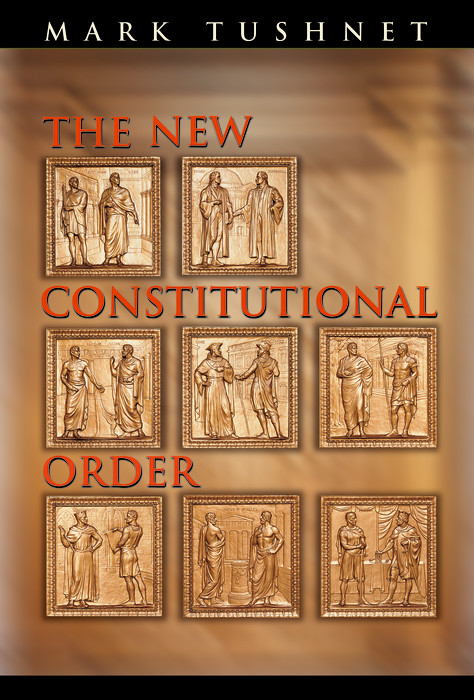
In his 1996 State of the Union Address, President Bill Clinton announced that the "e;age of big government is over."e; Some Republicans accused him of cynically appropriating their themes, while many Democrats thought he was betraying the principles of the New Deal and the Great Society. Mark Tushnet argues that Clinton was stating an observed fact: the emergence of a new constitutional order in which the aspiration to achieve justice directly through law has been substantially chastened. Tushnet argues that the constitutional arrangements that prevailed in the United States from the 1930s to the 1990s have ended. We are now in a new constitutional order--one characterized by divided government, ideologically organized parties, and subdued constitutional ambition. Contrary to arguments that describe a threatened return to a pre-New Deal constitutional order, however, this book presents evidence that our current regime's animating principle is not the old belief that government cannot solve any problems but rather that government cannot solve any more problems. Tushnet examines the institutional arrangements that support the new constitutional order as well as Supreme Court decisions that reflect it. He also considers recent developments in constitutional scholarship, focusing on the idea of minimalism as appropriate to a regime with chastened ambitions. Tushnet discusses what we know so far about the impact of globalization on domestic constitutional law, particularly in the areas of international human rights and federalism. He concludes with predictions about the type of regulation we can expect from the new order. This is a major new analysis of the constitutional arrangements in the United States. Though it will not be received without controversy, it offers real explanatory and predictive power and provides important insights to both legal theorists and political scientists.
Mark Tushnet is Carmack Waterhouse Professor of Constitutional Law at the Georgetown University Law Center. He is the author of Taking the Constitution Away from the Courts (Princeton) and was President of the Association of American Law Schools for 2003.
| Erscheint lt. Verlag | 9.2.2009 |
|---|---|
| Verlagsort | Princeton |
| Sprache | englisch |
| Themenwelt | Recht / Steuern ► Allgemeines / Lexika |
| Recht / Steuern ► EU / Internationales Recht | |
| Recht / Steuern ► Öffentliches Recht ► Verfassungsrecht | |
| Sozialwissenschaften ► Politik / Verwaltung ► Staat / Verwaltung | |
| Schlagworte | Adjudication • Affirmative Action • Alexander Bickel • Amendment • attempt • Bill Clinton • bipartisanship • Brown v. Board of Education • Bruce Ackerman • bush v. gore • Calculation • candidate • Cass Sunstein • Civil Rights Act of 1964 • Commandeering • commerce clause • Congress • Consideration • constitutional crisis • Constitutionalism • Constitutionality • constitutional law • Constitutional theory • Critical Legal Studies • Dealignment • Deliberation • Deregulation • divided government • Doctrine • Employment • Equal Protection Clause • Ex parte Young • Federal government of the United States • federal law • freedom of speech • George W. Bush • Governance • Governing (magazine) • Government • government agency • Great Society • Harvard Law Review • Ideology • Impeachment • injunction • Institution • International human rights law • Judicial Activism • Judicial interpretation • Jurisdiction • Jurisprudence • Lawmaking • Law of the United States • lawyer • Legislation • Legislator • Legislature • Lyndon B. Johnson • Member of Congress • Michigan Law Review • National policy • New Federalism • Nomination • Party System • Planned Parenthood v. Casey • Policy • Political Party • Political Science • Politician • Politics • Precedent • presumption • Privatization • Prosecutor • Public Policy • Realigning election • Reconstruction Amendments • Regime • Regulation • right to property • Roe v. Wade • Ronald Reagan • Sanford Levinson • Second Bill of Rights • Sociology • State court (United States) • State Government • State law (United States) • Statute • Statutory interpretation • Stephen Breyer • supermajority • Tax • Term limit • Treaty • United States v. Lopez • Voting • welfare • Welfare reform • What Happened |
| ISBN-10 | 1-4008-2555-5 / 1400825555 |
| ISBN-13 | 978-1-4008-2555-4 / 9781400825554 |
| Informationen gemäß Produktsicherheitsverordnung (GPSR) | |
| Haben Sie eine Frage zum Produkt? |
 PDF (Wasserzeichen)
Größe: 652 KB
DRM: Digitales Wasserzeichen
Dieses eBook enthält ein digitales Wasserzeichen und ist damit für Sie personalisiert. Bei einer missbräuchlichen Weitergabe des eBooks an Dritte ist eine Rückverfolgung an die Quelle möglich.
Dateiformat: PDF (Portable Document Format)
Mit einem festen Seitenlayout eignet sich die PDF besonders für Fachbücher mit Spalten, Tabellen und Abbildungen. Eine PDF kann auf fast allen Geräten angezeigt werden, ist aber für kleine Displays (Smartphone, eReader) nur eingeschränkt geeignet.
Systemvoraussetzungen:
PC/Mac: Mit einem PC oder Mac können Sie dieses eBook lesen. Sie benötigen dafür einen PDF-Viewer - z.B. den Adobe Reader oder Adobe Digital Editions.
eReader: Dieses eBook kann mit (fast) allen eBook-Readern gelesen werden. Mit dem amazon-Kindle ist es aber nicht kompatibel.
Smartphone/Tablet: Egal ob Apple oder Android, dieses eBook können Sie lesen. Sie benötigen dafür einen PDF-Viewer - z.B. die kostenlose Adobe Digital Editions-App.
Buying eBooks from abroad
For tax law reasons we can sell eBooks just within Germany and Switzerland. Regrettably we cannot fulfill eBook-orders from other countries.
 EPUB (Adobe DRM)
Kopierschutz: Adobe-DRM
Adobe-DRM ist ein Kopierschutz, der das eBook vor Mißbrauch schützen soll. Dabei wird das eBook bereits beim Download auf Ihre persönliche Adobe-ID autorisiert. Lesen können Sie das eBook dann nur auf den Geräten, welche ebenfalls auf Ihre Adobe-ID registriert sind.
Details zum Adobe-DRM
Dateiformat: EPUB (Electronic Publication)
EPUB ist ein offener Standard für eBooks und eignet sich besonders zur Darstellung von Belletristik und Sachbüchern. Der Fließtext wird dynamisch an die Display- und Schriftgröße angepasst. Auch für mobile Lesegeräte ist EPUB daher gut geeignet.
Systemvoraussetzungen:
PC/Mac: Mit einem PC oder Mac können Sie dieses eBook lesen. Sie benötigen eine
eReader: Dieses eBook kann mit (fast) allen eBook-Readern gelesen werden. Mit dem amazon-Kindle ist es aber nicht kompatibel.
Smartphone/Tablet: Egal ob Apple oder Android, dieses eBook können Sie lesen. Sie benötigen eine
Geräteliste und zusätzliche Hinweise
Buying eBooks from abroad
For tax law reasons we can sell eBooks just within Germany and Switzerland. Regrettably we cannot fulfill eBook-orders from other countries.
aus dem Bereich