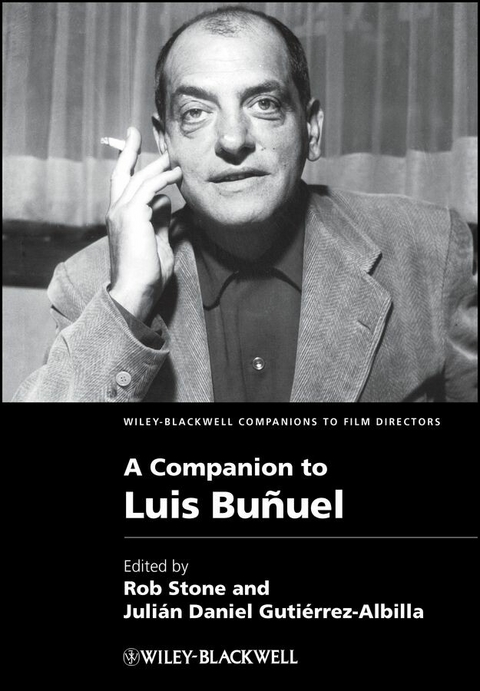
A Companion to Luis Buñuel presents a collection of critical readings by many of the foremost film scholars that examines and reassesses myriad facets of world-renowned filmmaker Luis Buñuel's life, works, and cinematic themes.
- A collection of critical readings that examine and reassess the controversial filmmaker's life, works, and cinematic themes
- Features readings from several of the most highly-regarded experts on the cinema of Buñuel
- Includes a multidisciplinary range of approaches from experts in film studies, Hispanic studies, Surrealism, and theoretical concepts such as those of Gilles Deleuze
- Presents a previously unpublished interview with Luis Buñuel's son, Juan Luis Buñuel
Rob Stone is Professor of European Film in the Department of Art History, Film and Visual Studies at the University of Birmingham where he directs B-Film: The Birmingham Centre for Film Studies. He is the author of Spanish Cinema (2001), The Wounded Throat: Flamenco in the Works of Federico García Lorca and Carlos Saura (2004), Julio Medem (2007) and Walk, Don't Run: The Cinema of Richard Linklater (2013).
Julián Daniel Gutiérrez Albilla is Assistant Professor of Spanish at the University of Southern California. He has published on a wide range of Hispanic films including articles and chapters in edited works on Pedro Almodóvar, Hector Babenco, Luis Buñuel or Lucrecia Martel. He is the author of Queering Buñuel: Sexual Dissidence and Psychoanalysis in his Mexican and Spanish Cinema (2008).
A Companion to Luis Bu uel presents a collection of critical readings by many of the foremost film scholars that examines and reassesses myriad facets of world-renowned filmmaker Luis Bu uel s life, works, and cinematic themes. A collection of critical readings that examine and reassess the controversial filmmaker s life, works, and cinematic themes Features readings from several of the most highly-regarded experts on the cinema of Bu uel Includes a multidisciplinary range of approaches from experts in film studies, Hispanic studies, Surrealism, and theoretical concepts such as those of Gilles Deleuze Presents a previously unpublished interview with Luis Bu uel s son, Juan Luis Bu uel
Rob Stone is Professor of European Film in the Department of Art History, Film and Visual Studies at the University of Birmingham where he directs B-Film: The Birmingham Centre for Film Studies. He is the author of Spanish Cinema (2001), The Wounded Throat: Flamenco in the Works of Federico García Lorca and Carlos Saura (2004), Julio Medem (2007) and Walk, Don't Run: The Cinema of Richard Linklater (2013). Julián Daniel Gutiérrez Albilla is Assistant Professor of Spanish at the University of Southern California. He has published on a wide range of Hispanic films including articles and chapters in edited works on Pedro Almodóvar, Hector Babenco, Luis Buñuel or Lucrecia Martel. He is the author of Queering Buñuel: Sexual Dissidence and Psychoanalysis in his Mexican and Spanish Cinema (2008).
A Companion to Luis Buñuel 5
Copyright 6
Contents 7
Contributors 10
Acknowledgments 20
Introduction 21
An Aragonese Dog 26
A Golden Age 31
The Forgotten One 34
Strange Passions 38
An Exterminating Angel 43
Discretion and Desire 55
And in the Spring 60
Note 75
References 75
Part One An Aragonese Dog 79
1 Interview with Juan Luis Buñuel 81
2 Luis Buñuel and the Politics of Self-Presentation 99
Early Days 100
The Man with the Knife: Un chien andalou 100
Assault and Retreat: L’Âge d’or (The Golden Age, 1930) 101
Selling Out and Signing Up: Las Hurdes, aka Tierra sin pan (Land without Bread, 1933/1936) 102
“Buñuel Is Dead”: The United States 103
Hard Times and Potboilers: Mexico 104
Return to Self: Los olvidados 105
A Hot Time: Viridiana 106
Staying Afloat: Publicity 109
The Oscar 111
Versions of Self 112
Playing Buñuel 113
Long Interviews: No Peeking 113
Telling It Like It Should Be: My Last Sigh 114
Notes 116
References 116
3 Buñuel, Master Pyrotechnician: The Role of Firearms in His Cinema 118
Introduction: A Passion for Firearms 118
Buñuel Opens Fire: The Six-Gun Mystique and Western Parody in Un chien andalou 122
L’Âge d’or: Parodic Pyrotechnics and Erotic Pulverization 125
Notes 132
References 134
4 Buñuel’s Critique of Nationalism: A Migratory Aesthetic? 136
Displacement, Misplacement 137
Migratory Aesthetics as a Cultural Politic 140
Sound Out of Place 145
Real, Right, True 148
Transnationalism versus Migratory Aesthetics 151
Notes 154
References 156
Part Two A Golden Age 159
5 Surreal Souls: Un chien andalou and Early French Film Theory 161
The Soul in the 1920s Avant-Garde in France 162
Surrealism and Un chien andalou 167
Notes 173
References 174
6 Fixed-Explosive: Buñuel’s Surrealist Time-Image 176
Notes 190
References 191
7 L’Âge d’or 192
Historical Context 192
Structure 196
Themes and Techniques 202
References 206
8 Buñuel Entomographer: From Las Hurdes to Robinson Crusoe 208
Notes 219
References 220
Part Three The Forgotten One 223
9 The Complicit Eye: Directorial and Ocular Paradigms in Luis Buñuel’s Mexican Films and Interdisciplinary Visuality (1940s and 1950s) 225
Terrains of the “Ojosauro” 225
The Unwholesome Eye and Visual Mediations 230
Cross-cuttings of the Eye in Art and Cinematography 235
The Last Arena 239
Notes 242
References 243
10 Out of Place, Out of Synch: Errant Movement and Rhythm in Buñuel’s Mexican Comedies 246
Conclusion 258
Notes 258
References 258
11 Susana: Melodrama and the Voluptuosity of Destruction 260
Notes 273
References 274
12 Young Outlaws and Marginal Lives in Latin American Cinema: The Landmark of Buñuel’s Los olvidados 275
Introduction 275
The Lesson of the Master 278
Los olvidados: A Classic 281
Conclusion 290
Notes 291
References 294
Part Four Strange Passions 297
13 The Creative Process of Robinson Crusoe: Exile, Loneliness, and Humanism 299
The Origins of an Assignment with Potential 299
Buñuel and the Blacklist: Writing the Script 301
The Shooting and the Script: Nature, Specters, and Instincts 306
The Rewriting of the Script during Editing and Dubbing 312
The Film’s Release and Reception 317
Notes 319
References 320
14 The Cinematic Labor of Affect: Urbanity and Sentimental Education in El bruto and Ensayo de un crimen 322
Learning Urbanity 323
Cinema and the Capture of Affect 326
Taming the Brute 327
Space, Family, and Genre 328
Of Crime, Musical Boxes, and Film Reels 332
Unheard-of Becomings 336
Notes 340
References 341
15 Stars in the Wilderness: La Mort en ce jardin 344
Exiles in Eden 347
Signoret, Piccoli, Marchal: Transnational Transformations? 349
Notes 358
References 358
16 Transitional Triptych: The Traps of International Cinemas in Buñuel’s Cela s’appelle l’aurore, La Mort en ce jardin, and La Fièvre monte à El Pao 360
Cela s’appelle l’aurore 361
La Mort en ce jardin 369
La Fièvre monte à El Pao 375
Conclusion 379
Note 381
References 381
17 Buñuel Goes Medieval: From Sewing to Cervantes and the Vagina Dentata 382
Notes 393
References 395
Part Five An Exterminating Angel 399
18 The Galdós Intertext in Viridiana 401
Buñuel and Literary Adaptations 402
Buñuel and Galdós: Mutual Illumination 404
Galdós Adaptations in Spanish Cinema: Lost Opportunities 412
Notes 415
References 416
19 Spectral Cinema: Le Journal d’une femme de chambre 419
Notes 432
References 433
20 Between God and the Machine: Buñuel’s Cine-Miracles 434
Miracles between Religion and Science 435
The Saint as Cineaste: Simón del desierto 438
Prodigious Travel: La Voie lactée 444
Notes 448
References 449
21 The Road and the Room: Narrative Drive in the Films of Luis Buñuel 451
On the Road and in the Room 451
The Way In and the Way Out: Un chien andalou and L’Âge d’or 455
Insiders and Outsiders: The Transnational Remix in Las Hurdes and Los olvidados 457
Narrative Vehicles in Mexican Road Movies 459
Internalizing the Narrative Vehicle and Eroticizing the Room: From Él to Belle de jour 461
Going on a Pilgrimage or Holding Your Sacred Ground 463
The Final Radical Remix: Le Fantôme de la liberté and Cet obscur objet du désir 466
Those Obscure Dynamics of Desire 469
References 472
Part Six Discretion and Desire 475
22 On a Road to Nowhere: Parodic Movement as Time-Image in La Voie lactée and Le Charme discret de la bourgeoisie 477
Notes 495
References 497
23 The Intertextual Presence of Lewis Carroll’s Alice in Belle de jour 499
Notes 511
References 512
24 Splitting Doubles: Ángela Molina and the Art of Screen Actingin Cet obscur objet du désir 514
Ángela Molina’s First Appearance: Conchita in Mathieu’s Bedroom 516
Conchita at Home 518
Conchita. Not the End 520
Interview with Ángela Molina, held in Madrid, February 19, 2011 522
Notes 528
References 528
25 Buñuel and Historical Reason 529
Notes 535
References 536
26 Through a Fractal Lens: New Perspectives on the Narratives of Luis Buñuel 538
Fractal Films 540
Techniques 543
Parallel Realities and Schrödinger’s cat 550
Notes 552
References 553
Part Seven And in the Spring 555
27 Mutilation, Misogyny, and Murder: Surrealist Violence or Torture Porn? 557
Notes 570
References 572
28 Inside/Outside: Space and Sexual Behavior in Belle de jour and La Pianiste 574
Don’t Box Me In: Confining Interior Space 576
Wanting Out: Desire for Sexual Perversion as a Means of Release 579
Go and Play Outside: Outside Space, Sexual Perversion, and Freedom 582
Inside and Outside: The Transition to Outside Space 585
Reclaiming Space: Belle de jour, La Pianiste, and Henri Lefebvre 587
Conclusion 589
Note 590
References 590
29 Surrealist Legacies: The Influence of Luis Buñuel’s “Irrationality” on Hiroshi Teshigahara’s “Documentary-fantasy” 592
Fredric Jameson’s Cinematic Magic Realism 593
Art-historical and Literary Roots of Magic Realism: An International Mode 595
Los olvidados: Buñuel’s Latin American Marvelous 597
Indigenous Japanese Modernism: Otoshiana and the Struggle for Survival 600
Marvelous Hybridity: A Composite Avant-Garde Response to Late Capitalism 606
References 608
30 Luis Buñuel’s Angel and Maya Deren’s Meshes: Trance and the Cultural Imaginary 610
Two Exiles 611
Repetition as Structure 616
Attacking Visual Space 620
A Communal Nightmare 623
Angel of History 625
References 627
Filmography 628
Index 644
"This attractive and meticulously produced companion is a major
contribution to Buñuel studies ... Summing Up: Highly
recommended. All Bunuel scholars and specialized
collections." (Choice, 1 November 2013)
"A Companion to Luis Buñuel is an
extraordinarily broad and detailed portrait of the master
filmmaker, boasting contributions by some of the very best scholars
in film studies."
Paul Julian Smith, City University of New York
"This multi-faceted volume has a knack for shaking up
received ideas. Thoroughly rethinking Buñuel, it sets his
films free to make their own transformative meanings."
Chris Perriam, University of Manchester
"Drawing on the expertise of international scholars from
different disciplines, A Companion to Luis Buñuel
delivers challenging readings worthy of their enthralling subject.
The scope and originality of these essays greatly enrich discussion
of Buñuel's films."
Isabel Santaolalla, University of Roehampton
| Erscheint lt. Verlag | 12.2.2013 |
|---|---|
| Reihe/Serie | WBCF - Wiley-Blackwell Companions to Film Directors | Wiley Blackwell Companions to Film Directors |
| Sprache | englisch |
| Themenwelt | Kunst / Musik / Theater ► Film / TV |
| Sozialwissenschaften ► Kommunikation / Medien ► Medienwissenschaft | |
| Schlagworte | Auteur, Auteurism, filmmaker, director, Spanish cinema, surrealism, Hispanic film • Bunuel, Luis • Cultural Studies • Europäische Geschichte • European History • Filmforschung • Film Studies • Filmtheorie • Film theory • Geschichte • History • Kulturwissenschaften |
| ISBN-13 | 9781118323106 / 9781118323106 |
| Informationen gemäß Produktsicherheitsverordnung (GPSR) | |
| Haben Sie eine Frage zum Produkt? |
 PDF (Adobe DRM)
Kopierschutz: Adobe-DRM
Adobe-DRM ist ein Kopierschutz, der das eBook vor Mißbrauch schützen soll. Dabei wird das eBook bereits beim Download auf Ihre persönliche Adobe-ID autorisiert. Lesen können Sie das eBook dann nur auf den Geräten, welche ebenfalls auf Ihre Adobe-ID registriert sind.
Details zum Adobe-DRM
Dateiformat: PDF (Portable Document Format)
Mit einem festen Seitenlayout eignet sich die PDF besonders für Fachbücher mit Spalten, Tabellen und Abbildungen. Eine PDF kann auf fast allen Geräten angezeigt werden, ist aber für kleine Displays (Smartphone, eReader) nur eingeschränkt geeignet.
Systemvoraussetzungen:
PC/Mac: Mit einem PC oder Mac können Sie dieses eBook lesen. Sie benötigen eine
eReader: Dieses eBook kann mit (fast) allen eBook-Readern gelesen werden. Mit dem amazon-Kindle ist es aber nicht kompatibel.
Smartphone/Tablet: Egal ob Apple oder Android, dieses eBook können Sie lesen. Sie benötigen eine
Geräteliste und zusätzliche Hinweise
Buying eBooks from abroad
For tax law reasons we can sell eBooks just within Germany and Switzerland. Regrettably we cannot fulfill eBook-orders from other countries.
aus dem Bereich