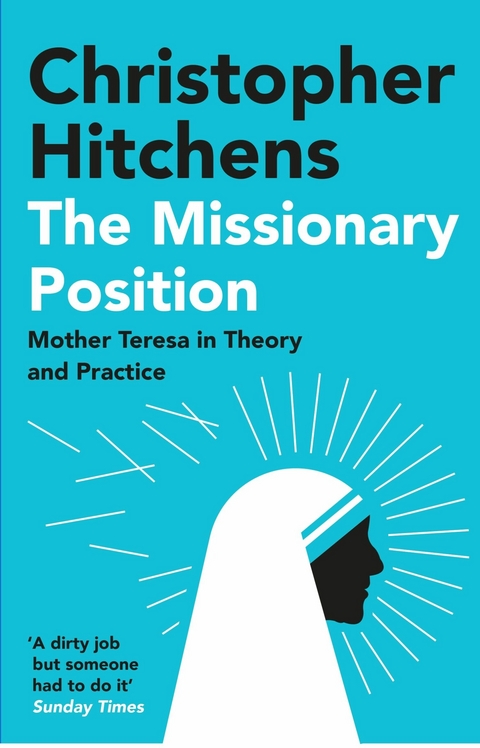
The Missionary Position (eBook)
128 Seiten
Atlantic Books (Verlag)
978-0-85789-840-1 (ISBN)
Christopher Hitchens is a contributing editor to Vanity Fair and Visiting Professor in liberal studies at the New School in New York. He was named one of the world's 'Top 100 Public Intellectuals' by Foreign Policy and Prospect. His books include Love, Poverty & War and Blood, Class & Empire. Thomas Paine's Rights of Man and God Is Not Great were published by Atlantic Books.
Christopher Hitchens (1949-2011) was a contributing editor to Vanity Fair and a regular contributor to the New York times Book Review and Slate. He is the author of numerous books, including works on Thomas Jefferson, Thomas Paine, George Orwell, Henry Kissinger and Bill and Hillary Clinton, as well as his international bestseller and National Book Award nominee, god Is Not Great.
Foreword
During the middle of the last decade, in his great period of political apostasy, Christopher Hitchens often entertained, along with his older left-leaning pals, a sprinkling of younger conservative journalists and operatives, all of them not only thrilled to be in his company—who ever wasn’t?—but also grateful and deeply reassured to have such a blue-chip intellectual on their side of the Iraq War, that historical moment’s great divide.
I would smile quietly while these young men cheered him on and hear-hear’d. Just wait, I’d think, knowing the moment would arrive when the ideological fiddler would have to be paid, when the host would change the topic and the earnest and happy young men would be reduced to looking at their shoes and muttering Oh, well, yes, I suppose. I like to think of this as the Mother Teresa Moment, named for Hitch’s most incendiary cultural dissent but applicable to any subject that might startle the Christian soldiers of the Bush administration into remembering that, apart from Saddam Hussein, Hitch remained entirely his unreconstructed secular and socialist self.
Hitchens’s disdain for the “thieving, fanatical Albanian dwarf”—i.e., Mother Teresa—became so famous that new readers of The Missionary Position may be surprised to discover that the phrase appears nowhere in this slender volume. If the book’s main title produces a guffaw, its subhead (“Mother Teresa in Theory and Practice”) more closely tracks its spirit. Far from being some cackle of defilement, or even just a bit of bad-boy blasphemy, The Missionary Position is, in fact, a modest, rational inquiry, a calm lifting of the veil that drapes its sacred subject. “Once the decision is taken to do without awe and reverence, if only for a moment,” writes Hitchens, “the Mother Teresa phenomenon assumes the proportions of the ordinary and even the political.” The author wishes to examine his subject’s public pronouncements, her finances, projects and associates, and to judge “Mother Teresa’s reputation by her actions and words rather than her actions and words by her reputation.”
Does anyone have a problem with that?
What’s under the veil turns out to be pretty unsightly: Mother Teresa’s missions—backed by a yachtful of grifters from Haitian first lady Michèle Duvalier to 1980s S&L fleecer Charles Keating—are revealed to be less concerned with eliminating the poverty of the poor (and even their attendant physical pain) than with extending those things as their means toward salvation in the afterlife: “The point is not the honest relief of suffering but the promulgation of a cult based on death and suffering and subjection.” Hitchens’s most devastating source is “Mother” herself: She “has never pretended that her work is anything but a fundamentalist religious campaign,” through which the poorest of the poor, the least of these, must grin and bear it until they’re transmuted from being the last to the first.
Hitch being Hitch, he cannot, here and there, resist pouring it on for the reader’s edified delight. Commenting upon the decision of advice columnist Ann Landers to share one of Mother’s prescriptions for improving the world (“smile more”), he writes: “It is . . . doubtful whether a fortune-cookie maxim of such cretinous condescension would have been chosen even by Ann Landers unless it bore the imprimatur of Mother Teresa, one of the few untouchables in the mental universe of the mediocre and the credulous.”
But The Missionary Position remains less a polemic than an investigation rooted in personal passion. In the manner of such intrepid, also-departed colleagues as Oriana Fallaci and Ryszard Kapuściński, Hitchens traveled the world toward eruptions of what fundamentally agitated him, and that was tyranny. “This is,” he writes in the book’s original foreword, “a small episode in an unending argument between those who know they are right and therefore claim the mandate of heaven, and those who suspect that the human race has nothing but the poor candle of reason by which to light its way.” Preferring “antitheist” to “atheist,” Hitchens liked to draw comparisons between Christianity and North Korea, both mental kingdoms offering their inhabitants the chance to commit “thought crime” and to deliver “everlasting praise” of the leader.
This small book is part of a big career devoted to pulverizing cant, deflating oppression, and maximizing human liberty. Not a day went by that Hitch didn’t enter the lists against some iniquity. Nearly all his causes were noble; a few were quixotic and probably not worth his time. I remember one piece he wrote a half-dozen years ago in defense of free speech for David Irving, the Holocaust-denying historian. Writing against the clock, with his usual urgency, he made a slip of the keyboard in an attempted reference to one of Irving’s editors, putting down “Thomas Mallon” for “Thomas Dunne.” Oh, joy, I thought, seeing my name mistakenly next to Irving’s in the pages of The Wall Street Journal. I sent Hitch an e-mail that began, more or less: “I know that to the sons of British naval officers all of us Micks must seem the same, but . . . .” He responded late that night with “Oh, fuck,” or words to that effect—no apology, just an injunction to turn up, the next day, at a demonstration he was organizing to support the Danish cartoonists who’d recently had the temerity to draw the prophet Mohammed. I thought about going, knew that I should, and finally never made it. If you want one more epitaph to add to all the ones that already have been suggested for this dual man-of-letters/man-of-action, let it be: He Showed Up. Throughout his life and times, whenever and wherever something important was on the line, he presented himself.
The Missionary Position appeared in 1995, eight years before Mother Teresa’s beatification, an occurrence that Hitchens had seen rushing our way. He notes in his text how Pope John Paul II was readying so many candidates so quickly for this enhanced status (“the ante-room to sainthood”) that the process had begun to “[recall] the baptism by firehose with which Chinese generals Christianized their armies.”
In the event, Hitchens played a necessary, if negative, role in Mother Teresa’s elevation, testifying before an official church body as to her unworthiness. He explained the task, undertaken in 2001, in the magazine Free Inquiry: “The present pope . . . has abolished the traditional office of ‘Devil’s Advocate,’ so I drew the job of representing the Evil One, as it were, pro bono. Fine by me—I don’t believe in Satan either.” The writer’s wife, Carol, can recall sending Hitch off to Father David O’Connor of the Washington, D.C., archdiocese to perform this strange and futile exercise in debunking, and then welcoming him home to lunch in their apartment on Columbia Road, as if he’d just come back from a radio interview.
Another, even more significant, development—this one, too, coming years after The Missionary Position—was the publication of Mother Teresa’s letters. The spiritual doubts they were discovered to contain created a sensation worthy of the cover of Time. Let me present just one extract: “Jesus has a very special love for you,” Mother Teresa wrote to the Reverend Michael Van Der Peet in 1979, the year she received her Nobel Peace Prize. “As for me, the silence and the emptiness is so great that I look and do not see, listen and do not hear.” No, let’s quote one more passage, just in case this was some momentary slip: “I am told God loves me—and yet the reality of darkness & coldness & emptiness is so great that nothing touches my soul.”
You mean you’re not sure?
Had these letters been available to him in the 1990s, I can hear Hitchens asking Mother Teresa just that question, face-to-face, as she showed him around the Calcutta orphanage. And it seems to me that the existence of such doubts makes her enterprise all the more breathtakingly presumptuous: She in fact was not one of “those who know they are right.” She felt no certainty that the poverty she was barely palliating would lead its sufferers toward an eternal reward. It is one thing to take Pascal’s wager and bet on the existence of God, no matter what one’s doubts may be. But to lead thousands of others to the gaming table, insisting that they double down with their one paltry handful of chips?
After his cancer diagnosis, I often prayed, on my knees and through all my own doubts, for Hitch. Not for his soul; just for his earthly continuation. Nothing bothered me more during the long months of his illness (and suffering) than having to watch interviewers ask him if he might now not be ready to change his mind on matters cosmic. He met such inquiries with a sort of Christian forbearance, treated them as one more teachable moment in which he could explain his position. And throughout this grim period, by his conduct and example, he provided me with one specific religious certainty, the only one I’ve had in a very long time: If God does exist, He would have been deeply disappointed in any renunciation of nonbelief by Christopher Hitchens, that spectacular...
| Erscheint lt. Verlag | 1.4.2012 |
|---|---|
| Verlagsort | London |
| Sprache | englisch |
| Themenwelt | Religion / Theologie ► Christentum ► Kirchengeschichte |
| Geisteswissenschaften ► Sprach- / Literaturwissenschaft ► Literaturwissenschaft | |
| Geisteswissenschaften ► Sprach- / Literaturwissenschaft ► Sprachwissenschaft | |
| Sozialwissenschaften ► Kommunikation / Medien ► Journalistik | |
| Schlagworte | abolition of liberty • AC Grayling • agnosticism • And Yet • AN Wilson • Arguably • Atheism • Atheist • Atlantic • Atlantic Monthly • barack obama • Belief • biblical cristism • blood class and empire • Blood, Class and Empire • Che Guevara • Christianity • christoper hitchens books • clive james • Cultural Amnesia • Daniel Dennett • darwins dangerous idea • Dawkins • Dickens • dickensl • Essay • Essays • George Orwell • Gertrude Bell • god is Not Great • Gore Vidal • Hezbollah • Hillary Clinton • History • Hitch-22 • hitchens • Humour • Ian Fleming • Iran • Islam • Judaism • Literature • love poverty and war • Love, Poverty and War • Makeover • Martin Amis • Michel Onfray • missionary position • Mortality • new atheism • New Statesman • No One Left to Lie to • Orhan Pamuk • Orwell • Patriotism • Political • political books • Politics • politics books • poltics • Religion • religion for athiests • religion poltics • Religious • religious books • Richard Dawkins • Salman Rushdie • Sam Harris • secular humanism • self-improvement • slate • The Abolition of Liberty • The Four Horsemen • the god argument • the god debate • the god delusion • The Missionary Position • Theology • The Trial of Henry Kissinger • The War Against Cliche • Thomas Paine's Rights of Man • trial of henry kissinger • United States Essays 1952-92 • VICE • war against cliche |
| ISBN-10 | 0-85789-840-X / 085789840X |
| ISBN-13 | 978-0-85789-840-1 / 9780857898401 |
| Informationen gemäß Produktsicherheitsverordnung (GPSR) | |
| Haben Sie eine Frage zum Produkt? |
 EPUB (Wasserzeichen)
DRM: Digitales Wasserzeichen
Dieses eBook enthält ein digitales Wasserzeichen und ist damit für Sie personalisiert. Bei einer missbräuchlichen Weitergabe des eBooks an Dritte ist eine Rückverfolgung an die Quelle möglich.
Dateiformat: EPUB (Electronic Publication)
EPUB ist ein offener Standard für eBooks und eignet sich besonders zur Darstellung von Belletristik und Sachbüchern. Der Fließtext wird dynamisch an die Display- und Schriftgröße angepasst. Auch für mobile Lesegeräte ist EPUB daher gut geeignet.
Systemvoraussetzungen:
PC/Mac: Mit einem PC oder Mac können Sie dieses eBook lesen. Sie benötigen dafür die kostenlose Software Adobe Digital Editions.
eReader: Dieses eBook kann mit (fast) allen eBook-Readern gelesen werden. Mit dem amazon-Kindle ist es aber nicht kompatibel.
Smartphone/Tablet: Egal ob Apple oder Android, dieses eBook können Sie lesen. Sie benötigen dafür eine kostenlose App.
Geräteliste und zusätzliche Hinweise
Buying eBooks from abroad
For tax law reasons we can sell eBooks just within Germany and Switzerland. Regrettably we cannot fulfill eBook-orders from other countries.
aus dem Bereich