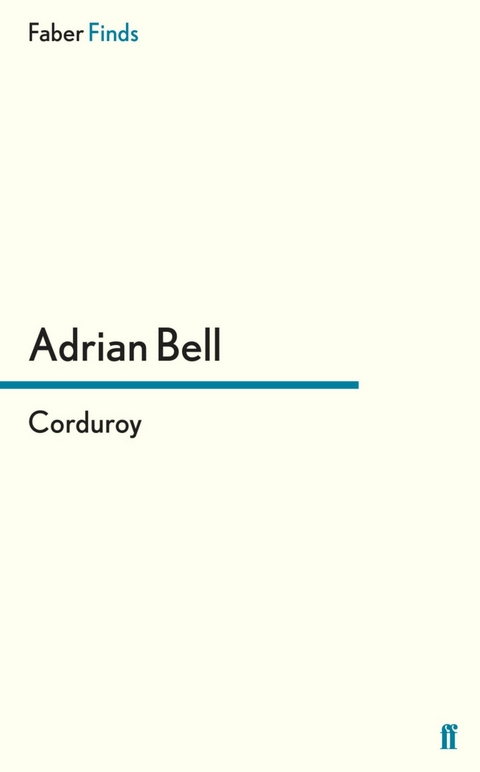
Corduroy (eBook)
200 Seiten
Faber & Faber (Verlag)
978-0-571-25293-0 (ISBN)
Adrian Bell (1901-1980) was born in Lancashire, grew up in London, and was educated at Uppingham School which he hated. His father, news editor of the Observer, was a republican and a socialist and had no truck with university education. His son was to do something useful; in 1920 he went to East Anglia to work as a farm apprentice. He subsequently became a farmer himself. These experiences provide the material for his famous rural trilogy, Corduroy, Silver Ley and The Cherry Tree. In total he wrote over twenty-five books, he also set the first Times in 1930 and continued to devise crosswords for the paper for the next thirty years.
Corduroy was first published in 1930. It was followed by Silver Ley in 1931 and The Cherry Treein 1932. Together they form a trilogy that has been described as 'the classic account of a twentieth-century Englishman's conversion to rural life'. In Corduroy the author's experiences as a farm apprentice in Suffolk are described. The tone is affectionate, humourous and not in the least patronizing. At times there is an elegiac strain not dissimilar to Edward Thomas. The three books constitute a threnody for, what was then, a vanishing, pre-mechanized way, of farming and rural life.
Corduroy was originally published in 1930. It was my father’s first and best-known book, in a writing career that lasted for half a century and also yielded thousands of newspaper columns and crossword puzzles. It became established very quickly as a countryside classic, and earned him a special place in the history as well as the literature of the Suffolk that he caressed with his words for sixty years.
It was not his native Suffolk. Corduroy begins as an escape story about a rather Bohemian young-man-about-Battersea fleeing from the threat of an office life in London. His education had ended at Uppingham School, which he hated and which had been selected by his mother on the advice of the Army and Navy Stores, of all places, which was where she did her shopping for everything, including schools. His father, who was a republican and socialist as well as the news editor of the Observer, refused to entertain the idea of sending him to a university, on the grounds that universities were the citadels of privilege and the playgrounds of the rich. His father also convinced him that his professed desire to write was but a manifestation of adolescence, and it was time to go out and do something else with his life. That something would be done in the open air, for he had heard the call of the land, and heeded it. The twenty-year-old dreamy and loitering youth (his own description) mounted his newly acquired motorcycle, which had seen wartime service in France, and headed east. In Weston Colville near Bury St Edmunds he was apprenticed to Vic Savage, a yeoman farmer of the old school who taught him all he knew in the best agricultural college of all, a well-run working farm. The fame of Vic Savage endures, as it deserves to even to this day, in Mr Colville of Corduroy – the story of my father’s arduous apprenticeship.
The farmer and his apprentice did not know it at the time, but these were the last years of the inherited order of things in agriculture, in which the old ways and rhythms of the land prevailed. Hedging and ditching were done by hand, fox-hunting was not a political issue and fields were farmed by the concerted muscle-power of men and horses. The supporting past of Corduroy includes the Suffolk Punches. This was the world before the Great Depression, before the mechanical revolution which drove so many farm-workers from the land – and long before the farms of Suffolk were threatened by the sinister advance of agribusiness. My father, who went on for the next twenty years to own his own small farms in west and east Suffolk, and to write about them in his other masterpieces – Silver Ley, The Cherry Tree and Apple Acre – clung tenaciously to the old ways of doing things, whether or not they were economical, just for the sake of doing them as he had learned them. He was still ploughing with horses in the late 1940s. My twin sister Sylvia and I used the backs of his old and original manuscripts to draw pictures of his venerable farm horses, Kitty and Boxer. We were thus responsible for the loss of some real collectors’ items.
There was something about the world he was writing about – mainly because by the mid-1930s it was already seen to be vanishing – and something about the way he wrote about it, that had a most extraordinary impact on readers at that time and in the cataclysmic war that followed. These were not necessarily country people, except in the special and privileged sense that they somehow became so by reading what he wrote. His work, for which Corduroy set the standard, had an elegiac quality. It spoke of calmer times and saner values. Its distinguishing feature was a sort of rooted and practical mysticism, seeing its visions and dreaming its dreams in the fields and furrows of a working Suffolk farm. He wrote somewhere, ‘I felt I was being used by a power beyond myself for its own purposes.’
Corduroy ran into many editions, together with its sequels, Silver Ley and The Cherry Tree, throughout the 1930s and 1940s. The most elaborate was the full trilogy, published by The Bodley Head in 1948, and illustrated by Harry Becker. The writer and the artist never met (Becker died in 1928), but they surely knew their Suffolk. The words and pictures match and illuminate each other to perfection. A full set is a rare and treasured possession, much in demand among members of the flourishing Adrian Bell Society.
The most influential edition, without doubt, was Penguin’s. It was published in 1940 in a small format and on paper of distinctly wartime quality. It could fit into a soldier’s pocket or his kitbag, and often did. It thus found a place wherever British forces served, by land, sea and air, in the war zones of the Second World War.
It was only after his death, in 1980, that I became fully aware of the effect he had had on so many people’s lives. At the bottom of a drawer we found a collection of letters sent to him from servicemen who had read his books in their bivouacs and tank turrets, and drawn from them a measure of comfort and hope in the hardest times of their lives. He opened a window on another world, a world of peace and sanity, of enduring values and seasonal rhythms remote from the war’s destruction. I also discovered, having visited some of the planet’s unquiet corners, that his books held within them an extra resonance for someone who had endured such bleak experiences. It was not nostalgia that he offered, but an alternative vision of England. A Lieutenant in the Royal Artillery wrote to him in November 1943 from North Africa to thank him for having written The Cherry Tree, and to urge him to write more:
You will no doubt realise that to us who have not seen green grass, trees and country lanes bounded with hedgerows for a long time, such a book which carries one back to the English countryside so easily is very much appreciated.
In a now half-forgotten magazine, Everybody’s, he wrote an open letter to one of his far-flung constituents, an RAF fighter pilot serving in the Mediterranean – a pilot who must have faced the prospect of death whenever he took to the skies. It is hard for us who take so much for granted to imagine such an ordeal. But my father understood:
You wrote to me from Malta, from a Malta pounded by air from Italy, from Sicily, from North Africa, ringed by U-Boats, all but cut off. You wrote to me (heaven knows how the letter got through) that when the war was finished, you and your girl wanted to marry and have a little farm in England. You have a vision of England. Wherever you are, it has been your consolation and hope. Keep that vision, because it’s true. It may be the key to your life. I am anxious that you should know this; because if you follow your impulses and lead your farming life, with all its ups and downs, at the end of it you will sit back and recall that first vision of it that you had in the desert or the jungle. And you will know then that it was all in all a true vision.
Adrian Bell was born in 1901. He was mercifully just too young for active service in the First World War, and too old for it in the second – even if his health had allowed, which it did not. But he did the state some service, in sharing and communicating his vision of England through the conscripted paperback edition of Corduroy. Through the words of writers such as my father, the faith and fortitude of men who had lost touch with friends and family, and the country for which they were fighting, were sustained. Knowing warfare as I now do, I am convinced that in many cases it must have helped to save their sanity. When the war was over and the survivors returned, it is my opinion that the author and the publisher should have been decorated with the DPM (Distinguished Publications Medal), or some such. They had surely earned it.
Adrian Bell’s books, with Corduroy at the head of the list, were especially prized among prisoners of war. I have in front of me a postcard marked ‘Kriegsgefangenenpost’. It was written on 25 May 1943 by Philip Forsyth, POW number 1156, from Stammlager IX C, somewhere in Germany. He wrote to my father:
It’s so good to read of simple things still going on in my lovely Suffolk. Three Mays ago I took Corduroy to re-read in France. Alas, I lost it unread at Dunkirk. But I found another at Cerniers. Later, on the march in, I abandoned book after book till it remained alone. Then I read each page slowly, twice, for I didn’t know when I’d see a book again.
Sergeant G. W. Risdon wrote on 17 March 1943 from Stalag XVIII A:
With anything like luck I hope to be reading Apple Acre in England soon. But no matter what the place may be, it will ever be good to absorb the story of England’s farms and fieldworkers written by someone who appreciates them for themselves.
And a South African, Coombe Arnold Walter, sent a letter on 10 June 1943 from a prison camp in Italy:
The charm, the homeliness, the peace even in turmoil, the deep satisfying joy of your day to day experiences, come to me and many others in like circumstances as a delight that refreshes and abides, and makes more bearable our own strange life here.
Never mind the critics – and even the critics were impressed – no author could ask for better reviews than those. They show how the words he wrote, most often by lamplight on the kitchen table when the farming day was done, touched the hearts of men in extraordinary circumstances and with extraordinary force. The Suffolk of Adrian Bell has changed beyond recognition, not all...
| Erscheint lt. Verlag | 4.6.2009 |
|---|---|
| Reihe/Serie | A rural trilogy |
| Verlagsort | London |
| Sprache | englisch |
| Themenwelt | Literatur ► Biografien / Erfahrungsberichte |
| Literatur ► Romane / Erzählungen | |
| Sachbuch/Ratgeber ► Beruf / Finanzen / Recht / Wirtschaft ► Wirtschaft | |
| Sachbuch/Ratgeber ► Natur / Technik ► Natur / Ökologie | |
| Geschichte ► Teilgebiete der Geschichte ► Kulturgeschichte | |
| Sozialwissenschaften ► Politik / Verwaltung | |
| Wirtschaft | |
| Schlagworte | countryside • Faber Finds • farming • Rural |
| ISBN-10 | 0-571-25293-1 / 0571252931 |
| ISBN-13 | 978-0-571-25293-0 / 9780571252930 |
| Informationen gemäß Produktsicherheitsverordnung (GPSR) | |
| Haben Sie eine Frage zum Produkt? |
 EPUB (Adobe DRM)
Kopierschutz: Adobe-DRM
Adobe-DRM ist ein Kopierschutz, der das eBook vor Mißbrauch schützen soll. Dabei wird das eBook bereits beim Download auf Ihre persönliche Adobe-ID autorisiert. Lesen können Sie das eBook dann nur auf den Geräten, welche ebenfalls auf Ihre Adobe-ID registriert sind.
Details zum Adobe-DRM
Dateiformat: EPUB (Electronic Publication)
EPUB ist ein offener Standard für eBooks und eignet sich besonders zur Darstellung von Belletristik und Sachbüchern. Der Fließtext wird dynamisch an die Display- und Schriftgröße angepasst. Auch für mobile Lesegeräte ist EPUB daher gut geeignet.
Systemvoraussetzungen:
PC/Mac: Mit einem PC oder Mac können Sie dieses eBook lesen. Sie benötigen eine
eReader: Dieses eBook kann mit (fast) allen eBook-Readern gelesen werden. Mit dem amazon-Kindle ist es aber nicht kompatibel.
Smartphone/Tablet: Egal ob Apple oder Android, dieses eBook können Sie lesen. Sie benötigen eine
Geräteliste und zusätzliche Hinweise
Buying eBooks from abroad
For tax law reasons we can sell eBooks just within Germany and Switzerland. Regrettably we cannot fulfill eBook-orders from other countries.
aus dem Bereich