


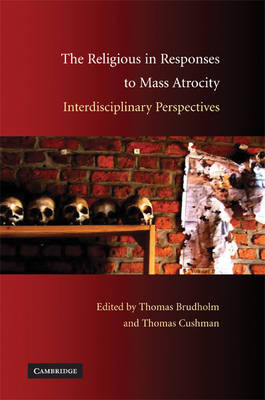
Religious in Responses to Mass Atrocity (eBook)
Cambridge University Press (Verlag)
978-0-511-51253-7 (ISBN)
A peculiar and fascinating aspect of many responses to mass atrocities is the creative and eclectic use of religious language and frameworks. Some crimes are so extreme that they 'cry out to heaven', drawing people to employ religious vocabulary to make meaning of and to judge what happened, to deal with questions of guilt and responsibility, and to re-establish hope and trust in their lives. Moreover, in recent years, religious actors have become increasingly influential in worldwide contexts of conflict-resolution and transitional justice. This collection offers a critical assessment of the possibilities and problems pertaining to attempts to bring religious or semi-religious allegiances and perspectives to bear in responses to the mass atrocities of our time: When and how can religious language or religious beliefs and practices be either necessary or helpful? And what are the problems and reasons for caution or critique? In this book, a group of distinguished scholars explore these questions and offer a range of original explanatory and normative perspectives.
A peculiar and fascinating aspect of many responses to mass atrocities is the creative and eclectic use of religious language and frameworks. Some crimes are so extreme that they ''cry out to heaven'', drawing people to employ religious vocabulary to make meaning of and to judge what happened, to deal with questions of guilt and responsibility, and to re-establish hope and trust in their lives. Moreover, in recent years, religious actors have become increasingly influential in worldwide contexts of conflict-resolution and transitional justice. This collection offers a critical assessment of the possibilities and problems pertaining to attempts to bring religious - or semi-religious - allegiances and perspectives to bear in responses to the mass atrocities of our time: When and how can religious language or religious beliefs and practices be either necessary or helpful? And what are the problems and reasons for caution or critique? In this book, a group of distinguished scholars explore these questions and offer a range of original explanatory and normative perspectives.
| Erscheint lt. Verlag | 7.5.2009 |
|---|---|
| Sprache | englisch |
| Themenwelt | Sachbuch/Ratgeber |
| Geisteswissenschaften ► Geschichte | |
| Geisteswissenschaften ► Religion / Theologie | |
| Recht / Steuern ► EU / Internationales Recht | |
| Recht / Steuern ► Öffentliches Recht ► Völkerrecht | |
| Sozialwissenschaften ► Soziologie ► Spezielle Soziologien | |
| ISBN-10 | 0-511-51253-8 / 0511512538 |
| ISBN-13 | 978-0-511-51253-7 / 9780511512537 |
| Informationen gemäß Produktsicherheitsverordnung (GPSR) | |
| Haben Sie eine Frage zum Produkt? |
 PDF (Adobe DRM)
Kopierschutz: Adobe-DRM
Adobe-DRM ist ein Kopierschutz, der das eBook vor Mißbrauch schützen soll. Dabei wird das eBook bereits beim Download auf Ihre persönliche Adobe-ID autorisiert. Lesen können Sie das eBook dann nur auf den Geräten, welche ebenfalls auf Ihre Adobe-ID registriert sind.
Details zum Adobe-DRM
Dateiformat: PDF (Portable Document Format)
Mit einem festen Seitenlayout eignet sich die PDF besonders für Fachbücher mit Spalten, Tabellen und Abbildungen. Eine PDF kann auf fast allen Geräten angezeigt werden, ist aber für kleine Displays (Smartphone, eReader) nur eingeschränkt geeignet.
Systemvoraussetzungen:
PC/Mac: Mit einem PC oder Mac können Sie dieses eBook lesen. Sie benötigen eine
eReader: Dieses eBook kann mit (fast) allen eBook-Readern gelesen werden. Mit dem amazon-Kindle ist es aber nicht kompatibel.
Smartphone/Tablet: Egal ob Apple oder Android, dieses eBook können Sie lesen. Sie benötigen eine
Geräteliste und zusätzliche Hinweise
Buying eBooks from abroad
For tax law reasons we can sell eBooks just within Germany and Switzerland. Regrettably we cannot fulfill eBook-orders from other countries.


