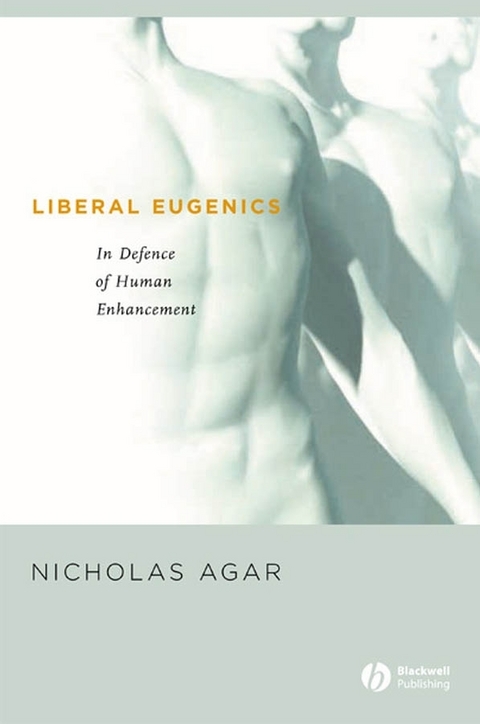
Liberal Eugenics (eBook)
John Wiley & Sons (Verlag)
978-0-470-77757-2 (ISBN)
- Gets away from fears of a Huxleyan 'Brave New World' or a return to the fascist eugenics of the past
- Written from a philosophically and scientifically informed point of view
- Considers real contemporary cases of parents choosing what kind of child to have
- Uses 'moral images' as a way to get readers with no background in philosophy to think about moral dilemmas
- Provides an authoritative account of the science involved, making the book suitable for readers with no knowledge of genetics
- Creates a moral framework for assessing all new technologies
Nicholas Agar is Senior Lecturer at Victoria University of Wellington. His previous books include Life's Intrinsic Value (2001) and Perfect Copy (2002).
In this provocative book, philosopher Nicholas Agar defends the idea that parents should be allowed to enhance their children s characteristics. Gets away from fears of a Huxleyan Brave New World or a return to the fascist eugenics of the past Written from a philosophically and scientifically informed point of view Considers real contemporary cases of parents choosing what kind of child to have Uses moral images as a way to get readers with no background in philosophy to think about moral dilemmas Provides an authoritative account of the science involved, making the book suitable for readers with no knowledge of genetics Creates a moral framework for assessing all new technologies
Nicholas Agar is Senior Lecturer at Victoria University of Wellington. His previous books include Life's Intrinsic Value (2001) and Perfect Copy (2002).
Preface and Acknowledgments..
1. Genius Sperm, Eugenics, and Enhancement Technologies..
2. A Pragmatic Optimism about Enhancement Technologies..
3. Making Moral Images of Biotechnology..
4. The moral image of therapy..
5. The moral Image of Nature..
6. The Moral Image of Nurture.
7. Our Postliberal Future?.
8. Enhanced Humans When?.
Notes.
Further Reading.
References.
Index.
"The options for human enhancement that genetic science may
eventually make possible tend to resist evaluation by traditional
approaches to ethics, since the central issue is nothing less than
what human nature itself shall be. Liberal Eugenics offers
refreshingly sensible guidance to the possibilities of cloning,
genetic therapy, and genetic enhancement by reference to our
'moral images' of more familiar but relevantly similar
practices. At once conservative in its methodology and daring in
its defiance of conventional wisdom, this book is a lively and
accessible antidote to the prejudice and obscurantism that pervade
public debates about these challenging issues." Jeff
McMahan, Professor of Philosophy,
RutgersUniversity
"With Liberal Eugenics, Nicholas Agar has given us
a lively, sophisticated defense of genetic enhancement, challenging
the anxious sentimentality of biotech luddites without embracing
the naïve, reckless optimism of bio-tech enthusiasts. Readers
may not always agree with Agar, but they will be engaged by his
original and forceful arguments and his apt and delightful
examples. The book is a pleasure to read and a provocative piece of
applied philosophy - a rare combination." David
Wasserman, University of Maryland
"A very persuasive case for an informed, liberal though not
laissez-faire approach to research." The Guardian
"This [is a] clear, scientifically well informed and
philosophically sophisticated study." Notre Dame Philosophical
Review
| Erscheint lt. Verlag | 15.4.2008 |
|---|---|
| Sprache | englisch |
| Themenwelt | Geisteswissenschaften ► Philosophie ► Allgemeines / Lexika |
| Geisteswissenschaften ► Philosophie ► Ethik | |
| Sozialwissenschaften ► Soziologie ► Empirische Sozialforschung | |
| Schlagworte | Agar • Bioethics & Medical Ethics • Bioethik, Medizinethik • brave • Cell • Childrens • controversial book • Debate • describes • Fears • Genetic • goals • huxleyan • Idea • Liberal • New • Nicholas • Nuclear • Philosopher • Philosophie • Philosophy • possibility cloning • Practical • Public • Social Identity • Sociology • Somatic • Soziale Identität • Soziale Identität • Soziologie • Technology • Three • Transfer • use • World |
| ISBN-10 | 0-470-77757-5 / 0470777575 |
| ISBN-13 | 978-0-470-77757-2 / 9780470777572 |
| Informationen gemäß Produktsicherheitsverordnung (GPSR) | |
| Haben Sie eine Frage zum Produkt? |
 PDF (Adobe DRM)
Kopierschutz: Adobe-DRM
Adobe-DRM ist ein Kopierschutz, der das eBook vor Mißbrauch schützen soll. Dabei wird das eBook bereits beim Download auf Ihre persönliche Adobe-ID autorisiert. Lesen können Sie das eBook dann nur auf den Geräten, welche ebenfalls auf Ihre Adobe-ID registriert sind.
Details zum Adobe-DRM
Dateiformat: PDF (Portable Document Format)
Mit einem festen Seitenlayout eignet sich die PDF besonders für Fachbücher mit Spalten, Tabellen und Abbildungen. Eine PDF kann auf fast allen Geräten angezeigt werden, ist aber für kleine Displays (Smartphone, eReader) nur eingeschränkt geeignet.
Systemvoraussetzungen:
PC/Mac: Mit einem PC oder Mac können Sie dieses eBook lesen. Sie benötigen eine
eReader: Dieses eBook kann mit (fast) allen eBook-Readern gelesen werden. Mit dem amazon-Kindle ist es aber nicht kompatibel.
Smartphone/Tablet: Egal ob Apple oder Android, dieses eBook können Sie lesen. Sie benötigen eine
Geräteliste und zusätzliche Hinweise
Buying eBooks from abroad
For tax law reasons we can sell eBooks just within Germany and Switzerland. Regrettably we cannot fulfill eBook-orders from other countries.
aus dem Bereich