


- Provides a comprehensive, up-to-date, and stimulating picture of the field for students and researchers in a wide range of disciplines
Features data and case studies from interactions in different social contexts and from a range of different communities
Janet Holmes holds a personal Chair in Linguistics at Victoria University of Wellington and is Director of the Wellington Language in the Workplace Project and the Wellington Corpus of Spoken New Zealand English. She is the author of numerous books and articles, including Introduction to Sociolinguistics (second edition, 2001) and Women, Men and Politeness (1995). She is editor of Gendered Speech in Social Context (2000).
Miriam Meyerhoff is Reader in Linguistics at the University of Edinburgh, before which she was Assistant Professor at the University of Hawai'i, Manoa. She has published articles on language and gender, language change in creoles, and is the author of Constraints on Null Subjects in Bislama (Vanuatu) (2000).
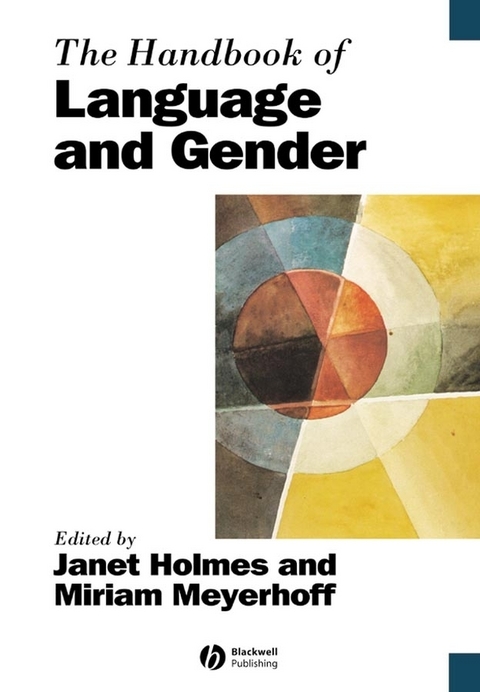
The Handbook of Language and Gender is a collection of articles written by leading specialists in the field that examines the dynamic ways in which women and men develop and manage gendered identities through their talk. Provides a comprehensive, up-to-date, and stimulating picture of the field for students and researchers in a wide range of disciplines Features data and case studies from interactions in different social contexts and from a range of different communities
Janet Holmes holds a personal Chair in Linguistics atVictoria University of Wellington and is Director of the WellingtonLanguage in the Workplace Project and the Wellington Corpus ofSpoken New Zealand English. She is the author of numerous books andarticles, including Introduction to Sociolinguistics (secondedition, 2001) and Women, Men and Politeness (1995). She iseditor of Gendered Speech in Social Context (2000). Miriam Meyerhoff is Reader in Linguistics at theUniversity of Edinburgh, before which she was Assistant Professorat the University of Hawai'i, Manoa. She has published articles onlanguage and gender, language change in creoles, and is the authorof Constraints on Null Subjects in Bislama(Vanuatu) (2000).
The Handbook of Language and Gender 5
Contents 9
Notes on Contributors 12
Acknowledgments 18
Different Voices, Different Views: An Introduction to Current Research in Language and Gender 19
Part I History and Theoretical Background to the Study of Language and Gender 37
1 Theorizing Gender in Sociolinguistics and Linguistic Anthropology 39
2 Theories of Discourse as Theories of Gender: Discourse Analysis in Language and Gender Studies 61
3 “What’s in a Name?” Social Labeling and Gender Practices 87
4 Variation in Language and Gender 116
5 Language and Desire 137
6 “One Man in Two is a Woman”: Linguistic Approaches to Gender in Literary Texts 160
Part II Negotiating Relations 177
7 Language, Gender, and Politics: Putting “Women” and “Power” in the Same Sentence 179
8 Gender and Family Interaction 197
9 Gender and Power in On-line Communication 220
10 The Relevance of Ethnicity, Class, and Gender in Children’s Peer Negotiations 247
11 The Power of Gender Ideologies in Discourse 270
Part III Authenticity and Place 295
12 Crossing Genders, Mixing Languages: The Linguistic Construction of Transgenderism in Tonga 297
13 Claiming a Place: Gender, Knowledge, and Authority as Emergent Properties 320
14 Constructing and Managing Male Exclusivity in Talk-in-interaction 345
15 Exceptional Speakers: Contested and Problematized Gender Identities 371
16 Language and Gender in Adolescence 399
17 Language and Gendered Modernity 419
18 A Marked Man: The Contexts of Gender and Ethnicity 441
Part IV Stereotypes and Norms 463
19 Gender and Language Ideologies 465
20 Gender Stereotypes: Reproduction and Challenge 486
21 Gender and Identity: Representation and Social Action 505
22 Prestige, Cultural Models, and Other Ways of Talking About Underlying Norms and Gender 527
23 Communicating Gendered Professional Identity: Competence, Cooperation, and Conflict in the Workplace 546
24 Linguistic Sexism and Feminist Linguistic Activism 568
Part V Institutional Discourse 589
25 “Feminine” Workplaces: Stereotype and Reality 591
26 Creating Gendered Demeanors of Authority at Work and at Home 618
27 Schooled Language: Language and Gender in Educational Settings 642
28 Coercing Gender: Language in Sexual Assault Adjudication Processes 663
29 Multiple Identities: The Roles of Female Parliamentarians in the EU Parliament 689
Epilogue: Reflections on Language and Gender Research 717
Index 740
"This extensive collection of articles is testimony to thecontinuing topicality and diversity of research in language andgender, spanning a wide range of disciplines, theoretical stances,and methodological approaches and examining gender in a vastvariety of linguistic, sociocultural and group-specific contexts."Language in Society
"For anyone interested in the relationship between language andgender, this book is a must. It contains a multitude of fascinatingarticles on every conceivable topic, written by experts in thefield. A veritable treasure trove!" Jennifer Coates, Universityof Surrey, Roehampton
"I did not think there was anything new left to say on thewell-researched topic of language and gender. But the editors ofthis Handbook lead us through a host of new perspectives as well asproviding the most up-to-date coverage possible of the morefamiliar topics in the field. The unique scope of the Handbookshows beyond any doubt the fundamental importance of gender in allaspects of our lives, both public and private. This is the mostauthoritative account of the field to date, and is essentialreading for anyone with an interest in language, no matter whattheir background." Jenny Cheshire, Queen Mary, University ofLondon
"This impressive handbook provides not only a thoroughorientation in the interdisciplinary field of language and genderbut also a presentation of the newest findings and theoreticalreflections. Above all, it shows how stimulating studies onlanguage and gender are for many other areas such as discourseanalysis, sociolinguistics, anthropological linguistics, andrelated disciplines." Helga Kotthoff, PädagogischeHochschule Freiburg
"The ideas here will keep students, professors, and researchersbusy talking and thinking for years to come. We're lucky to havesuch a diverse collection of perspectives, thinkers, and data; theywill surely deepen our growing understanding of language andgender." Keith Walters, University of Texas at Austin
| Erscheint lt. Verlag | 15.4.2008 |
|---|---|
| Reihe/Serie | Blackwell Handbooks in Linguistics | Blackwell Handbooks in Linguistics |
| Sprache | englisch |
| Themenwelt | Geisteswissenschaften ► Sprach- / Literaturwissenschaft ► Sprachwissenschaft |
| Sozialwissenschaften ► Soziologie ► Gender Studies | |
| Schlagworte | Articles • Casestudies • Collection • contexts • Data • Different • disciplines • Field • Handbook • language • leading • Linguistics • Number • Picture • Potential benefits • Problems • Range • Research • Social • Sociolinguistics • Sociology • Sociology Special Topics • Soziolinguistik • Soziologie • specialists • Spezialthemen Soziologie • Sprachwissenschaften • stimulating • Team • Volume • wide |
| ISBN-13 | 9780470756706 / 9780470756706 |
| Informationen gemäß Produktsicherheitsverordnung (GPSR) | |
| Haben Sie eine Frage zum Produkt? |
 PDF (Adobe DRM)
Kopierschutz: Adobe-DRM
Adobe-DRM ist ein Kopierschutz, der das eBook vor Mißbrauch schützen soll. Dabei wird das eBook bereits beim Download auf Ihre persönliche Adobe-ID autorisiert. Lesen können Sie das eBook dann nur auf den Geräten, welche ebenfalls auf Ihre Adobe-ID registriert sind.
Details zum Adobe-DRM
Dateiformat: PDF (Portable Document Format)
Mit einem festen Seitenlayout eignet sich die PDF besonders für Fachbücher mit Spalten, Tabellen und Abbildungen. Eine PDF kann auf fast allen Geräten angezeigt werden, ist aber für kleine Displays (Smartphone, eReader) nur eingeschränkt geeignet.
Systemvoraussetzungen:
PC/Mac: Mit einem PC oder Mac können Sie dieses eBook lesen. Sie benötigen eine
eReader: Dieses eBook kann mit (fast) allen eBook-Readern gelesen werden. Mit dem amazon-Kindle ist es aber nicht kompatibel.
Smartphone/Tablet: Egal ob Apple oder Android, dieses eBook können Sie lesen. Sie benötigen eine
Geräteliste und zusätzliche Hinweise
Buying eBooks from abroad
For tax law reasons we can sell eBooks just within Germany and Switzerland. Regrettably we cannot fulfill eBook-orders from other countries.
aus dem Bereich


