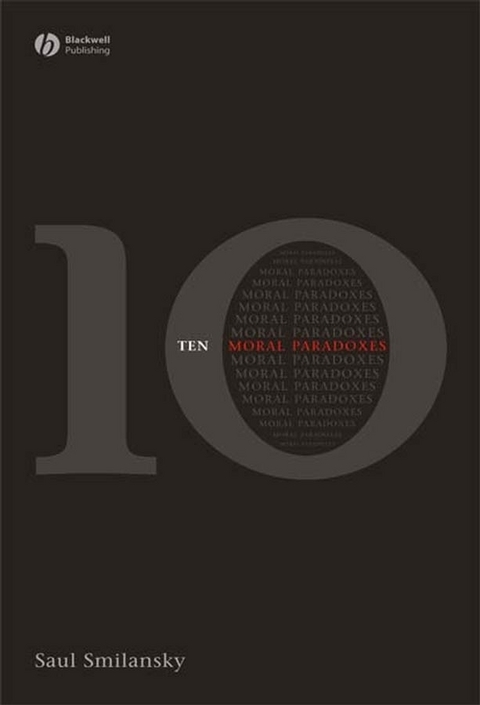
10 Moral Paradoxes (eBook)
John Wiley & Sons (Verlag)
978-0-470-69586-9 (ISBN)
- Explores what these paradoxes can teach us about morality and the human condition
- Considers a broad range of subjects, from familiar topics to rarely posed questions, among them 'Fortunate Misfortune', 'Beneficial Retirement' and 'Preferring Not To Have Been Born'
- Asks whether the existence of moral paradox is a good or a bad thing
- Presents analytic moral philosophy in a provocative, engaging and entertaining way; posing new questions, proposing possible solutions, and challenging the reader to wrestle with the paradoxes themselves
Saul Smilansky is a professor in the department of philosophy at the University of Haifa, Israel. He is the author of the widely acclaimed book, Free Will and Illusion (2000) and has published articles in many of the leading philosophical journals.
Presenting ten diverse and original moral paradoxes, this cutting edge work of philosophical ethics makes a focused, concrete case for the centrality of paradoxes within morality. Explores what these paradoxes can teach us about morality and the human condition Considers a broad range of subjects, from familiar topics to rarely posed questions, among them "e;Fortunate Misfortune"e;, "e;Beneficial Retirement"e; and "e;Preferring Not To Have Been Born"e; Asks whether the existence of moral paradox is a good or a bad thing Presents analytic moral philosophy in a provocative, engaging and entertaining way; posing new questions, proposing possible solutions, and challenging the reader to wrestle with the paradoxes themselves
Saul Smilansky is a professor in the department of philosophy at the University of Haifa, Israel. He is the author of the widely acclaimed book, Free Will and Illusion (2000) and has published articles in many of the leading philosophical journals.
List of Figures viii
Acknowledgments ix
Introduction 1
1 Fortunate Misfortune 11
2 The Paradox of Beneficial Retirement 23
3 Two Paradoxes about Justice and the Severity of Punishment 33
4 Blackmail: The Solution 42
5 The Paradox of Non-Punishment 50
6 On Not Being Sorry about the Morally Bad 59
7 Choice-Egalitarianism and the Paradox of the Baseline 67
8 Morality and Moral Worth 77
9 The Paradox of Moral Complaint 90
10 Preferring Not to Have Been Born 100
11 A Meta-Paradox: Are Paradoxes Bad? 113
12 Reflections on Moral Paradox 122
Postscript: The Future and Moral Paradox 134
References 138
Index 142
"This is an excellent book which I recommend wholeheartedly both as
a source of beneficial thought experiments for the professional
moral philosopher, and as a better stimulus for the student of
moral philosophy than any theory-focused book could possibly be . .
. It is clearly, elegantly and succinctly written, it is
provocative and sometimes perplexing without ever crossing the line
into the melodramatic or the precious and, perhaps best of all, it
promotes tentative conclusions whilst leaving the reader plenty of
space to pursue each of the issues further for herself." (The
Analysis Trust, 3 July 2011)
"Smilansky's examples are freshly minted...
They're thought provoking, and Smilansky's discussion
is a pleasure... [I]f we take morality seriously, we need to
reflect with open minds about the kinds of cases he describes, and
finding views we can live with will constitute some kind of
progress in our moral life." (Mark Sainsbury FBA, Times
Literary Supplement)
"Saul Smilansky's 10 Moral Paradoxes is a
delightful book. The paradoxes are easy to appreciate and though
it's written in a light and accessible style, it still has plenty
of philosophical heft. " (Michael Cholbi, PEA
Soup)
"His writing is clear and lively. He avoids unnecessary
technicalities. His ideas are grounded in vivid examples."
(Notre Dame Philosophical Reviews, May 2009)
"[B]rief, succinct, and a pleasure to read. Some of the
chapters (for instance, the chapter on Fortunate Misfortune) would
also make excellent reading for seminars on any undergraduate
course... It is well worth reading." (Theoria)
"Smilansky has written a book in which he argues, in my view
persuasively, that much of our thinking within and about morality
leads to paradox... [He] delights in the complexity of the moral
life and his approach is tailored to uncover rather than to conceal
that complexity. Moral thinking can and should be as deep, as
exhilarating and as surprising as intelligently reflective life
itself... This is an excellent book which I recommend
wholeheartedly... I know of no better book to serve as an
introduction to moral philosophy." J.A. Burgess, Analysis, June 13,
2011
"This is a delightful and engaging little book. With its bite-size
chapters, lively exposition, and important subject matter, this is
the kind of book that can spark an interest in philosophy among
those unfamiliar with it. But its appeal is not limited to
neophytes; it poses significant new challenges to moral theory that
even hardened professional philosophers will find stimulating and
provocative."
-Jeff McMahan, Rutgers University
"Smilansky has an unerring eye for noticing
intriguing - sometimes quite
startling - paradoxes, both in our common
unreflective attitudes to much of the business of ordinary life and
in our more reasoned positions on a wide variety of public issues
and personal concerns. From retirement to blackmail to punishment
to the nature of moral complaint, his ability to isolate the
anomalies and inconsistencies that beset our thinking about these
and other subjects provides us with a set of essays that are at
once provocative and illuminating. No one can fail to benefit from
reading this book."
-Hillel Steiner, Manchester University
| Erscheint lt. Verlag | 30.4.2008 |
|---|---|
| Sprache | englisch |
| Themenwelt | Geisteswissenschaften ► Philosophie ► Allgemeines / Lexika |
| Geisteswissenschaften ► Philosophie ► Ethik | |
| Sozialwissenschaften | |
| Schlagworte | abundant literature • Angewandte Ethik • Applied Ethics • competent medical doctors • ethics • Ethik • Evident • importance • innocent people • Justice system • Life • Metaphysics • misfortune • Need • Paradox • Philosophie • Philosophy • punishment • Study • Subject • terrorists morally complain • things become • Unjust |
| ISBN-10 | 0-470-69586-2 / 0470695862 |
| ISBN-13 | 978-0-470-69586-9 / 9780470695869 |
| Informationen gemäß Produktsicherheitsverordnung (GPSR) | |
| Haben Sie eine Frage zum Produkt? |
 PDF (Adobe DRM)
Kopierschutz: Adobe-DRM
Adobe-DRM ist ein Kopierschutz, der das eBook vor Mißbrauch schützen soll. Dabei wird das eBook bereits beim Download auf Ihre persönliche Adobe-ID autorisiert. Lesen können Sie das eBook dann nur auf den Geräten, welche ebenfalls auf Ihre Adobe-ID registriert sind.
Details zum Adobe-DRM
Dateiformat: PDF (Portable Document Format)
Mit einem festen Seitenlayout eignet sich die PDF besonders für Fachbücher mit Spalten, Tabellen und Abbildungen. Eine PDF kann auf fast allen Geräten angezeigt werden, ist aber für kleine Displays (Smartphone, eReader) nur eingeschränkt geeignet.
Systemvoraussetzungen:
PC/Mac: Mit einem PC oder Mac können Sie dieses eBook lesen. Sie benötigen eine
eReader: Dieses eBook kann mit (fast) allen eBook-Readern gelesen werden. Mit dem amazon-Kindle ist es aber nicht kompatibel.
Smartphone/Tablet: Egal ob Apple oder Android, dieses eBook können Sie lesen. Sie benötigen eine
Geräteliste und zusätzliche Hinweise
Buying eBooks from abroad
For tax law reasons we can sell eBooks just within Germany and Switzerland. Regrettably we cannot fulfill eBook-orders from other countries.
aus dem Bereich