Crystal Clear (eBook)
John Wiley & Sons (Verlag)
978-0-470-05128-3 (ISBN)
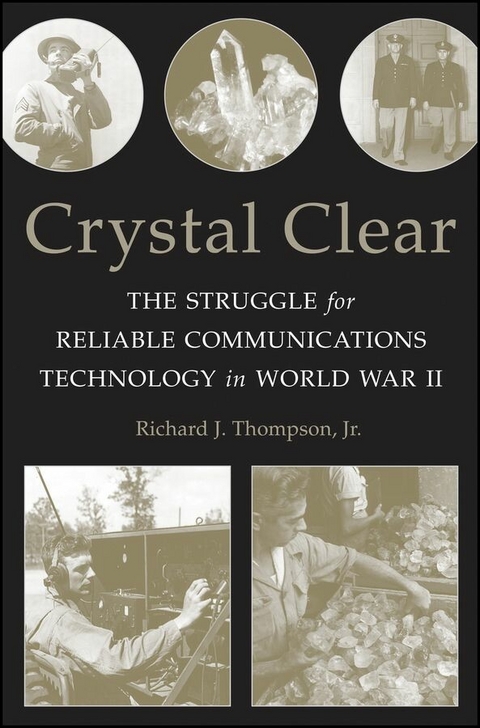
Some of the defining leaps in technology in the twentieth century occurred during the Second World War, from radar to nuclear energy. Often left out of historical discussions are quartz crystals, which proved to be just as pivotal to the Allied victory-and to post-war development-as other technologies. Quartz crystals provided the U.S. military, for the first time, with reliable communication on the front lines, and then went on to become the core of some of the most basic devices of the post-war era, from watches, clocks, and color televisions, to cell phones and computers.
In Crystal Clear, Richard Thompson relates the story of the quartz crystal in World War II, from its early days as a curiosity for amateur radio enthusiasts, to its use by the United States Armed Forces. It follows the intrepid group of scientists and engineers from the Office of the Chief Signal Officer of the U.S. Army as they raced to create an effective quartz crystal unit. They had to find a reliable supply of radio-quality quartz; devise methods to reach, mine, and transport the quartz; find a way to manufacture quartz crystal oscillators rapidly; and then solve the puzzling 'aging problem' that plagued the early units. Ultimately, the development of quartz oscillators became the second largest scientific undertaking in World War II after the Manhattan Project.
Bringing to light a little-known aspect of World War II, Crystal Clear offers a glimpse inside one of the most significant efforts in the annals of engineering.
Quartz crystal-a technology that changed the tide of World War II Some of the defining leaps in technology in the twentieth century occurred during the Second World War, from radar to nuclear energy. Often left out of historical discussions are quartz crystals, which proved to be just as pivotal to the Allied victory-and to post-war development-as other technologies. Quartz crystals provided the U.S. military, for the first time, with reliable communication on the front lines, and then went on to become the core of some of the most basic devices of the post-war era, from watches, clocks, and color televisions, to cell phones and computers. In Crystal Clear, Richard Thompson relates the story of the quartz crystal in World War II, from its early days as a curiosity for amateur radio enthusiasts, to its use by the United States Armed Forces. It follows the intrepid group of scientists and engineers from the Office of the Chief Signal Officer of the U.S. Army as they raced to create an effective quartz crystal unit. They had to find a reliable supply of radio-quality quartz; devise methods to reach, mine, and transport the quartz; find a way to manufacture quartz crystal oscillators rapidly; and then solve the puzzling "e;aging problem"e; that plagued the early units. Ultimately, the development of quartz oscillators became the second largest scientific undertaking in World War II after the Manhattan Project. Bringing to light a little-known aspect of World War II, Crystal Clear offers a glimpse inside one of the most significant efforts in the annals of engineering.
RICHARD J. THOMPSON, Jr., is the Dean of Mathematics and Science at The College of Saint Rose in Albany, New York. He received a PhD in astronomy and astrophysics from The Pennsylvania State University in 1994 and has served as a physics professor and department chairman at McMurry University in Abilene, Texas.
Acknowledgments vii
Introduction: "We Were Heavily Armed and We Had Crystals" 1
1 From Wire to Wireless: The Development--and
Acceptance--of Tactical Radio 5
2 Crystal Control--the Great Gamble 17
3 The Signal Corps Lays the Foundation 31
4 Nothing Else to Do but Grind Crystals 55
5 Riding the "Flat Wheel Limited"--Overseeing a Mass
Production Industry 69
6 Supplying a Mass Production Industry--the Civilian
Government Steps In 93
7 "The Whole Radio Crystal Program of the Armed Services Depends
Upon the Success of the Procurement Program in Brazil. Nothing Must
Be Allowed to Interfere With It" 117
8 "God Made Lots of Small Crystals" 129
9 The Aging Crisis--Stopgap Measures 145
10 The Aging Crisis--Physics to the Rescue! 153
11 "Without Crystals You Have Radio; With Them, Communications"
163
Appendix 1: Crystal-Controlled Equipment 175
Appendix 2: Crystal Manufacturers 179
References 183
Index 219
"A fascinating book, in which I found the interplay of all the
characters and companies becoming more and more enthralling."
(Practical Wireless, March 2009)
"...a highly readable and engaging account..." (IEEE
Newsletter, July 2007)
"I would highly recommend this book to anyone that has the
slightest interest in the topic." (E-STREAMS, June 2007)
"...a fascinating account of a nearly-forgotten technology
leap that impacted the course of the war." (Monitoring
Times, December 2006)
| Erscheint lt. Verlag | 30.11.2011 |
|---|---|
| Zusatzinfo | Photos: 25 B&W, 0 Color; Drawings: 7 B&W, 0 Color |
| Sprache | englisch |
| Themenwelt | Geschichte ► Allgemeine Geschichte ► 1918 bis 1945 |
| Geschichte ► Teilgebiete der Geschichte ► Militärgeschichte | |
| Sozialwissenschaften ► Politik / Verwaltung | |
| Technik ► Elektrotechnik / Energietechnik | |
| Schlagworte | allied • BASIC • Communication • Communication technology • Core • crystala • defining leaps • devices • discussions • Drahtlose Kommunikation • Electrical & Electronics Engineering • Elektrotechnik u. Elektronik • Energy • First Time • Front • Geschichte der Elektrotechnik • Historical • History of Electrical Engineering • Kommunikationstechnik • lines • Militärgeschichte • Militärgeschichte • Mobile & Wireless Communications • Nuclear • Pivotal • postwar developmentas • postwar era • quarttechnology • Radar • reliable • Tide • victoryand • war • World |
| ISBN-10 | 0-470-05128-0 / 0470051280 |
| ISBN-13 | 978-0-470-05128-3 / 9780470051283 |
| Informationen gemäß Produktsicherheitsverordnung (GPSR) | |
| Haben Sie eine Frage zum Produkt? |
 PDF (Adobe DRM)
Kopierschutz: Adobe-DRM
Adobe-DRM ist ein Kopierschutz, der das eBook vor Mißbrauch schützen soll. Dabei wird das eBook bereits beim Download auf Ihre persönliche Adobe-ID autorisiert. Lesen können Sie das eBook dann nur auf den Geräten, welche ebenfalls auf Ihre Adobe-ID registriert sind.
Details zum Adobe-DRM
Dateiformat: PDF (Portable Document Format)
Mit einem festen Seitenlayout eignet sich die PDF besonders für Fachbücher mit Spalten, Tabellen und Abbildungen. Eine PDF kann auf fast allen Geräten angezeigt werden, ist aber für kleine Displays (Smartphone, eReader) nur eingeschränkt geeignet.
Systemvoraussetzungen:
PC/Mac: Mit einem PC oder Mac können Sie dieses eBook lesen. Sie benötigen eine
eReader: Dieses eBook kann mit (fast) allen eBook-Readern gelesen werden. Mit dem amazon-Kindle ist es aber nicht kompatibel.
Smartphone/Tablet: Egal ob Apple oder Android, dieses eBook können Sie lesen. Sie benötigen eine
Geräteliste und zusätzliche Hinweise
Buying eBooks from abroad
For tax law reasons we can sell eBooks just within Germany and Switzerland. Regrettably we cannot fulfill eBook-orders from other countries.
aus dem Bereich