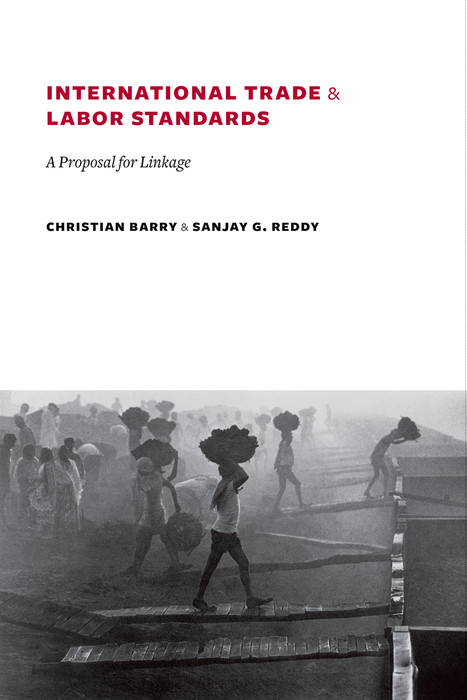
International Trade and Labor Standards (eBook)
Columbia University Press (Verlag)
978-0-231-51296-1 (ISBN)
Christian Barry teaches philosophy in the School of Humanities and is a senior research fellow at the Center for Applied Philosophy and Public Ethics at the Australian National University. He holds a Ph.D. in philosophy from Columbia University, and his research interests include international ethics, global justice, and the philosophy of action.
Sanjay G. Reddy is an assistant professor of economics at Barnard College and at the School of International and Public Affairs at Columbia University. He holds a Ph.D. in economics from Harvard University, and his research interests include development economics, international economics, and economics and philosophy.
Progressive governments in poor countries fear that if they undertake measures to enhance real wages and working conditions, rising labor costs would cause wealthier countries to import from and invest elsewhere. Yet if the world trading system were designed to facilitate or even reward measures to promote labor standards, poor countries could undertake them without fear.In this book, Christian Barry and Sanjay G. Reddy propose ways in which the international trading system can support poor countries in promoting the well-being of their peoples. Reforms to the trading system can lessen the collective-action problem among poor countries, increasing their freedom to pursue policy that better serves the interests of their people. Incorporating the right kind of linkage between trading opportunities and the promotion of labor standards could empower countries, allowing them greater effective sovereignty and enabling them to improve the circumstances of the less advantaged. Barry and Reddy demonstrate how linkage can be made acceptable to all players, and they carefully defend these ideas against those who might initially disagree. Their volume is accessible to general readers but draws on sophisticated economic and philosophical arguments and includes responses from leading labor activists, economists, and philosophers, including Kyle Bagwell, Robert Goodin, Rohini Hensman, and Roberto Mangabeira Unger.
Christian Barry teaches philosophy in the School of Humanities and is a senior research fellow at the Center for Applied Philosophy and Public Ethics at the Australian National University. He holds a Ph.D. in philosophy from Columbia University, and his research interests include international ethics, global justice, and the philosophy of action.Sanjay G. Reddy is an assistant professor of economics at Barnard College and at the School of International and Public Affairs at Columbia University. He holds a Ph.D. in economics from Harvard University, and his research interests include development economics, international economics, and economics and philosophy.
List of TablesPrefaceAcknowledgmentsIntroduction1. What Is Linkage? Two Propositions2. Three Types of Linkage, and What Linkage Proponents Must Show3. What Linkage Opponents Must Show4. Arguments Against Linkage5. Ruling Out Linkage Proposals6. A Constructive Procedure—Identifying Linkage Proposals That Meet the Standard Objections—A Constructive Procedure7. Sketch of One Posible Linkage System8. ConclusionAppendix. Empirical Evidence on the Likely Effects of Improvements in Labor StandardsCommentary by Kyle Bagwell: Economic Theory, WTO Rules, and LinkageCommentary by Rohini Hensman: Fine-Tuning the Linkage ProposalCommentary by Robert Goodin: The Ethics of Political LinkageCommentary by Roberto Mangabeira Unger: The Transformative Imagination and the World Trading SystemReply to CommentatorsNotesIndex
| Erscheint lt. Verlag | 3.7.2008 |
|---|---|
| Zusatzinfo | 3 tables |
| Verlagsort | New York |
| Sprache | englisch |
| Themenwelt | Recht / Steuern ► Arbeits- / Sozialrecht ► Arbeitsrecht |
| Recht / Steuern ► EU / Internationales Recht | |
| Sozialwissenschaften ► Politik / Verwaltung | |
| Wirtschaft ► Volkswirtschaftslehre ► Makroökonomie | |
| ISBN-10 | 0-231-51296-1 / 0231512961 |
| ISBN-13 | 978-0-231-51296-1 / 9780231512961 |
| Informationen gemäß Produktsicherheitsverordnung (GPSR) | |
| Haben Sie eine Frage zum Produkt? |
 PDF (Wasserzeichen)
Größe: 677 KB
DRM: Digitales Wasserzeichen
Dieses eBook enthält ein digitales Wasserzeichen und ist damit für Sie personalisiert. Bei einer missbräuchlichen Weitergabe des eBooks an Dritte ist eine Rückverfolgung an die Quelle möglich.
Dateiformat: PDF (Portable Document Format)
Mit einem festen Seitenlayout eignet sich die PDF besonders für Fachbücher mit Spalten, Tabellen und Abbildungen. Eine PDF kann auf fast allen Geräten angezeigt werden, ist aber für kleine Displays (Smartphone, eReader) nur eingeschränkt geeignet.
Systemvoraussetzungen:
PC/Mac: Mit einem PC oder Mac können Sie dieses eBook lesen. Sie benötigen dafür einen PDF-Viewer - z.B. den Adobe Reader oder Adobe Digital Editions.
eReader: Dieses eBook kann mit (fast) allen eBook-Readern gelesen werden. Mit dem amazon-Kindle ist es aber nicht kompatibel.
Smartphone/Tablet: Egal ob Apple oder Android, dieses eBook können Sie lesen. Sie benötigen dafür einen PDF-Viewer - z.B. die kostenlose Adobe Digital Editions-App.
Buying eBooks from abroad
For tax law reasons we can sell eBooks just within Germany and Switzerland. Regrettably we cannot fulfill eBook-orders from other countries.
 EPUB (Adobe DRM)
Kopierschutz: Adobe-DRM
Adobe-DRM ist ein Kopierschutz, der das eBook vor Mißbrauch schützen soll. Dabei wird das eBook bereits beim Download auf Ihre persönliche Adobe-ID autorisiert. Lesen können Sie das eBook dann nur auf den Geräten, welche ebenfalls auf Ihre Adobe-ID registriert sind.
Details zum Adobe-DRM
Dateiformat: EPUB (Electronic Publication)
EPUB ist ein offener Standard für eBooks und eignet sich besonders zur Darstellung von Belletristik und Sachbüchern. Der Fließtext wird dynamisch an die Display- und Schriftgröße angepasst. Auch für mobile Lesegeräte ist EPUB daher gut geeignet.
Systemvoraussetzungen:
PC/Mac: Mit einem PC oder Mac können Sie dieses eBook lesen. Sie benötigen eine
eReader: Dieses eBook kann mit (fast) allen eBook-Readern gelesen werden. Mit dem amazon-Kindle ist es aber nicht kompatibel.
Smartphone/Tablet: Egal ob Apple oder Android, dieses eBook können Sie lesen. Sie benötigen eine
Geräteliste und zusätzliche Hinweise
Buying eBooks from abroad
For tax law reasons we can sell eBooks just within Germany and Switzerland. Regrettably we cannot fulfill eBook-orders from other countries.
aus dem Bereich