Zum Hauptinhalt springen
Nicht aus der Schweiz? Besuchen Sie lehmanns.de
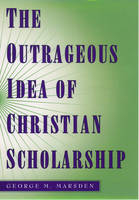
Outrageous Idea of Christian Scholarship -  George M. Marsden

Outrageous Idea of Christian Scholarship (eBook)

eBook Download: PDF
1998
160 Seiten
Oxford University Press (Verlag)
9780198026556 (ISBN)
Systemvoraussetzungen
9,53 inkl. MwSt
(CHF 9,30)
Der eBook-Verkauf erfolgt durch die Lehmanns Media GmbH (Berlin) zum Preis in Euro inkl. MwSt.
  • Download sofort lieferbar
  • Zahlungsarten anzeigen
At the end of his 1994 book, The Soul of the American University, George Marsden advanced a modest proposal for an enhanced role for religious faith in today's scholarship. This "e;unscientific postscript"e; helped spark a heated debate that spilled out of the pages of academic journals and The Chronicle of Higher Education into mainstream media such as The New York Times, and marked Marsden as one of the leading participants in the debates concerning religion and public life. Marsden now gives his proposal a fuller treatment in The Outrageous Idea of Christian Scholarship, a thoughtful and thought-provoking book on the relationship of religious faith and intellectual scholarship. More than a response to Marsden's critics, The Outrageous Idea of Christian Scholarship takes the next step towards demonstrating what the ancient relationship of faith and learning might mean for the academy today. Marsden argues forcefully that mainstream American higher education needs to be more open to explicit expressions of faith and to accept what faith means in an intellectual context. While other defining elements of a scholar's identity, such as race or gender, are routinely taken into consideration and welcomed as providing new perspectives, Marsden points out, the perspective of the believing Christian is dismissed as irrelevant or, worse, antithetical to the scholarly enterprise. Marsden begins by examining why Christian perspectives are not welcome in the academy. He rebuts the various arguments commonly given for excluding religious viewpoints, such as the argument that faith is insufficiently empirical for scholarly pursuits (although the idea of complete scientific objectivity is consider naive in most fields today), the fear that traditional Christianity will reassert its historical role as oppressor of divergent views, and the received dogma of the separation of church and state, which stretches far beyond the actual law in the popular imagination. Marsden insists that scholars have both a religious and an intellectual obligation not to leave their deeply held religious beliefs at the gate of the academy. Such beliefs, he contends, can make a significant difference in scholarship, in campus life, and in countless other ways. Perhaps most importantly, Christian scholars have both the responsibility and the intellectual ammunition to argue against some of the prevailing ideologies held uncritically by many in the academy, such as naturalistic reductionism or unthinking moral relativism. Contemporary university culture is hollow at its core, Marsden writes. Not only does it lack a spiritual center, but it is without any real alternative. He argues that a religiously diverse culture will be an intellectually richer one, and it is time that scholars and institutions who take the intellectual dimensions of their faith seriously become active participants in the highest level of academic discourse. Whether the reader agrees or disagrees with this conclusion, Marsden's thoughtful, well-argued book is necessary reading for all sides of the debate on religion's role in education and culture.
PDFPDF (Adobe DRM)

Kopierschutz: Adobe-DRM
Adobe-DRM ist ein Kopierschutz, der das eBook vor Mißbrauch schützen soll. Dabei wird das eBook bereits beim Download auf Ihre persönliche Adobe-ID autorisiert. Lesen können Sie das eBook dann nur auf den Geräten, welche ebenfalls auf Ihre Adobe-ID registriert sind.
Details zum Adobe-DRM

Dateiformat: PDF (Portable Document Format)
Mit einem festen Seiten­layout eignet sich die PDF besonders für Fach­bücher mit Spalten, Tabellen und Abbild­ungen. Eine PDF kann auf fast allen Geräten ange­zeigt werden, ist aber für kleine Displays (Smart­phone, eReader) nur einge­schränkt geeignet.

Systemvoraussetzungen:
PC/Mac: Mit einem PC oder Mac können Sie dieses eBook lesen. Sie benötigen eine Adobe-ID und die Software Adobe Digital Editions (kostenlos). Von der Benutzung der OverDrive Media Console raten wir Ihnen ab. Erfahrungsgemäß treten hier gehäuft Probleme mit dem Adobe DRM auf.
eReader: Dieses eBook kann mit (fast) allen eBook-Readern gelesen werden. Mit dem amazon-Kindle ist es aber nicht kompatibel.
Smartphone/Tablet: Egal ob Apple oder Android, dieses eBook können Sie lesen. Sie benötigen eine Adobe-ID sowie eine kostenlose App.
Geräteliste und zusätzliche Hinweise

Buying eBooks from abroad
For tax law reasons we can sell eBooks just within Germany and Switzerland. Regrettably we cannot fulfill eBook-orders from other countries.

Mehr entdecken
aus dem Bereich