Zum Hauptinhalt springen
Nicht aus der Schweiz? Besuchen Sie lehmanns.de
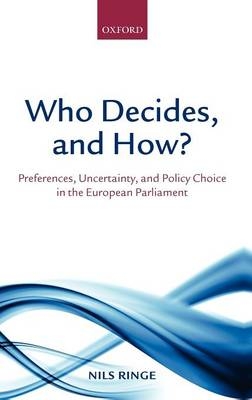
Who Decides, and How? -  Nils Ringe

Who Decides, and How? (eBook)

Preferences, Uncertainty, and Policy Choice in the European Parliament

(Autor)

eBook Download: PDF
2009
250 Seiten
OUP Oxford (Verlag)
9780191571947 (ISBN)
Systemvoraussetzungen
89,09 inkl. MwSt
(CHF 86,95)
Der eBook-Verkauf erfolgt durch die Lehmanns Media GmbH (Berlin) zum Preis in Euro inkl. MwSt.
  • Download sofort lieferbar
  • Zahlungsarten anzeigen
How do individual legislators in the European Parliament (EP) make decisions on the wide variety of policy proposals they routinely confront? Despite a flourishing literature on the European Union's only directly elected institution, we know surprisingly little about the micro-foundations of EP politics. Who Decides, and How? seeks to address this shortcoming by examining how individual legislators make policy choices, how these choices are aggregated, and what role parties and committees play in this process. It argues that members of the EP lack adequate resources to make equally informed decisions across policy areas. Therefore, when faced with policy choices in policy areas outside their realms of expertise, members make decisions on the basis of perceived preference coherence: they adopt the positions of their expert colleagues in the responsible EP committee whose preferences over policy outcomes they believe to most closely match their own. These preferences are difficult to determine, however, which is why legislators rely on a shared party label as a stand-in for common preferences. This results in cohesive parties, despite the inability of EP parties to discipline their members. Who Decides, and How? relies on the respective strengths of quantitative and qualitative data to shed new light on the inner workings of the EP. It illustrates how legislators make broadly representative decisions under conditions of resource scarcity, informational uncertainty, and problematic policy preferences, and how structurally weak EP parties can act in an internally cohesive and externally competitive manner when carrying out their policy commitments to Europe's citizens.
PDFPDF (Adobe DRM)

Kopierschutz: Adobe-DRM
Adobe-DRM ist ein Kopierschutz, der das eBook vor Mißbrauch schützen soll. Dabei wird das eBook bereits beim Download auf Ihre persönliche Adobe-ID autorisiert. Lesen können Sie das eBook dann nur auf den Geräten, welche ebenfalls auf Ihre Adobe-ID registriert sind.
Details zum Adobe-DRM

Dateiformat: PDF (Portable Document Format)
Mit einem festen Seiten­layout eignet sich die PDF besonders für Fach­bücher mit Spalten, Tabellen und Abbild­ungen. Eine PDF kann auf fast allen Geräten ange­zeigt werden, ist aber für kleine Displays (Smart­phone, eReader) nur einge­schränkt geeignet.

Systemvoraussetzungen:
PC/Mac: Mit einem PC oder Mac können Sie dieses eBook lesen. Sie benötigen eine Adobe-ID und die Software Adobe Digital Editions (kostenlos). Von der Benutzung der OverDrive Media Console raten wir Ihnen ab. Erfahrungsgemäß treten hier gehäuft Probleme mit dem Adobe DRM auf.
eReader: Dieses eBook kann mit (fast) allen eBook-Readern gelesen werden. Mit dem amazon-Kindle ist es aber nicht kompatibel.
Smartphone/Tablet: Egal ob Apple oder Android, dieses eBook können Sie lesen. Sie benötigen eine Adobe-ID sowie eine kostenlose App.
Geräteliste und zusätzliche Hinweise

Buying eBooks from abroad
For tax law reasons we can sell eBooks just within Germany and Switzerland. Regrettably we cannot fulfill eBook-orders from other countries.